Max Planck
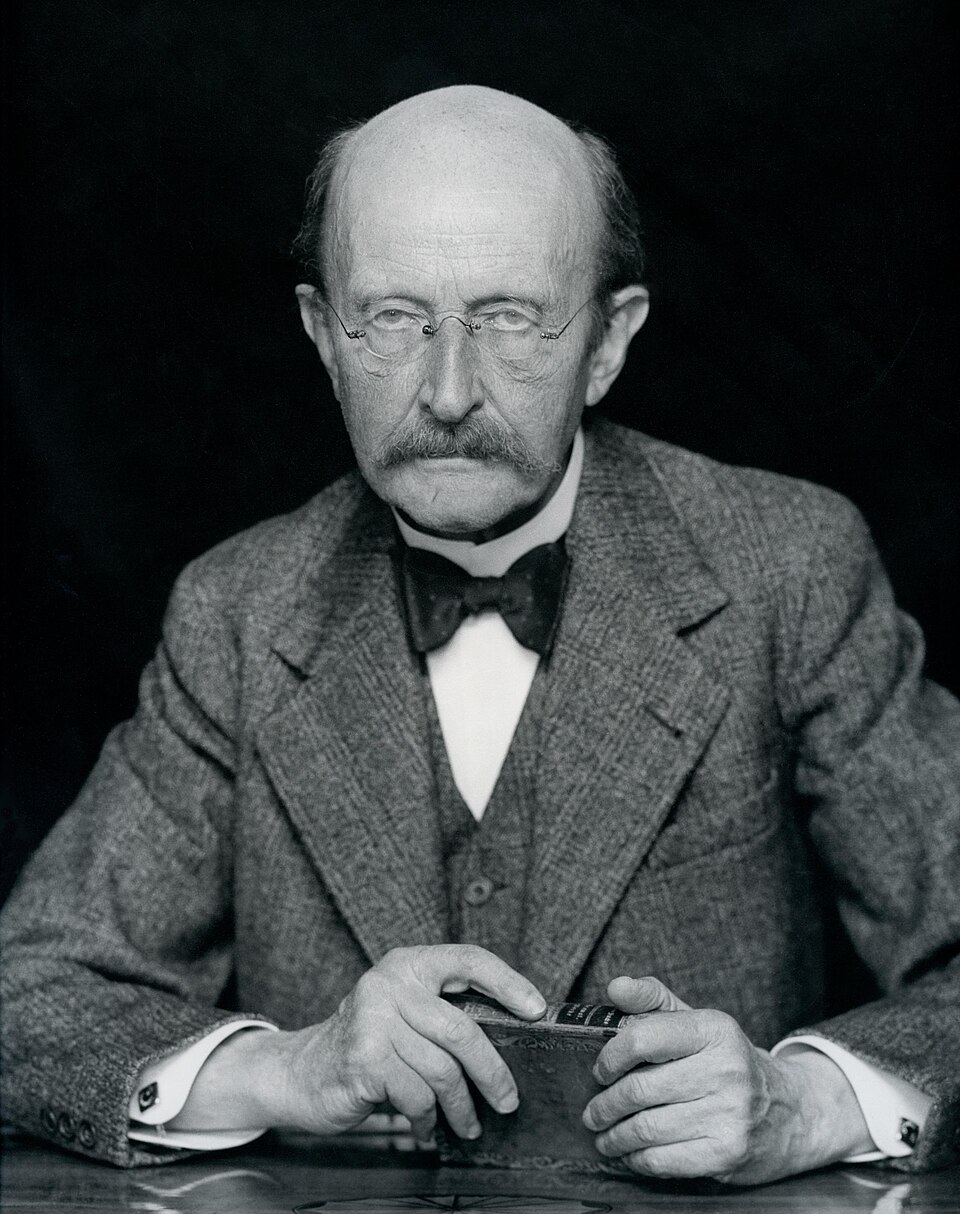
The theoretical physicist who broke with classical science in 1900 by proposing that energy is not continuous but arrives in discrete packets — a discovery that founded quantum theory and reshaped every branch of physics that followed.
Max Planck did not set out to overthrow classical physics. He was trying to solve a practical problem: why did heated objects emit light the way they did? The formula he derived in 1900 to fit the experimental data required him to assume that energy could only be absorbed or emitted in indivisible units — quanta — a hypothesis he initially regarded as a mathematical convenience. It turned out to be the foundation of a new science.
Early life and formation
Max Karl Ernst Ludwig Planck was born in Kiel on 23 April 1858 into an educated professional family with a long tradition of scholarship and public service. His father was a professor of constitutional law; the family moved to Munich in 1867, where Planck attended the Maximilian Gymnasium. He entered the University of Munich in 1874 and completed his doctorate in 1879 with a dissertation on the second law of thermodynamics.
His early career was shaped by a deep engagement with thermodynamics, the branch of physics concerned with heat and energy. He joined the University of Berlin in 1889, becoming full professor in 1892. Berlin was then the centre of German scientific life, and Planck became a central figure there — eventually succeeding Hermann von Helmholtz as the chair of theoretical physics.
The quantum hypothesis
The problem that led to Planck's greatest discovery was known as the black-body radiation problem. Classical physics predicted that a perfect absorber of radiation — a black body — should emit infinite energy at high frequencies, a result so obviously wrong that it was called the ultraviolet catastrophe. Experimental data showed a distinct peak and a curve that classical formulae could not reproduce.
In October 1900, Planck derived a formula that fitted the observed data exactly. To make the mathematics work, he had to introduce what he called an "energy element": the idea that energy could not vary continuously but came in discrete packets proportional to the frequency of the radiation. The constant of proportionality — now known as Planck's constant, h — is one of the fundamental constants of nature, with a value of approximately 6.626 × 10⁻³⁴ joule-seconds.
Planck himself was ambivalent about the physical meaning of this step. He spent years trying to reconcile the quantum hypothesis with classical physics before accepting, reluctantly, that a genuine break had occurred. It was Albert Einstein who, in 1905, extended the idea by proposing that light itself was composed of discrete quanta — photons — and it was Niels Bohr who applied quantum ideas to atomic structure. The discipline of quantum mechanics grew from Planck's seed.
Nobel Prize and scientific leadership
Planck was awarded the Nobel Prize in Physics in 1918, formally received in 1919, "for the services he rendered to the advancement of physics by his discovery of energy quanta." By that point he was already the most respected figure in German science. He served as president of the Kaiser Wilhelm Society — the organisation that coordinated Germany's scientific research — from 1930 to 1937, and again briefly in 1945–1946 as it was reconstituted after the war.
During the National Socialist period Planck remained in Germany, a choice historians continue to assess. He met with Adolf Hitler in 1933 to advocate for Jewish colleagues and was rebuffed. He did not resign from public positions, believing he could protect some degree of scientific integrity from within. The limits of what he achieved under those conditions were considerable.
Personal losses
Planck's life was marked by exceptional sorrow alongside its public honours. His first wife, Marie Merck, died in 1909. His daughter Grete died in 1917 in childbirth; her twin Emma died the same way in 1919. His eldest son Karl was killed in action in the First World War in 1916. Most devastating was the fate of his son Erwin: implicated in the July 1944 assassination attempt against Hitler, Erwin Planck was arrested, tried, and executed by the Gestapo in January 1945. Planck's home in Berlin was destroyed by bombing the same year. He died in Göttingen on 4 October 1947, at the age of eighty-nine.
It was an act of desperation. For six years I had struggled with the blackbody theory. I knew the problem was fundamental and I knew the answer. I had to find a theoretical explanation at any cost, except for the inviolability of the two laws of thermodynamics.