Michael Faraday
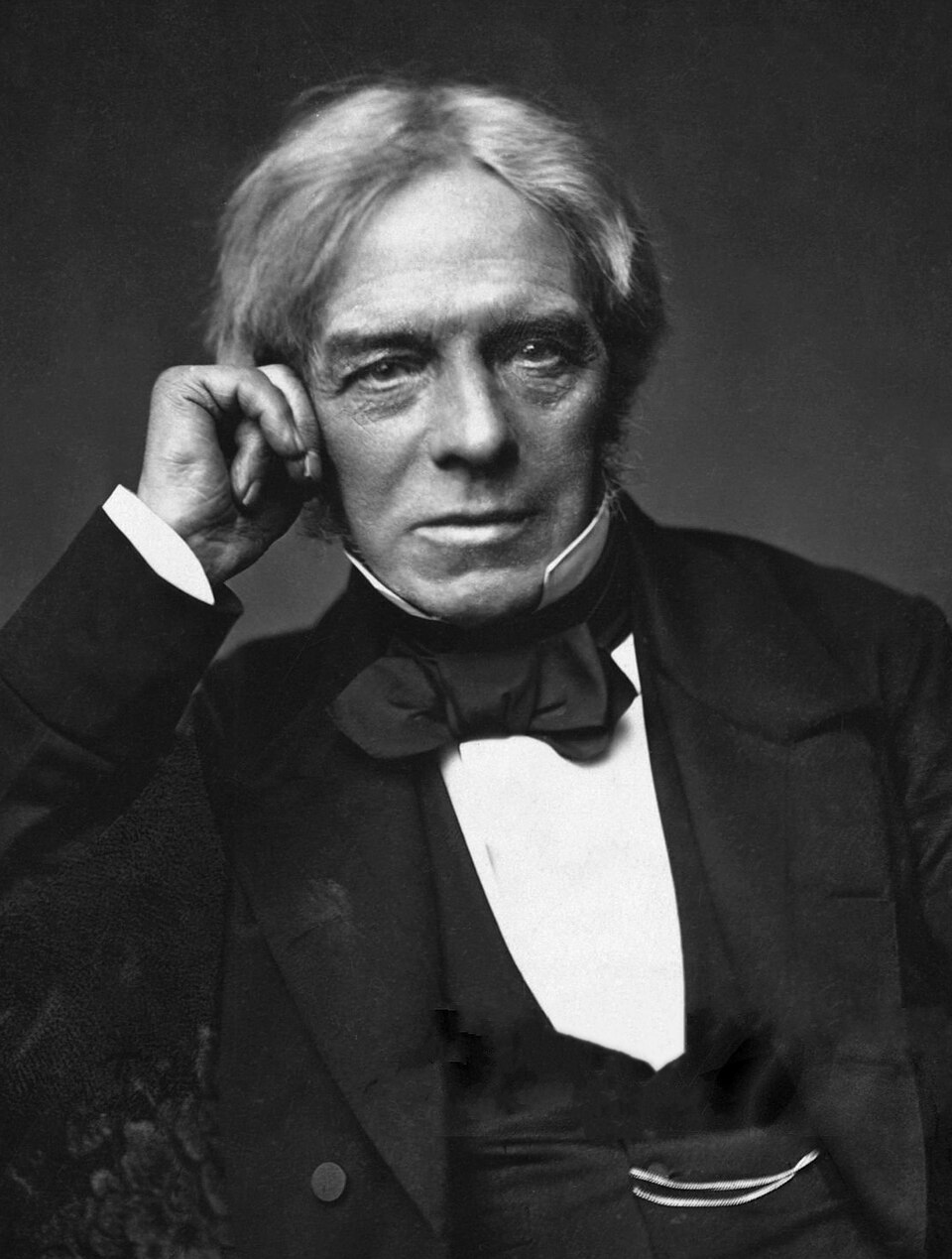
The self-taught blacksmith's son who gave the world the electric motor, the generator, and the concept of the field — remaking physics and engineering without a university education.
Michael Faraday rose from a bookbinder's apprentice with almost no formal schooling to become one of the most productive experimental scientists in history. His discoveries of electromagnetic induction and the laws of electrolysis laid the physical and chemical foundations on which modern electrical civilisation was built.
Origins and apprenticeship
Faraday was born on 22 September 1791 in Newington Butts, then a village south of London, the third child of a blacksmith who had migrated from the north of England. The family was poor and Faraday received only basic schooling. At fourteen he was apprenticed to a bookbinder and bookseller in London, a position that gave him access to books he could otherwise never have afforded. He read voraciously — articles on electricity in the Encyclopaedia Britannica and Jane Marcet's Conversations on Chemistry among them — and began conducting simple electrical experiments with materials he assembled himself.
In 1812 a customer gave him tickets to four lectures by Humphry Davy at the Royal Institution. Faraday attended, took meticulous notes, and bound them; he then sent the bound volume to Davy with a letter asking for employment in science. When a laboratory assistant was dismissed the following year, Davy offered Faraday the post. In 1813 Faraday accompanied Davy and his wife on a grand tour of Europe, meeting Ampère, Gay-Lussac, and Volta, before returning to take up a permanent position at the Royal Institution that would last his entire career.
Electrical discoveries
In 1821 Faraday demonstrated electromagnetic rotation: a current-carrying wire could be made to revolve continuously around a fixed magnet, and vice versa. This was the first conversion of electrical energy into continuous mechanical motion — the operating principle of the electric motor. A decade later, in August 1831, he discovered electromagnetic induction: a changing magnetic field induces an electric current in a nearby conductor. The inverse principle — turning mechanical motion into electricity — is the basis of every generator and transformer in use today.
Between 1833 and 1834 Faraday quantified the relationship between electricity and chemical change, establishing the two laws of electrolysis that now bear his name: that the mass of substance deposited is proportional to the charge passed, and that the masses deposited by the same charge are proportional to the chemical equivalent weights. He introduced the terminology still in use — electrode, electrolyte, anode, cathode, ion.
Fields, diamagnetism, and light
Faraday's most far-reaching conceptual contribution was the electromagnetic field. Where his contemporaries understood electrical and magnetic forces as acting at a distance between particles, Faraday visualised lines of force filling the space around charged and magnetised bodies. The concept seemed intuitive to him but vague to mathematicians; James Clerk Maxwell later gave it precise mathematical form, producing the theory of electromagnetism that would in turn lead to radio, radar, and modern optics.
In 1845 Faraday discovered diamagnetism — the weak repulsion of certain materials by a magnetic field — and, in the same year, the Faraday effect: a magnetic field can rotate the plane of polarisation of light passing through a glass block. The demonstration that magnetism could influence light suggested, and Faraday openly speculated, that light itself might be an electromagnetic phenomenon. Maxwell proved this twenty years later.
Faraday also isolated benzene in 1825 and invented the Faraday cage — an enclosure of conducting material that shields its interior from external electric fields, now used everywhere from microwave ovens to shielded cables.
Public science
From 1827 Faraday delivered the Royal Institution Christmas Lectures for children, a tradition he effectively established and which continues today. His most celebrated course, The Chemical History of a Candle, was given in 1848 and published in 1861; it remains in print and is among the finest examples of public scientific communication ever produced. Faraday believed that science belonged to everyone, not merely to specialists, and his lecture style was celebrated for its clarity and theatrical precision.
He declined a knighthood, consistent with his devout Sandemanian faith, which counselled against worldly honours. He died at his grace-and-favour house at Hampton Court on 25 August 1867, aged seventy-five.
The secret is comprised in three words — Work, Finish, Publish.