Michael Haneke
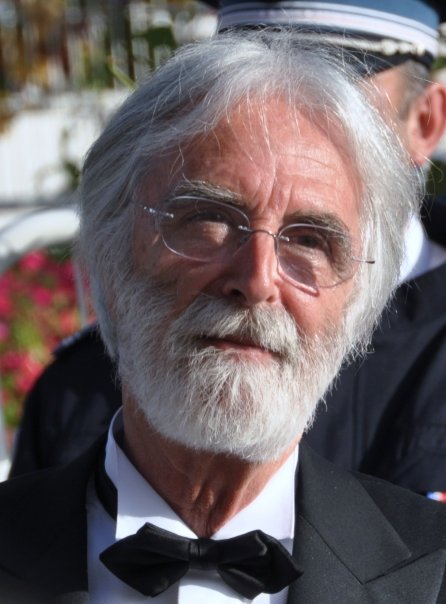
The Austrian director who turned the cinema screen into a moral interrogation room — implicating the viewer in the violence and complacency he films.
Michael Haneke makes films that refuse to comfort. German-born and Austrian by formation, he builds cold, precise dramas about the estrangement, cruelty, and self-deception of comfortable modern life — and stages them so that the audience's own appetite for spectacle becomes part of the subject.
Origins and television years
Haneke was born in Munich in 1942 and raised in Austria, the son of a director and an actress. He studied philosophy, psychology, and drama in Vienna and worked as a film critic and a television editor before directing. Through the 1970s and 1980s he made a series of films for German and Austrian television, refining the austere, controlled style — long static takes, muted colour, withheld information — that would define his cinema work.
His feature debut proper, The Seventh Continent (1989), traced a bourgeois family's methodical self-destruction with an almost clinical detachment. It opened what critics later called his "glaciation trilogy," continued in Benny's Video (1992) and 71 Fragments of a Chronology of Chance (1994), all studying how media and affluence numb the capacity to feel.
Confronting the viewer
Haneke's central provocation is that watching is never innocent. Funny Games (1997) staged a home invasion while breaking the fourth wall to accuse the spectator of wanting the violence to continue; he later remade it shot-for-shot in English (2007) to carry the argument to a Hollywood audience. Caché (2005) buried a nation's colonial guilt inside a surveillance thriller that never resolves.
The Piano Teacher (2001), adapted from Elfriede Jelinek's novel, won the Grand Prix at Cannes and cemented his international standing. The White Ribbon (2009), a black-and-white study of authoritarian cruelty in a pre-war German village, won the Palme d'Or.
Film is twenty-four lies per second at the service of truth.
Method
Haneke's technique is one of subtraction. He favours long, fixed frames that force the eye to search, denies establishing music, and cuts away from violence to leave its sound and consequence rather than its image. Nothing is explained more than necessary; endings withhold closure. The effect is to make the viewer an active, uneasy participant rather than a passive consumer.
He works repeatedly with the same performers — Isabelle Huppert, Jean-Louis Trintignant, Juliette Binoche — trusting restraint over display.
Legacy
Amour (2012) — an unsparing account of an elderly couple facing the wife's decline — won Haneke a second Palme d'Or and the Academy Award for Best Foreign Language Film, making him one of the few directors to take the top Cannes prize twice in consecutive eligible cycles. His work has become a reference point for a rigorous, morally serious European art cinema that treats the audience as responsible rather than indulged. He teaches film directing at the Film Academy Vienna.