Michel Foucault
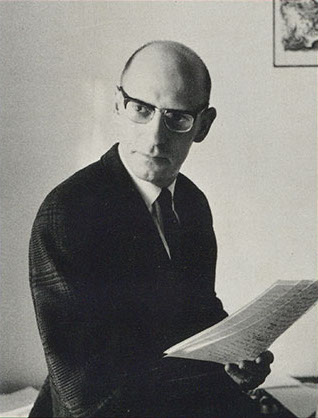
The French philosopher who mapped the hidden architectures of power, showing how institutions — clinics, prisons, schools — produce the very subjects they claim to manage.
Michel Foucault spent his career excavating the historical conditions under which knowledge is produced and the ways that institutions translate knowledge into power over bodies and populations. His historical studies of madness, medicine, punishment, and sexuality are also analyses of how modern societies govern individuals from within, producing subjects who police themselves.
Formation in Paris
Born in Poitiers in 1926, Foucault was the son of a surgeon and was expected to follow the same profession. Instead he pursued philosophy, studying at the École Normale Supérieure in Paris — the most competitive academic institution in France — where he encountered Louis Althusser and fell under the influence of Hegel, Marx, Heidegger, and Nietzsche. He earned his philosophy agrégation in 1951 alongside a degree in psychology, and worked as a researcher in psychopathology before taking up academic posts in Sweden, Poland, and Germany. He completed his doctoral thesis, published as Madness and Civilization (1961), a history of how European society progressively excluded and confined the mad, under the supervision of Georges Canguilhem.1
The defining works
Foucault's major books are historical in method but philosophical in ambition. The Birth of the Clinic (1963) traced the emergence of clinical medicine and the "medical gaze" that reconstitutes the patient as an object of knowledge. The Order of Things (1966) examined the underlying structures — he called them epistemes — that govern what counts as knowledge in a given era; the book made him famous and controversial simultaneously. Discipline and Punish (1975) studied the transition from public torture to the modern prison, arguing that the prison is not an improvement on earlier punishment but a transformation of its targets: from the condemned body to the docile soul. The History of Sexuality (three volumes, 1976–1984) examined how sexuality became, in the modern period, a privileged site of truth, identity, and power.
| Work | Year | Central subject |
|---|---|---|
| Madness and Civilization | 1961 | Confinement of the mad |
| The Birth of the Clinic | 1963 | Medical gaze and clinical knowledge |
| The Order of Things | 1966 | Epistemes and the conditions of knowledge |
| Discipline and Punish | 1975 | Prison, surveillance, docile bodies |
| The History of Sexuality, Vol. 1 | 1976 | Power and the production of sexuality |
Method and genealogy
Foucault distinguished between two phases in his method: archaeology, which excavates the structures underlying discursive formations, and genealogy, which traces the contingent, often violent histories through which truths are established. Both approaches were indebted to Nietzsche's On the Genealogy of Morality, which taught Foucault to treat moral categories as historical events rather than eternal truths. His analyses of the panopticon — the prison design by Jeremy Bentham in which inmates are potentially visible at all times — became central to discussions of surveillance, discipline, and the internalisation of the observer's gaze. In 1970 he was appointed to the Collège de France, France's most prestigious research institution, where he held the chair of History of Systems of Thought until his death.
Legacy
Foucault died in Paris in June 1984 from complications of AIDS — one of the first prominent public figures in France to die of the illness, though his diagnosis was not confirmed publicly until after his death. His influence across disciplines is extraordinarily wide: gender studies, queer theory, criminology, sociology, literary theory, postcolonial studies, and the history of science have all been fundamentally shaped by his concepts of discourse, biopower, and governmentality. Judith Butler, Edward Said, and Paul Rabinow are among the many thinkers who built directly on his work. His lectures at the Collège de France, published posthumously, continue to generate scholarship.
Power is not an institution, and not a structure; neither is it a certain strength we are endowed with; it is the name that one attributes to a complex strategical situation in a particular society.
Footnotes
- The full, unabridged doctoral thesis was published in French as Folie et déraison: Histoire de la folie à l'âge classique (1961); the English translation Madness and Civilization (1965) is an abridged version. ↩