Miguel de Cervantes
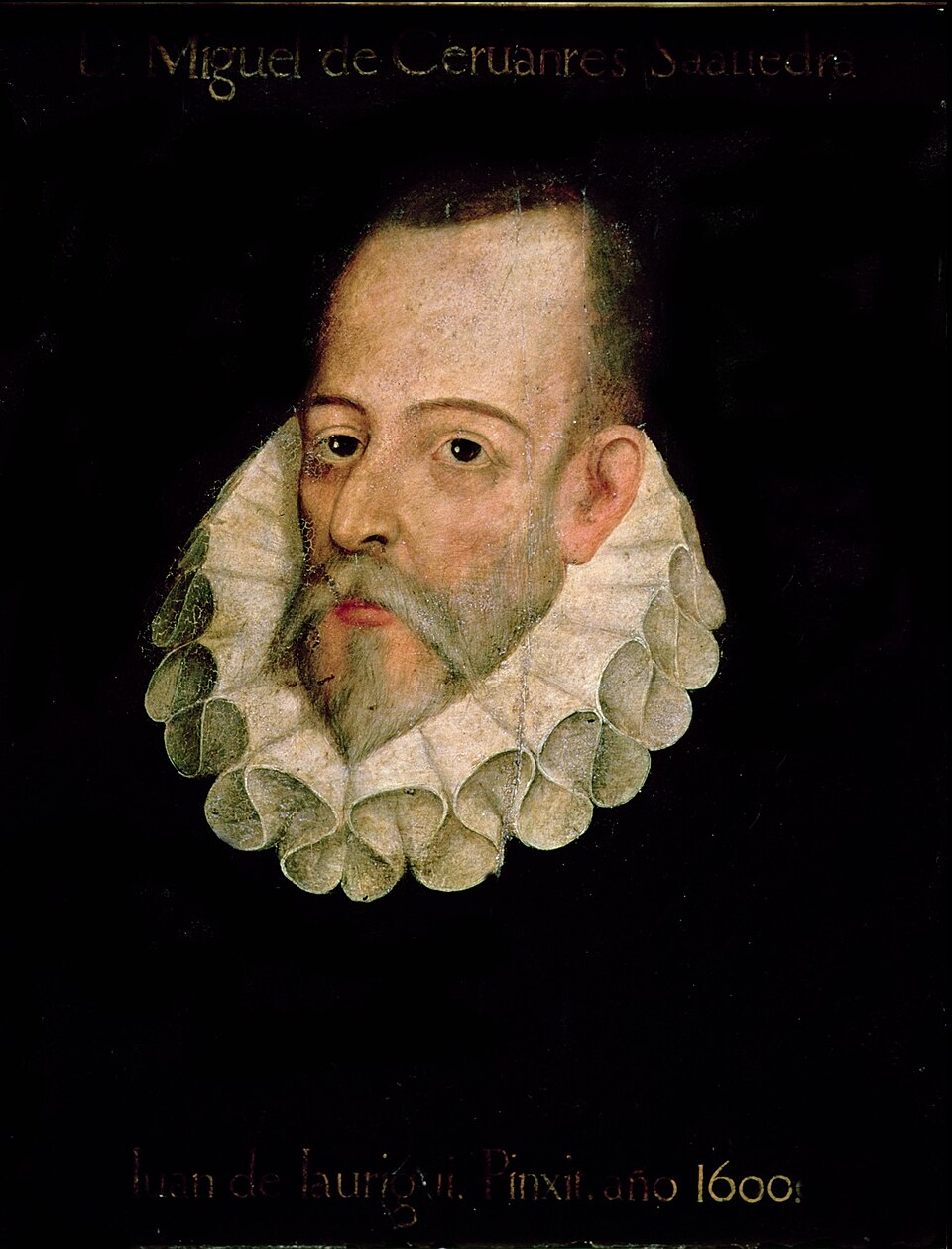
The Spanish writer whose Don Quixote — a hidalgo who mistakes fiction for reality — is widely regarded as the first modern novel and the greatest work in the Spanish language.
Miguel de Cervantes spent much of his life in poverty, imprisonment, and obscurity before producing, in his late fifties, the first part of Don Quixote — a book that invented the modern novel's central preoccupation: the collision between the stories we tell ourselves and the world as it actually is.
A life of misadventure
Cervantes was born in Alcalá de Henares in 1547, the son of a barber-surgeon. His education was incomplete; he appears to have spent time in Rome as a chamberlain before enlisting in the Spanish navy. At the Battle of Lepanto in 1571 — the great naval engagement that stopped Ottoman westward expansion — he was wounded three times, losing the use of his left hand permanently. He bore this proudly for the rest of his life.
Returning to Spain by sea in 1575, his ship was captured by Barbary corsairs. He and his brother were taken to Algiers as slaves. He spent five years there, making several escape attempts before a ransom was eventually arranged by his family and Trinitarian friars in 1580. The experience — captivity, hope repeatedly frustrated, reliance on the charity of strangers — would leave traces throughout his writing.
Back in Spain, he worked as a tax collector and grain requisitioner for the Armada supply effort, was imprisoned at least twice for accounting irregularities, and struggled financially for much of his adult life. He began writing Don Quixote in prison.
Don Quixote
Don Quixote — published in two parts, in 1605 and 1615 — tells the story of Alonso Quijano, a provincial hidalgo who reads so many chivalric romances that he loses his mind, renames himself Don Quixote de la Mancha, and sets out on a series of adventures with his pragmatic squire Sancho Panza. He mistakes windmills for giants, inns for castles, and a coarse village girl for his lady Dulcinea.
The comedy operates on multiple levels simultaneously: the novel parodies chivalric romance while taking seriously the impulse behind it; it examines the relationship between literature and experience, idealism and reality, and the nature of perception. The second part, published ten years later, is more formally sophisticated than the first — Quixote and Sancho are now aware that a book about them has been published and must navigate their own fame, while a false second part (published by a rival writer between Parts I and II) further complicates questions of authorship and identity.
Too much sanity may be madness, and the maddest of all is to see life as it is rather than as it should be.
Note: This sentiment circulates widely but the wording varies across translations; the underlying idea is authentically Cervantine.
Other works
Cervantes also wrote plays, novellas, and a pastoral romance. The Novelas ejemplares (Exemplary Novels, 1613) is a collection of twelve short prose fictions — some realistic, some romantic — that he himself valued highly and that demonstrate the range of his gifts beyond the single overriding masterwork. Persiles y Sigismunda, a Byzantine romance he completed days before his death, was published posthumously.
Legacy
Don Quixote is consistently ranked among the greatest novels ever written — a status confirmed in surveys of international authors, including a 2002 Nobel Institute poll that placed it first among world literature. Its influence on the European novel is structural: the unreliable narrator, the self-conscious fiction, the comedy of idealism meeting reality — these are Cervantine inventions. Dostoevsky, Flaubert, Kafka, and Borges have all acknowledged the debt. It has been translated into more languages than any book except the Bible.