Molière
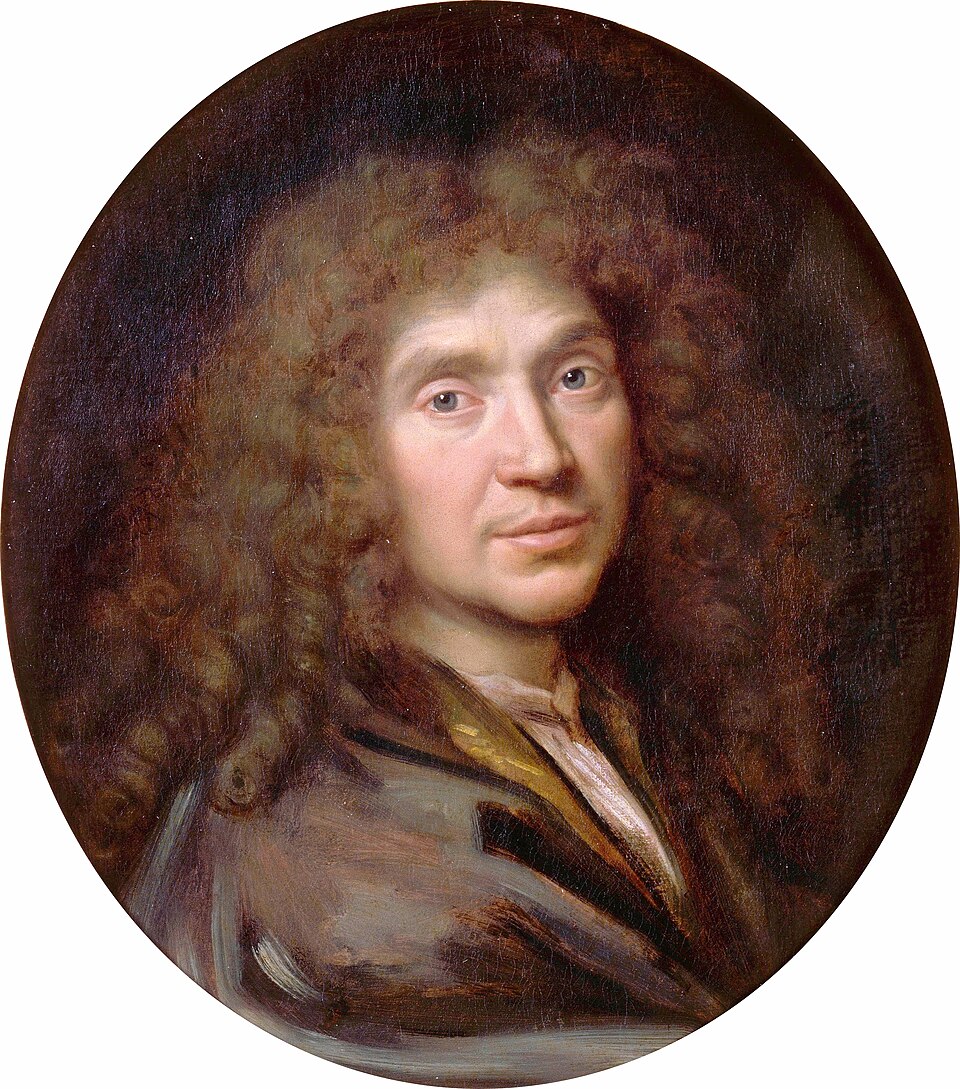
The French playwright who turned the comedy of manners into a scalpel — and became the language itself.
Jean-Baptiste Poquelin adopted the stage name Molière around 1643 and never looked back. In thirty years he wrote more than thirty plays, performed before Louis XIV, enraged the Church, and gave the French language a synonym for itself.
From upholsterer's son to royal playwright
Born in Paris in 1622 into a prosperous bourgeois family, Poquelin trained in law before abandoning it for the theatre. In 1643 he co-founded the Illustre Théâtre with the Béjart family, took his stage name, and began a decade touring the provinces — learning craft through failure and survival. When the troupe returned to Paris in 1658 it performed before Louis XIV; the king became Molière's patron and eventually housed the company at the Palais-Royal.
Comedy as diagnosis
Molière's mature comedies are machines for exposing monomania — hypocrisy in Tartuffe (1664), misanthropy in Le Misanthrope (1666), obsessive jealousy and libertinism in Dom Juan (1665). Each play places a man possessed by a single vice inside a world that cannot accommodate him. The laughter, when it comes, is uncomfortable: the audience recognises the disease.
Tartuffe caused a scandal powerful enough for the Archbishop of Paris to threaten excommunication for anyone who saw it; Louis XIV had to intervene twice before the play could be performed publicly in 1669.
Le devoir de la comédie est de corriger les hommes en les divertissant.
The comédie-ballet and a death on stage
In collaboration with the composer Jean-Baptiste Lully, Molière invented the comédie-ballet — plays interleaved with music and dance for court performance. Le Bourgeois Gentilhomme (1670) is the supreme example: social satire and spectacle fused for a king who loved both. The partnership dissolved acrimoniously, but the form endured.
On 17 February 1673 Molière collapsed during the fourth performance of Le Malade imaginaire, a play about a hypochondriac. He died that evening. The Church initially refused burial; Louis XIV intervened and Molière was interred at night, without ceremony.