Nicolaus Copernicus
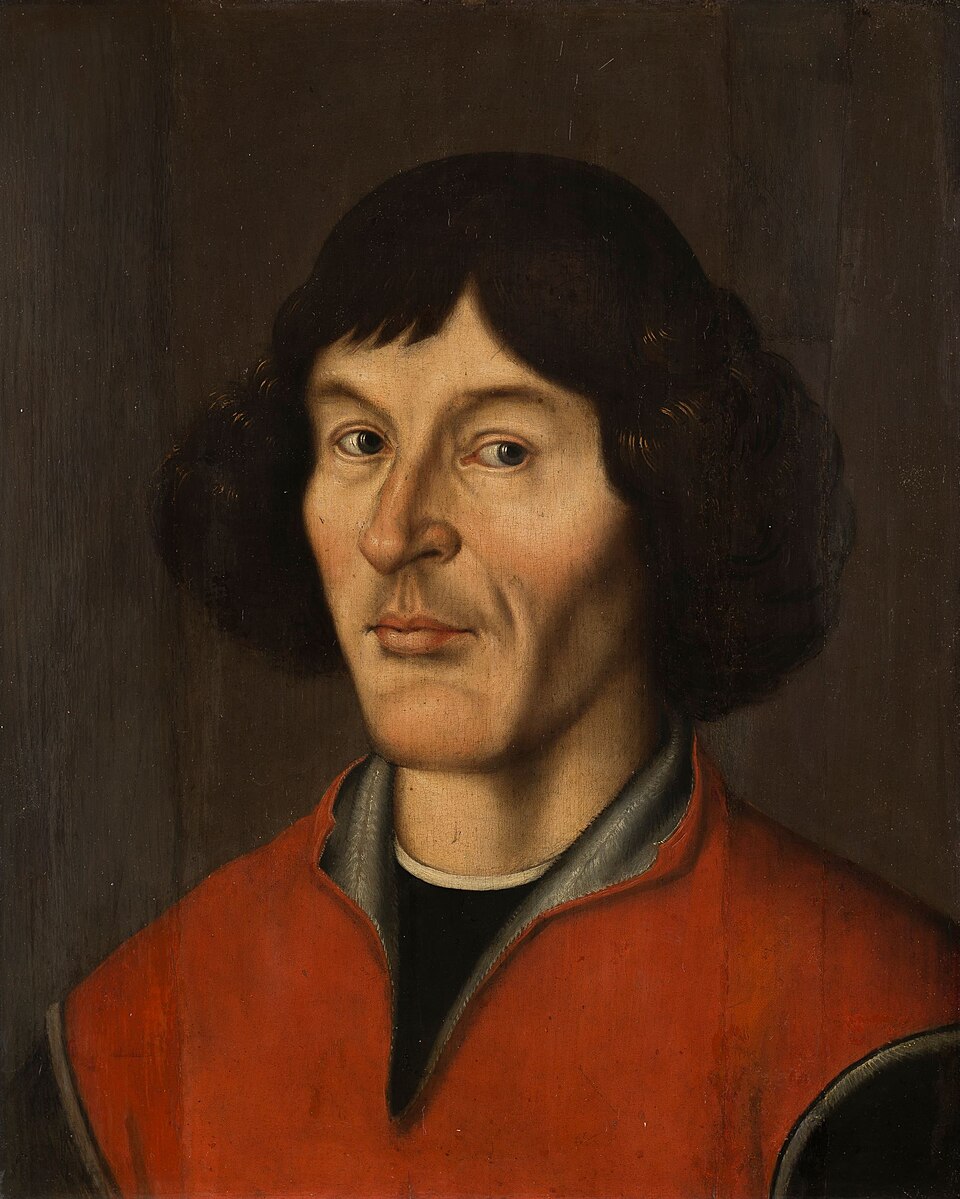
The Polish canon who displaced Earth from the centre of the cosmos and set the Scientific Revolution in motion.
Nicolaus Copernicus spent decades revising a model of the universe that had stood for fourteen centuries. By placing the Sun at the centre and Earth in orbit, he dismantled the cosmological authority of Ptolemy and the Church in a single treatise — published as he lay dying — and inaugurated the Scientific Revolution.
Formation
Copernicus was born on 19 February 1473 in the city of Toruń, then part of Royal Prussia under the Kingdom of Poland. After his father died, he was raised by his maternal uncle Lucas Watzenrode, who became Bishop of Warmia and arranged for his nephew's education and clerical career. Copernicus studied at the Jagiellonian University in Kraków, then in Bologna and Padua, where he received training in canon law, medicine, and mathematics. He absorbed the full range of Renaissance learning before returning to Poland around 1503.
He spent the rest of his life as a canon of the Warmia Cathedral Chapter — a church administrator and physician — working on his astronomical revision in parallel with his official duties.
The heliocentric model
Copernicus began developing his heliocentric hypothesis in the early 1500s. A preliminary sketch, the Commentariolus, circulated in manuscript around 1514. In it he proposed seven axioms placing the Sun near the centre of the universe and Earth as a planet moving in daily rotation and annual orbit.
The full argument appeared in De revolutionibus orbium coelestium (On the Revolutions of the Celestial Spheres), completed over decades and published in 1543. Copernicus retained epicycles and circular orbits — the model was not immediately more accurate than Ptolemy's — but the conceptual shift was decisive: Earth is not fixed, it moves, and the apparent motions of the planets follow from that premise.
He dedicated the work to Pope Paul III, acknowledging that it would disturb received opinion. He is said to have received the first printed copy on the day of his death.
At rest, however, in the middle of everything is the Sun.
Legacy
The Copernican Revolution took a century to complete. Tycho Brahe rejected heliocentrism but provided the precise observational data that allowed Kepler to derive his laws of planetary motion. Galileo provided the observational evidence — phases of Venus, moons of Jupiter — that confirmed the model. Newton supplied the gravitational mechanics. But the conceptual rupture — the demotion of Earth and humanity from the centre of creation — originated with Copernicus, and its implications were philosophical as much as astronomical.