Nikola Tesla
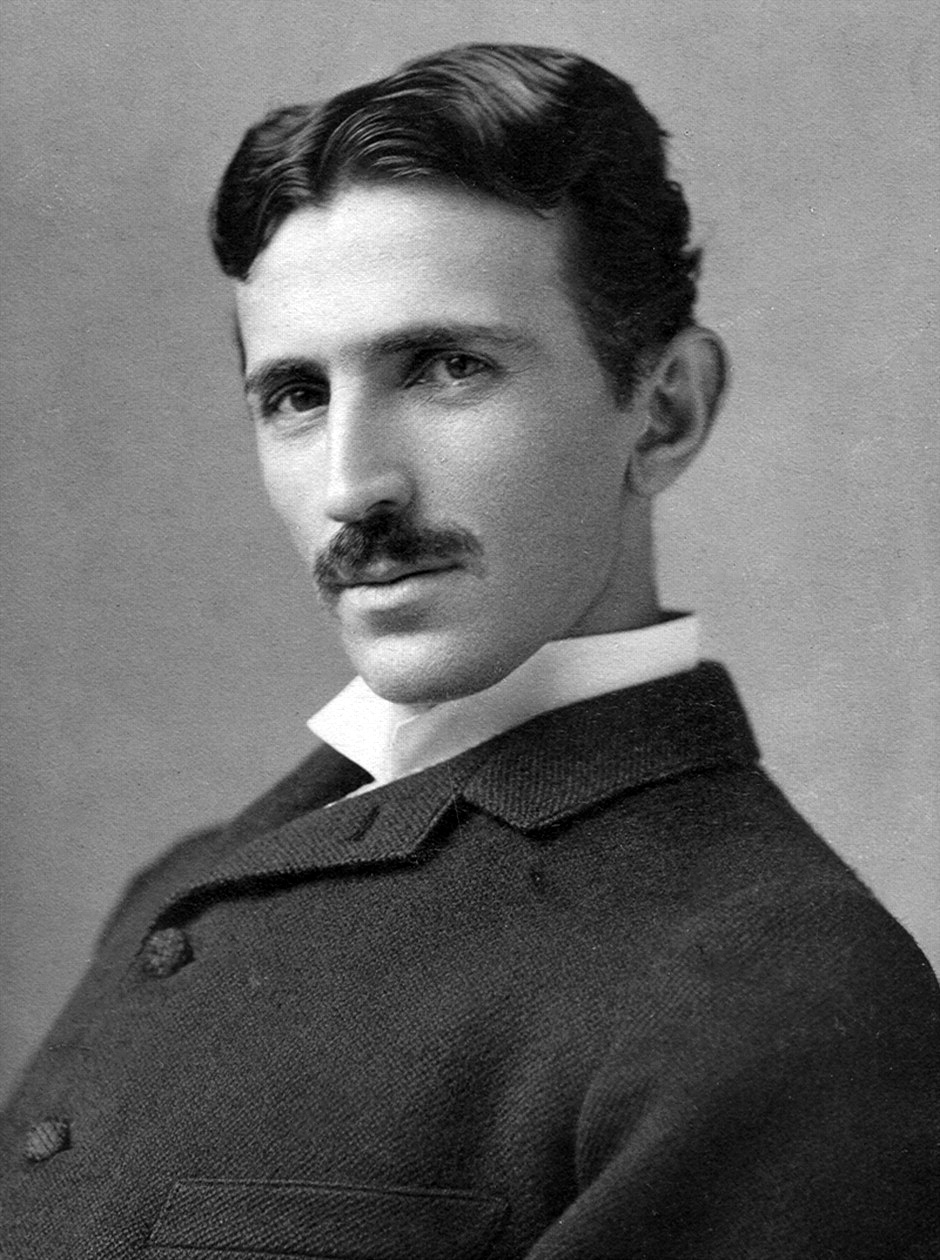
The Serbian-American inventor whose alternating current system powers the modern world, even as his broader ambitions for wireless energy transmission were never realised in his lifetime.
Nikola Tesla designed the alternating current electrical system that became the global standard for power transmission, and spent decades pursuing wireless energy and communication systems that were technically visionary and financially ruinous in equal measure.
Origins in Smiljan
Tesla was born in 1856 in Smiljan, then part of the Austrian Empire (present-day Croatia), the son of a Serbian Orthodox priest. He showed early aptitude for mathematics and physics, studying at the Polytechnic Institute in Graz and later at Charles-Ferdinand University in Prague before beginning work as a telegraph engineer. In 1882 he developed — reportedly in a sudden mental vision — the concept of the rotating magnetic field, which is the operating principle of the AC induction motor. He emigrated to the United States in 1884, arriving in New York with little more than a letter of introduction to Thomas Edison.
The war of currents
Tesla worked briefly for Edison before the two men fell out over payment and technical disagreements. Edison was committed to direct current (DC) for electrical distribution; Tesla believed alternating current — which could be stepped up to high voltages for efficient long-distance transmission and then stepped down for end use — was the only practical basis for a large-scale power grid. He licensed his AC patents to George Westinghouse, and the competition between Westinghouse's AC system and Edison's DC system — often called the "war of currents" — was resolved in favour of AC by the early 1890s. The demonstration of AC power transmission at the 1893 World's Columbian Exposition in Chicago and the construction of generators at Niagara Falls (operational from 1895) established AC as the global standard.
Wireless ambitions
With the AC contest settled, Tesla turned to wireless transmission of electricity and communications. He demonstrated radio communication in 1893 — before Guglielmo Marconi's more famous demonstrations — though the priority dispute remained contested for decades. His most ambitious project was the Wardenclyffe Tower on Long Island, begun in 1901 and intended to transmit power wirelessly across the Atlantic. His primary financial backer, J. P. Morgan, withdrew funding in 1903, and the project collapsed. Tesla's later career was marked by increasingly grandiose patents — a turbine, a bladeless centrifugal pump, proposals for particle beam weapons — and severe financial difficulties.
The present is theirs; the future, for which I really worked, is mine.
Last years and legacy
Tesla spent his final years in a room at the New Yorker Hotel in Manhattan, largely impoverished and increasingly isolated, surviving partly on a stipend from the Yugoslav government. He died in January 1943. His contributions to electrical engineering — AC motors, transformers, the polyphase system — are embedded in every power grid on earth. The SI unit of magnetic flux density is named the tesla. His reputation underwent a substantial popular revival in the late twentieth and early twenty-first centuries, producing both accurate historical recognition and considerable mythology.