Noam Chomsky
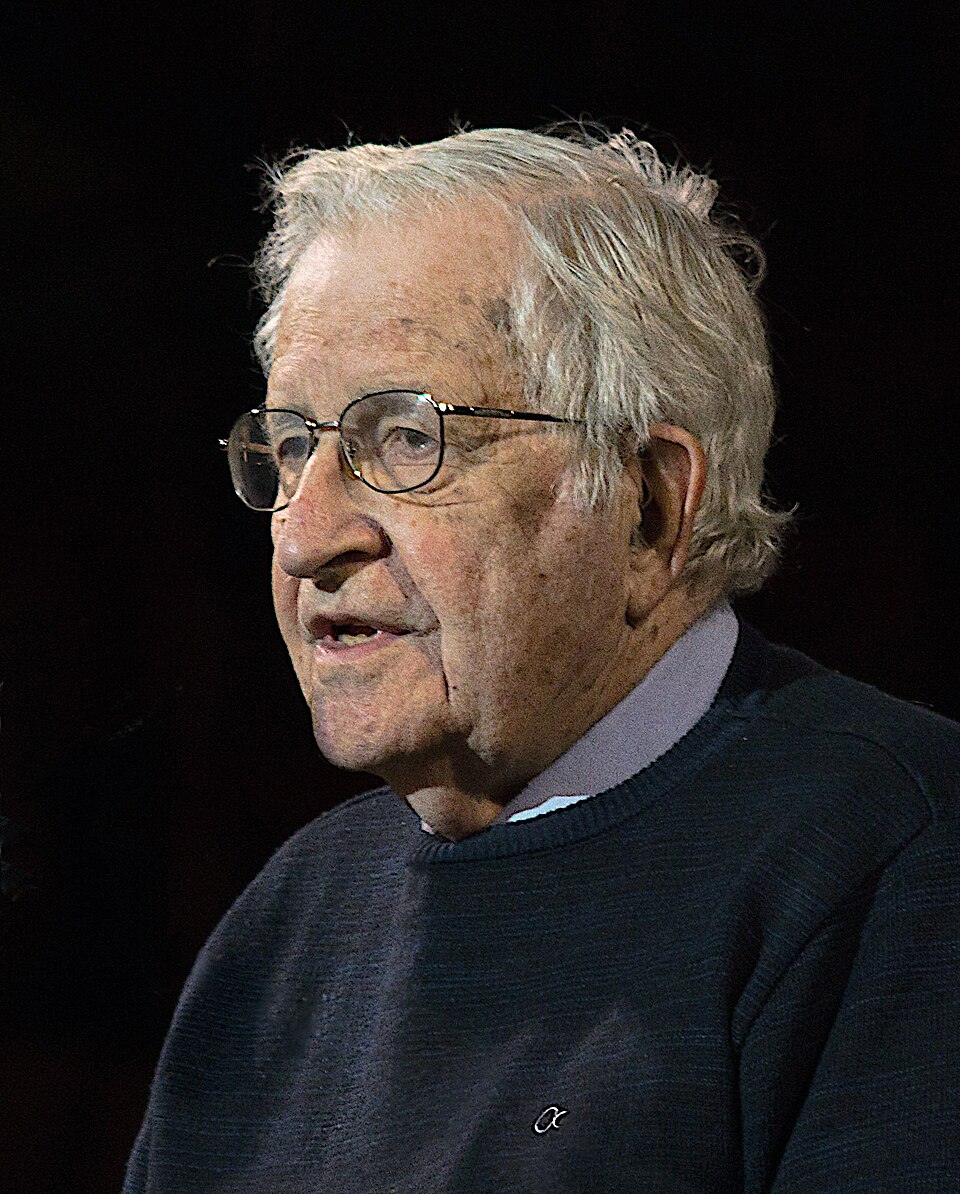
The linguist who rewired how humanity understands language — and spent sixty years holding power accountable from the outside.
Noam Chomsky transformed linguistics from a descriptive catalogue of languages into a science of the human mind. His proposal that grammar is not learned but innately structured — that all languages share a deep universal architecture — forced psychology, philosophy, and computer science to reckon with what it means to be a thinking species. In parallel, he built one of the twentieth century's most sustained critiques of American power.
Philadelphia and the Structures of Language
Chomsky grew up in Philadelphia in a family steeped in Hebrew scholarship. His father, William Chomsky, was a leading authority on medieval Hebrew grammar, and the environment shaped a precocious interest in language as a formal system rather than a social artefact. He studied linguistics and philosophy at the University of Pennsylvania, where he encountered Zellig Harris and began developing ideas that would eventually overturn the field.
His 1957 monograph Syntactic Structures introduced the concept of transformational grammar — the claim that surface sentences are derived from underlying deep structures through systematic rules. It was a decisive break from the behaviourist tradition embodied by B.F. Skinner, who held that language was acquired through conditioning.
The Language Acquisition Device
Chomsky's 1959 review of Skinner's Verbal Behavior is one of the most consequential book reviews in intellectual history. He argued that children acquire language too rapidly, and from too impoverished a stimulus, for learning alone to explain it. There must be, he proposed, an innate language acquisition device — a faculty specific to the human species and independent of general intelligence.
This nativist argument made linguistics a branch of cognitive science before cognitive science had a name. It shaped generations of researchers in psychology, neuroscience, and artificial intelligence. The Minimalist Program, which Chomsky developed from the early 1990s onward, refines the thesis further: asking what is the most elegant, computationally simple grammar consistent with human linguistic data.
| Theoretical stage | Approximate period | Key concept |
|---|---|---|
| Transformational Grammar | 1957–1965 | Deep/surface structure |
| Standard Theory | 1965 | Aspects of the Theory of Syntax |
| Government & Binding | 1980s | Principles and Parameters |
| Minimalist Program | 1990s– | Merge, economy |
Dissent as Method
From the mid-1960s, Chomsky turned a comparable analytical rigour onto American foreign policy. His 1967 essay "The Responsibility of Intellectuals" — written against the backdrop of the Vietnam War — argued that scholars who placed expertise in the service of state power betrayed the very independence that gave their work meaning.
With media analyst Edward Herman, he developed the propaganda model of mass media, elaborated in Manufacturing Consent (1988). The argument was structural: advertising-dependent outlets, corporate ownership, and official sources systematically filter information so that elite consensus becomes the horizon of public debate. The book, and the 1992 documentary it generated, made Chomsky a touchstone of the international left.1
Intellectuals are in a position to expose the lies of governments, to analyze actions according to their causes and motives and often hidden intentions.
Footnotes
- The 1992 documentary Manufacturing Consent: Noam Chomsky and the Media, directed by Mark Achbar and Peter Wintonick, became one of the most widely distributed Canadian documentaries of its era. ↩