Norbert Wiener
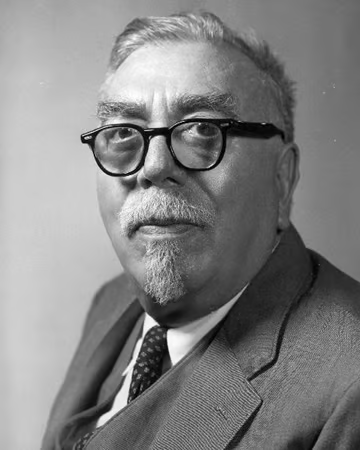
The mathematician who named cybernetics and showed that communication, control, and feedback are the same problem stated three different ways.
Norbert Wiener arrived at MIT at twenty-five and stayed for the rest of his career, accumulating a body of mathematical work — on stochastic processes, harmonic analysis, and signal theory — that culminated in a single unifying insight: that animals, machines, and societies all use feedback loops to maintain stability, and that a rigorous mathematics could describe all of them at once.
A childhood in acceleration
Wiener was born on 26 November 1894 in Columbia, Missouri. His father, Leo Wiener, was a Harvard professor of Slavic languages who home-schooled his son with exceptional intensity. Norbert entered Tufts College at eleven and received his bachelor's degree at fourteen. He earned a Harvard PhD in mathematical logic at eighteen, studying under Josiah Royce, before postdoctoral work in Cambridge with Bertrand Russell and in Göttingen with David Hilbert. The breadth of training — logic, philosophy, and pure mathematics in rapid succession — shaped a mind unusually comfortable crossing disciplinary lines.
He joined MIT's mathematics faculty in 1919 and remained there until his death. His early decades produced foundational work in harmonic analysis, the Wiener process (a rigorous mathematical model of Brownian motion), and the Paley–Wiener theorem. These were contributions entirely within pure mathematics; the applied synthesis came later.
Cybernetics and the unified theory of control
During World War II, Wiener worked on anti-aircraft fire control — specifically on predicting the future position of an aircraft from its erratic flight path. The problem forced him to think carefully about signals contaminated by noise, about prediction under uncertainty, and about the feedback loop by which a gun system adjusts based on the gap between aim and target. He recognised that the gunner's nervous system and the mechanical system he controlled were doing the same computation.
The synthesis he drew from this work appeared in Cybernetics: Or Control and Communication in the Animal and the Machine (1948). The book proposed that feedback — the use of a system's own output to correct its next action — was the governing mechanism shared by thermostats, muscles, brains, and social institutions. Wiener coined the term cybernetics from the Greek kybernetes (steersman). The book was a bestseller and launched an interdisciplinary movement spanning engineering, biology, psychology, and social science.
We have decided to call the entire field of control and communication theory, whether in the machine or in the animal, by the name Cybernetics.
Method and ethics
Wiener was a rigorous probabilist. His work on generalised harmonic analysis and the Wiener filter — an optimal linear filter for extracting a signal from noise — became fundamental tools in electrical engineering and signal processing. The Wiener filter underpins much of modern communications theory.
He was also, unusually for the period, a public moralist about the social implications of automation. His 1950 book The Human Use of Human Beings warned that feedback machines capable of displacing skilled labour demanded careful social policy, not mere technical optimism. He refused to take weapons contracts in the Cold War period and wrote openly about the dangers of automated warfare.
Legacy
Cybernetics as a formal research programme fragmented by the 1960s as its constituent fields — control theory, information theory, cognitive science, systems biology — developed their own vocabularies. But the core insight persisted: that feedback, communication, and purposive behaviour are aspects of a single logical structure. The field of systems theory, AI's early years, and the vocabulary of the internet all carry the imprint of Wiener's synthesis. The Wiener process remains a cornerstone of probability theory and mathematical finance.