Orson Welles
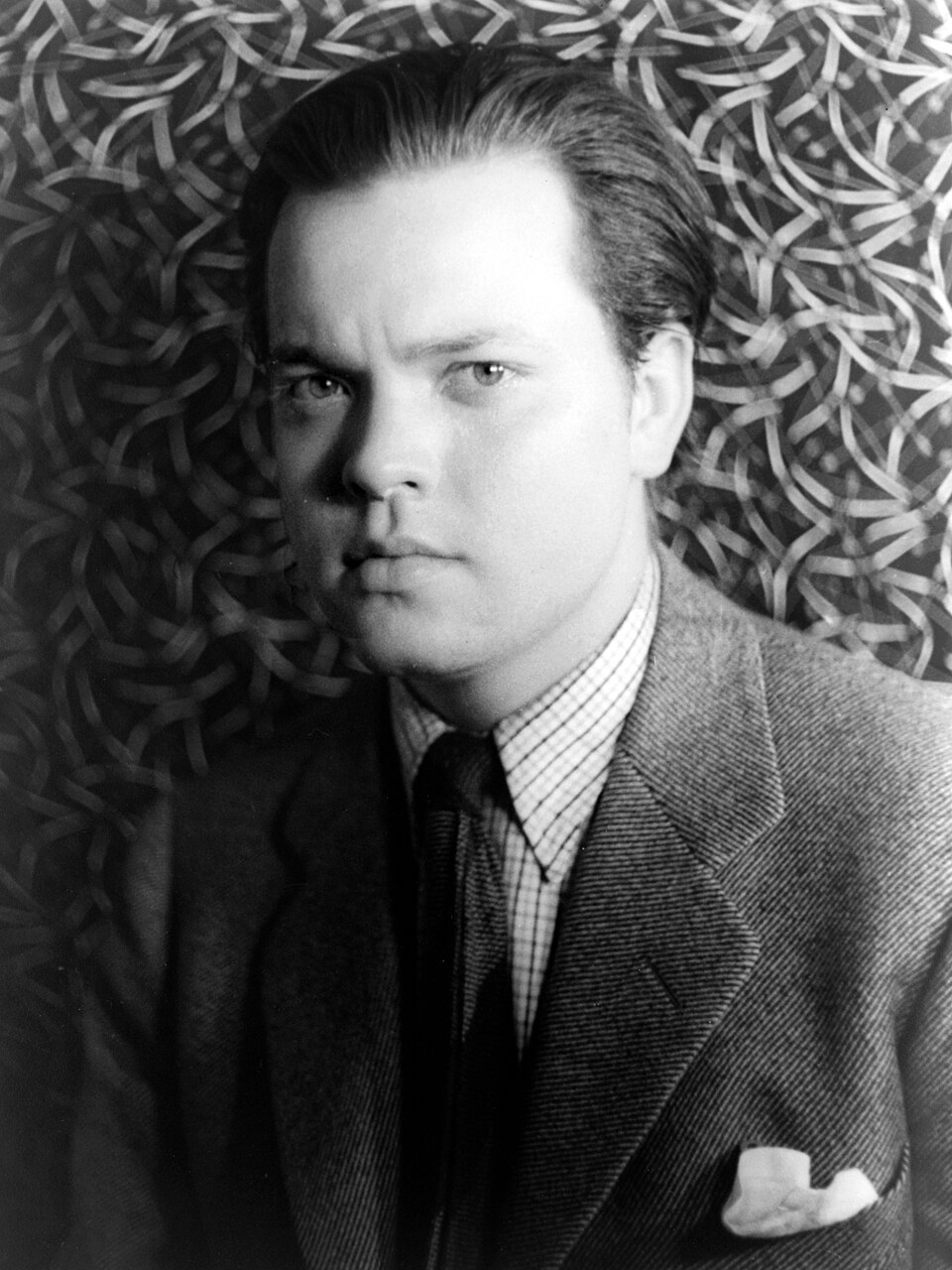
A prodigy who reinvented film grammar at twenty-five, then spent four decades fighting studios for the right to make the films he imagined.
George Orson Welles arrived in Hollywood at twenty-four with an unprecedented degree of creative control and no feature film experience. The result was Citizen Kane (1941), a work so formally inventive that critics still rank it among the greatest films ever made. What followed was a career defined by visionary ambition and repeated conflict with the studio system that funded his films — and frequently destroyed them.
Theatre, radio, and the road to Hollywood
Welles co-founded the Mercury Theatre with producer John Houseman in New York in 1937. The company staged provocative productions — an all-Black Macbeth, a fascism-allegory Julius Caesar — that earned Welles a national reputation before he was twenty-five. His radio adaptation of H. G. Wells's The War of the Worlds, broadcast on 30 October 1938 as a realistic news bulletin, prompted widespread alarm and landed Welles on the front pages of newspapers across the country. RKO Pictures, impressed, offered him a contract with almost total creative autonomy — terms no other first-time director had ever received.
Citizen Kane and its aftermath
Citizen Kane (1941), co-written with Herman J. Mankiewicz, portrayed the rise and ruin of a press magnate in a non-linear structure that worked backwards from death to origins. Welles and cinematographer Gregg Toland deployed deep-focus photography — keeping foreground and background in simultaneous sharp focus — and extreme low-angle compositions that had no precedent in studio filmmaking. The film received nine Academy Award nominations and won the Oscar for Best Original Screenplay; Welles received an honorary award from the Academy the following year for his work on it.1
The Magnificent Ambersons (1942), his second feature, was a sustained elegy for a vanishing American aristocracy. While Welles was filming in Brazil, RKO cut approximately fifty minutes from his final cut and destroyed the excised footage. The truncated version was released without his approval. The loss is considered one of the great acts of studio vandalism in cinema history.
Outside the system
Welles spent much of his subsequent career operating independently of Hollywood, financing productions through acting roles in other directors' films — including his celebrated turn as Harry Lime in Carol Reed's The Third Man (1949) — and through European co-productions. Touch of Evil (1958), a baroque thriller set on the US–Mexico border, reunited him briefly with a major studio; Universal re-edited it on release, though a restoration closer to Welles's intentions was completed in 1998 using his own fifty-eight-page memo. His late essay film F for Fake (1973), a meditation on forgery and authenticity, demonstrated that his formal restlessness had not diminished with age. At his death in 1985 he left several projects unfinished, among them The Other Side of the Wind, eventually edited and released in 2018.
A film is never really good unless the camera is an eye in the head of a poet.
Footnotes
- The Academy Honorary Award citation praised Citizen Kane specifically; Welles also received a nomination for Best Director for the same film. ↩