Oscar Wilde
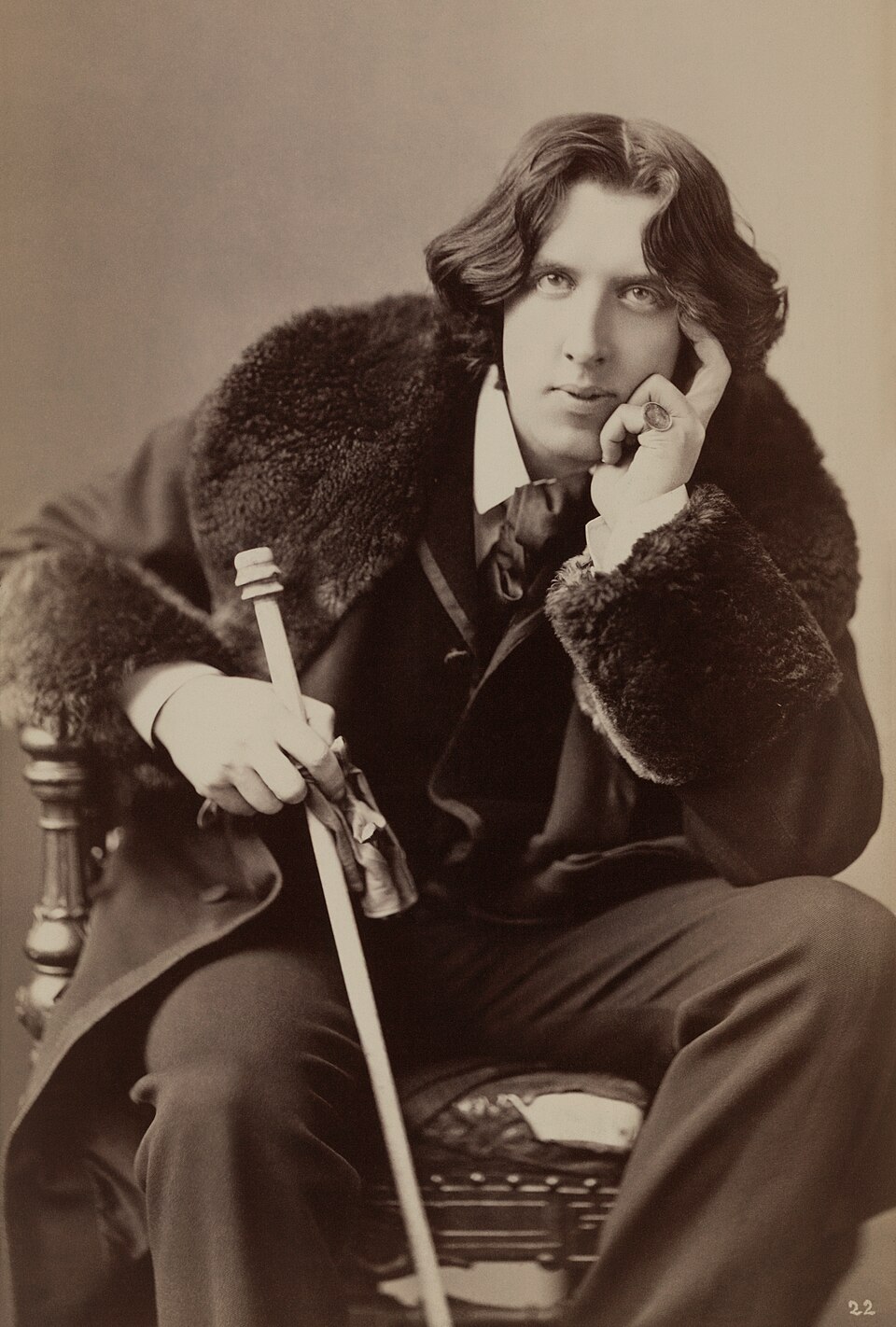
The Irish writer whose wit was the vehicle for a serious aesthetic philosophy, and whose fall from celebrity to prison became one of the defining cultural events of the Victorian era.
Oscar Wilde was the most brilliant conversationalist of his age and used that reputation — cultivated in London's drawing rooms and reflected in his plays — to argue a position: that art exists for its own sake, that beauty is a moral category, and that the decorative and the trivial are more honest than the earnest and the improving. The argument cost him everything.
Formation
Wilde was born in Dublin in 1854, the second son of Sir William Wilde, a noted surgeon and antiquarian, and Jane Francesca Wilde, a poet and Irish nationalist who published under the name "Speranza." The household was intellectual and unconventional. He studied at Trinity College Dublin and then at Magdalen College, Oxford, where he took a first-class degree and won the Newdigate Prize for poetry in 1878.
At Oxford he came under the influence of John Ruskin and Walter Pater, whose The Renaissance (1873) proposed that aesthetic experience — the appreciation of beauty — was life's highest value. Wilde made this idea his public persona, arriving in London as a self-created celebrity: aesthetic spokesman, professional wit, exemplar of art for art's sake.
Aestheticism and early work
Through the 1880s Wilde lectured in Britain, the United States, and Canada on aesthetics and decoration; he toured America in 1882 and made an impression that has lingered in cultural memory partly because he understood performance as a mode of argument. He edited The Woman's World magazine from 1887 to 1889 and published essays and critical dialogues — "The Decay of Lying" (1889), "The Critic as Artist" (1890) — that set out his aesthetic position in a form that was playful but philosophically serious.
The Picture of Dorian Gray, his only novel, was published in 1890 and immediately controversial: it depicted a man who remains physically young while a portrait ages and accumulates the marks of his moral corruption. The homoerotic subtext was noted and attacked; Wilde revised and expanded the text before book publication in 1891.
The plays
Between 1892 and 1895, Wilde wrote four plays that made him the most successful dramatist in London: Lady Windermere's Fan (1892), A Woman of No Importance (1893), An Ideal Husband (1895), and The Importance of Being Earnest (1895). The plays deploy the form of Victorian social comedy to undermine the social pieties that comedy conventionally reinforces; their epigrams are vehicles for inversions of conventional moral logic.
The Importance of Being Earnest opened on 14 February 1895. Wilde was at the height of his fame.
Prosecution and imprisonment
Wilde had a relationship with Lord Alfred Douglas ("Bosie"), whose father, the Marquess of Queensberry, left a card at Wilde's club accusing him of "posing as a somdomite." Wilde sued for criminal libel. The case collapsed; evidence gathered in preparation for Queensberry's defence was used against Wilde, who was prosecuted for gross indecency under the Criminal Law Amendment Act 1885. He was convicted in May 1895 and sentenced to two years' hard labour.
He served the sentence at Reading Gaol, during which he wrote the long letter to Douglas later published as De Profundis (1905). He was released in 1897 and went immediately to France, where he remained until his death in 1900, aged 46.
I can resist everything except temptation.
Legacy
Wilde's rehabilitation was gradual but thorough. His plays are among the most performed in the English-language repertoire; The Importance of Being Earnest has not left the stage since its first production. His trial and imprisonment became a touchstone for discussions of legal persecution of homosexuality, and in 2017 he received a posthumous pardon under the Policing and Crime Act 2017, alongside tens of thousands of men convicted under the same law.