Ovid
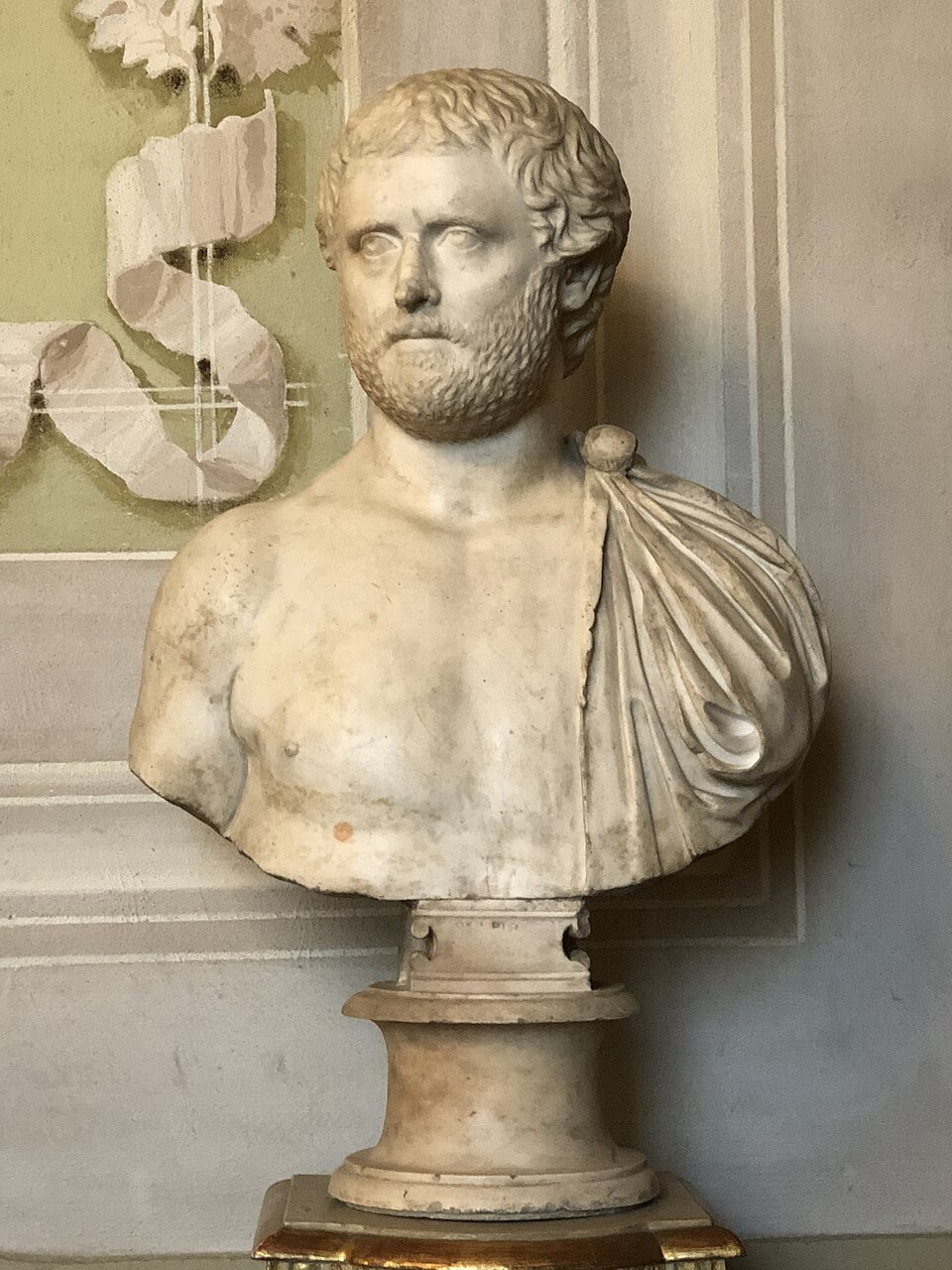
The most playful and most persecuted poet of the Augustan age — whose transformations, both mythological and personal, have fed Western art and literature for two thousand years.
Ovid mastered every form Latin poetry offered — love elegy, didactic verse, mythological epic — and was then silenced by imperial decree, exiled to the Black Sea for reasons he described only as "a poem and an error." His Metamorphoses, fifteen books of transformation myths in continuous hexameter, became the most read classical text of the European Middle Ages and Renaissance.
Early life and literary success
Publius Ovidius Naso was born at Sulmo (modern Sulmona) on 20 March 43 BC, one year after Julius Caesar's assassination, into an equestrian family with means. His father directed him toward a legal career; Ovid was drawn irresistibly to poetry. He received the education of his class — rhetoric in Rome, perhaps study in Athens — but abandoned the cursus honorum early.
His first major work, the Amores, a collection of love elegies in the tradition of Tibullus and Propertius, established him as the leading poet of his generation. Where his predecessors treated love as suffering, Ovid treated it as a game — elegant, ironic, and knowing. The Ars Amatoria (The Art of Love), a mock-didactic poem on the techniques of seduction, extended this into explicit instruction that later caused problems.
The Metamorphoses
The Metamorphoses, composed around 2–8 AD, is Ovid's masterwork and the transformation on which his entire reputation rests. Fifteen books of dactylic hexameter — the metre of epic — trace the history of the world from its creation to the deification of Julius Caesar, through the connective thread of change: gods becoming animals, humans becoming trees, men becoming stars. The poem contains approximately 250 myths, linked by transitions of extraordinary ingenuity.
The Metamorphoses is not a religious text or a celebration of Roman destiny. It is a poem about the vulnerability of form — about how nothing stays what it is — told with wit, pathos, and an eye for the psychological truth of transformation. Daphne becomes a laurel tree not as divine reward but to escape Apollo's assault. Actaeon becomes a stag and is torn apart by his own hounds for inadvertently seeing Diana bathing.
My mind is bent to tell of bodies changed into new forms.
Exile and the late poems
In 8 AD Augustus exiled Ovid to Tomis on the Black Sea (modern Constanța, Romania) — the furthest margin of the Roman world. Ovid described the cause as carmen et error: a poem and a mistake. The poem was presumably the Ars Amatoria, regarded as morally subversive; the error remains unknown. His late poems — the Tristia (Sorrows) and Epistulae ex Ponto (Letters from the Black Sea) — are extended laments written from exile, appealing to Augustus and then Tiberius for recall. Neither relented; Ovid died in Tomis.
The contrast between the playful certainty of the early work and the desolation of the exile poetry gives Ovid's career a shape almost too neat for biography — a life that illustrates his own theme of radical transformation.
Legacy
The Metamorphoses shaped European literature and art with exceptional thoroughness. Chaucer, Boccaccio, Shakespeare, Titian, Bernini, and Milton all worked with Ovidian material. The poem provided the Renaissance with its mythological repertoire and its model of how myth could be used — with psychological depth rather than religious weight. In the 20th century Ted Hughes produced an acclaimed free version, Tales from Ovid. Ovid's influence on narrative art is second only to Virgil's, and in some periods has exceeded it.