Paul Poiret
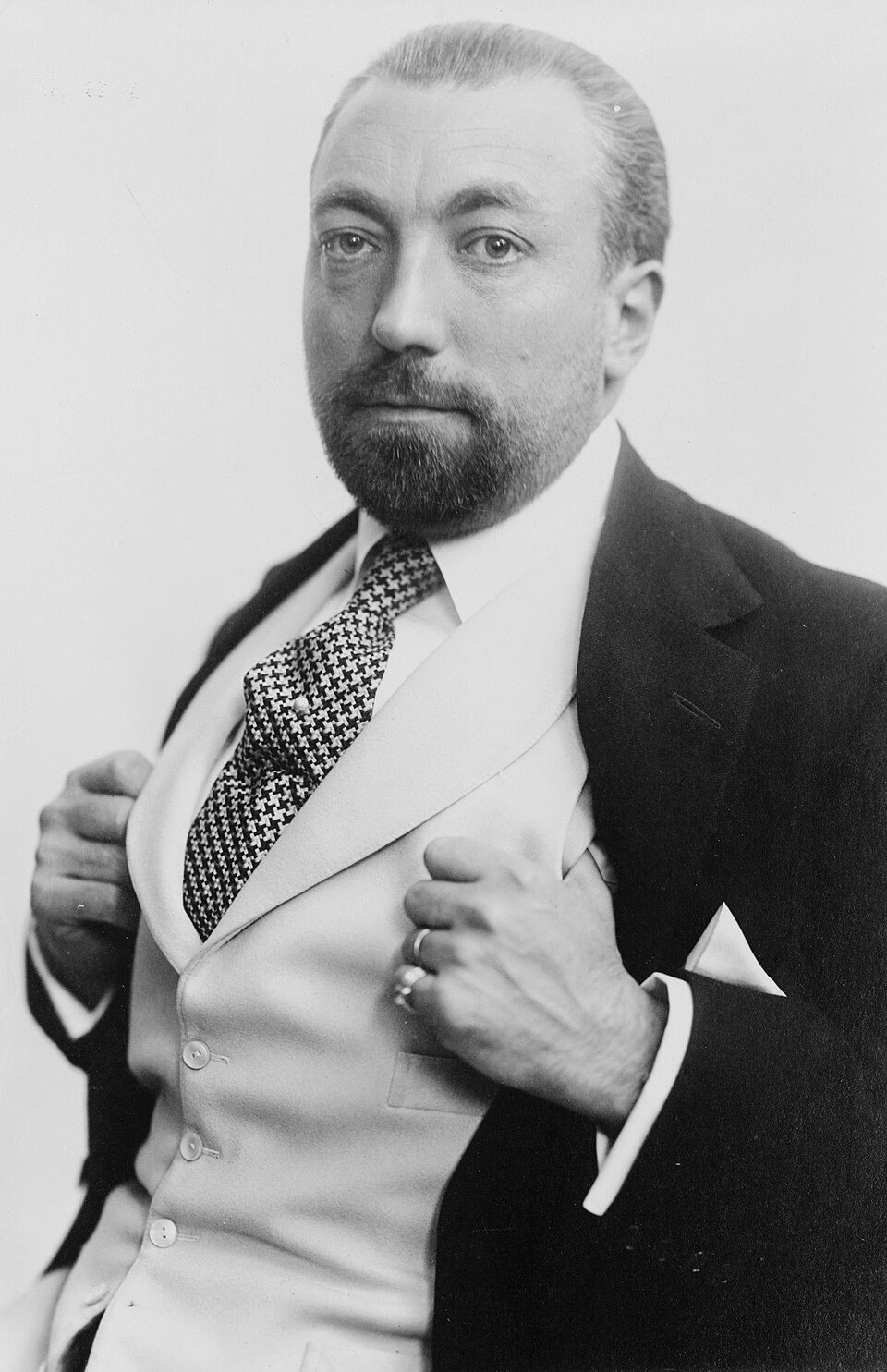
The couturier who abolished the corset, dressed Paris in Orientalist colour, and pioneered the licensing model that defines the luxury industry — then watched the century leave him behind.
Paul Poiret opened his couture house in Paris in 1903 and within a decade had overturned the structural logic of Western women's dress. He removed the corset, replaced the hourglass silhouette with a high-waisted column borrowed from antiquity, and flooded his collections with the colours and forms of the Ottoman Empire and East Asia. His career ended in financial ruin — the same modernity he helped usher in rendered his aesthetic obsolete — but the instruments he invented, from the branded perfume line to the licensed name, remain the operating model of the luxury industry.
Apprenticeship and founding
Poiret was born in Paris in 1879, the son of a cloth merchant. He sold umbrella-handle sketches to couture houses as a teenager before securing a position at the Maison Doucet in 1898, where he learned draping and the mechanics of haute couture. He moved to the House of Worth in 1901, then struck out independently, founding his own house at 5 rue Auber in 1903. He relocated to 37 rue Pasquier and subsequently to a grand mansion on the rue du Faubourg Saint-Honoré, where his theatrical sense of staging turned his salons into spectacles.
The uncorseted silhouette
Around 1906, Poiret began presenting dresses built on a high-waisted line that dispensed with the corset entirely. Where the Belle Époque S-curve had required rigid boning to force the body into shape, Poiret's dresses fell from the natural waistline or just below the bust, relying on drape and soft fabric rather than architecture.^1 The shift drew on Greek and Roman sources — he was attentive to the Louvre's classical galleries — and aligned with a broader avant-garde interest in liberating the body. Critics and clients recognised it as a rupture.
Orientalism and the Ballets Russes
Poiret's mature vocabulary was saturated with North African, Ottoman, and East Asian references. He introduced harem trousers for women — an adaptation of the salvar — and the lampshade tunic, a wired overskirt that floated above the figure like a pagoda. The hobble skirt (c. 1910–1911), tapering sharply at the ankle, became his most controversial design: it restricted walking to a shuffle, and drew both scandal and imitation in equal measure.
The 1909 Paris season of the Ballets Russes, with Léon Bakst's saturated stage designs, confirmed and amplified tendencies already present in Poiret's work. The two currents — his Orientalism, Bakst's theatrical colour — reinforced each other in the press and in the public imagination, making the early 1910s a period of extraordinary chromatic intensity in Parisian dress.
Commerce and branding
Poiret was among the first couturiers to understand fashion as a total luxury brand. In 1911 he founded Rosine, a perfume line named after one of his daughters — making him the first couturier to operate an in-house fragrance house, a decade before Chanel No. 5. He also licensed his name to furniture, interior objects, and decorative textiles through a subsidiary called Martine, employing young working-class women he trained in pattern-making and design. The licensing model, treated by contemporaries as an eccentricity, became the standard commercial structure of twentieth-century fashion.
I freed the bust and shackled the legs.