Percy Bysshe Shelley
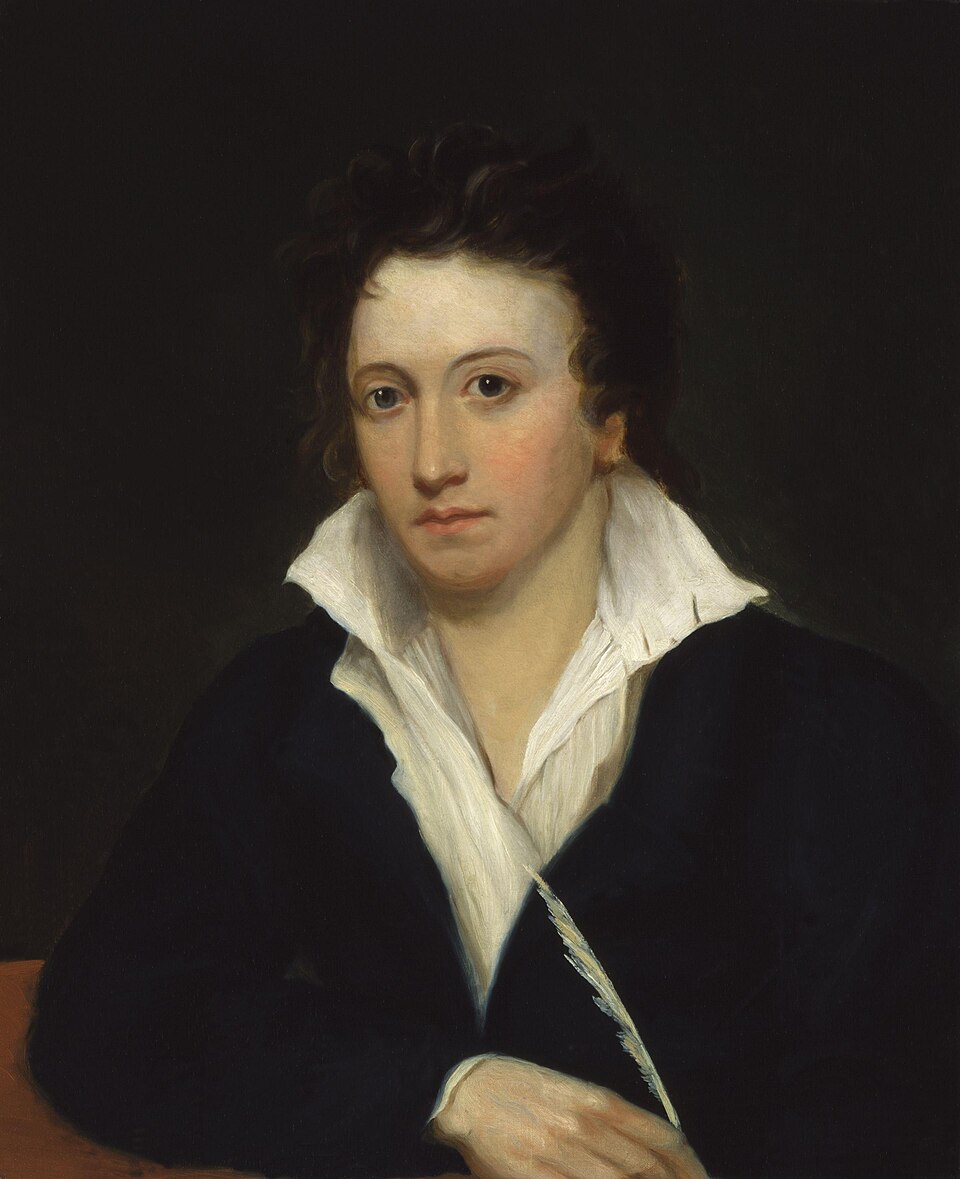
The most radical of the English Romantics, whose lyric intensity and political idealism gained their full audience only after his death at thirty.
Percy Bysshe Shelley wrote some of the most technically accomplished and politically charged verse in the English language and died before he was thirty, leaving a body of work that became increasingly central to the canon only in the decades following his drowning off the Italian coast.
Early radicalism
Born in Horsham, Sussex, in 1792, Shelley was educated at Eton and University College, Oxford, from which he was expelled in 1811 for co-authoring a pamphlet titled The Necessity of Atheism. He married Harriet Westbrook the same year. His early poetry, including Queen Mab (1813) — a utopian vision in verse — circulated widely among radical circles despite its lack of commercial publication. In 1814 he left Harriet, eloping with Mary Godwin (daughter of the philosopher William Godwin and Mary Wollstonecraft); they married in 1816 after Harriet's death.
Lyric achievement
Shelley's mature work was produced primarily in Italy between 1818 and 1822. Prometheus Unbound (1820) — a four-act lyrical drama in which the Titan who stole fire from the gods is eventually released and tyranny overthrown — is the most sustained expression of his political idealism. The same year saw "Ode to the West Wind," "To a Skylark," and the sonnet "Ozymandias" (1818, published 1819), which compresses an argument about the mortality of power into fourteen lines.
Adonaïs (1821), an elegy for John Keats written in Spenserian stanzas, is among the finest elegies in English. Shelley had met Keats only briefly, but the poem transcends biography to become a meditation on the fate of poets in an indifferent world.
Poets are the unacknowledged legislators of the world.
Death and posthumous reputation
Shelley drowned in the Gulf of La Spezia in July 1822, sailing from Livorno to Lerici. He was twenty-nine. His body, washed ashore days later, was cremated on the beach; his ashes were buried in Rome's Protestant Cemetery, near Keats. During his lifetime he had almost no public fame; his politically radical views made him difficult to publish. Recognition came steadily through the following decades, accelerated by his wife Mary's editorial work on his posthumous poems (1824).
Legacy
Robert Browning, Algernon Charles Swinburne, Thomas Hardy, and W. B. Yeats all acknowledged Shelley as a formative influence. His Defence of Poetry (written 1821, published 1840) remains one of the most eloquent arguments for poetry's social function. American literary critic Harold Bloom described him as "a superb craftsman, a lyric poet without rival."