Peter Behrens
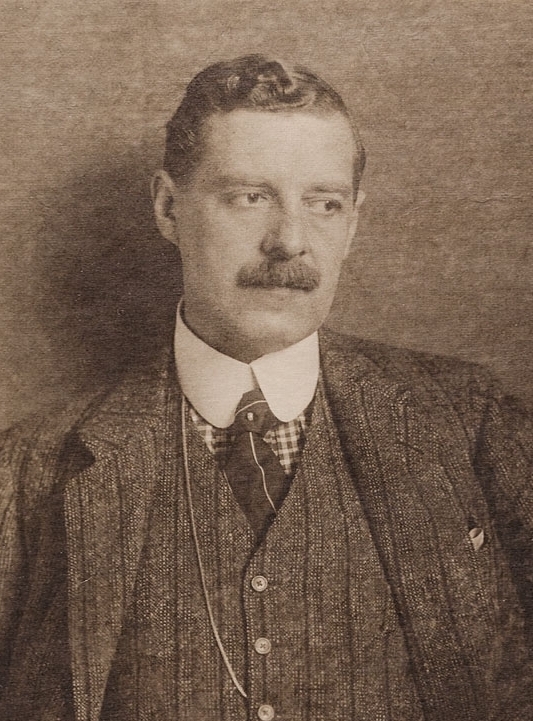
The German architect who invented corporate identity — and trained three of modernism's founding figures.
Peter Behrens did not simply design buildings and objects — he designed the first coherent corporate identity in industrial history. His appointment as artistic director at AEG in 1907 produced typefaces, products, posters, and architecture unified under a single visual logic, a practice so new it had no name yet.
Origins and formation
Behrens was born in Hamburg in 1868 and trained initially as a painter, studying in Karlsruhe, Düsseldorf, and Munich. He had no formal architectural training, yet by the late 1890s he had become a figure in the German Arts and Crafts movement, designing his own house at the Darmstadt Artists' Colony — furniture, interiors, and exterior all integrated — as a complete work of art. The experience confirmed his conviction that design was indivisible: a font and a factory wall belonged to the same discipline.
He was a founding member of the Deutscher Werkbund in 1907, the alliance of manufacturers, designers, and architects that argued for quality through industrial production. That same year, AEG — the Allgemeine Elektricitäts-Gesellschaft, then one of Germany's largest industrial combines — appointed him as its first artistic director.
The AEG years
The AEG commission was without precedent. Behrens designed not a single product but an entire material language: arc lamps, fans, kettles, clocks, catalogues, and exhibition stands were unified through consistent proportions, a house typeface he designed himself, and a hexagonal logo he refined into one of the period's most recognisable marks. Architecture followed: the AEG Turbine Hall in Berlin (1909), a vast nave of steel and glass with monumental corner pylons, gave an industrial shed the civic gravity of a Roman basilica without any classical ornament.
The commission attracted extraordinary talent. Among those who passed through Behrens's Berlin office in the 1910s were Ludwig Mies van der Rohe, Le Corbusier, and Walter Gropius — three figures who would collectively define European modernism. Each absorbed Behrens's discipline and shed his historical references.
A company's visual language should be as coherent as its engineering.
Style and method
Behrens moved across styles in a way that later critics found difficult to periodise. His pre-war work for AEG leaned toward a rationalised classicism — stripped columns, strong verticals, monumental scale. After the First World War he turned to Brick Expressionism, most visibly in the Hoechst Administration Building (1920–1924) near Frankfurt, where coloured brick and crystalline forms produced an atmosphere closer to cathedral than office. From the mid-1920s he shifted again toward the Neue Sachlichkeit — New Objectivity — the cool, empirical functionalism that dominated German architecture until the Nazi period.
He was never a single-movement architect. What remained constant was the belief that form should emerge from the specific demands of material, programme, and the organisation it served.
Legacy
From 1922 to 1936 Behrens headed the architecture school at the Academy of Fine Arts Vienna, shaping a generation of Austrian architects at the same moment Vienna was producing its own modernist culture. His influence operated through two channels simultaneously: the buildings themselves, and the three modernists who had apprenticed under him. Gropius founded the Bauhaus in 1919; Mies became its last director; Le Corbusier wrote Vers une architecture. All three acknowledged the Behrens office as formative.
The AEG Turbine Hall stands in Berlin's Moabit district, protected as a landmark, still used for industrial purposes — an origin point for both corporate design and modern architecture that looks as decisive now as when it was built.