Pier Paolo Pasolini
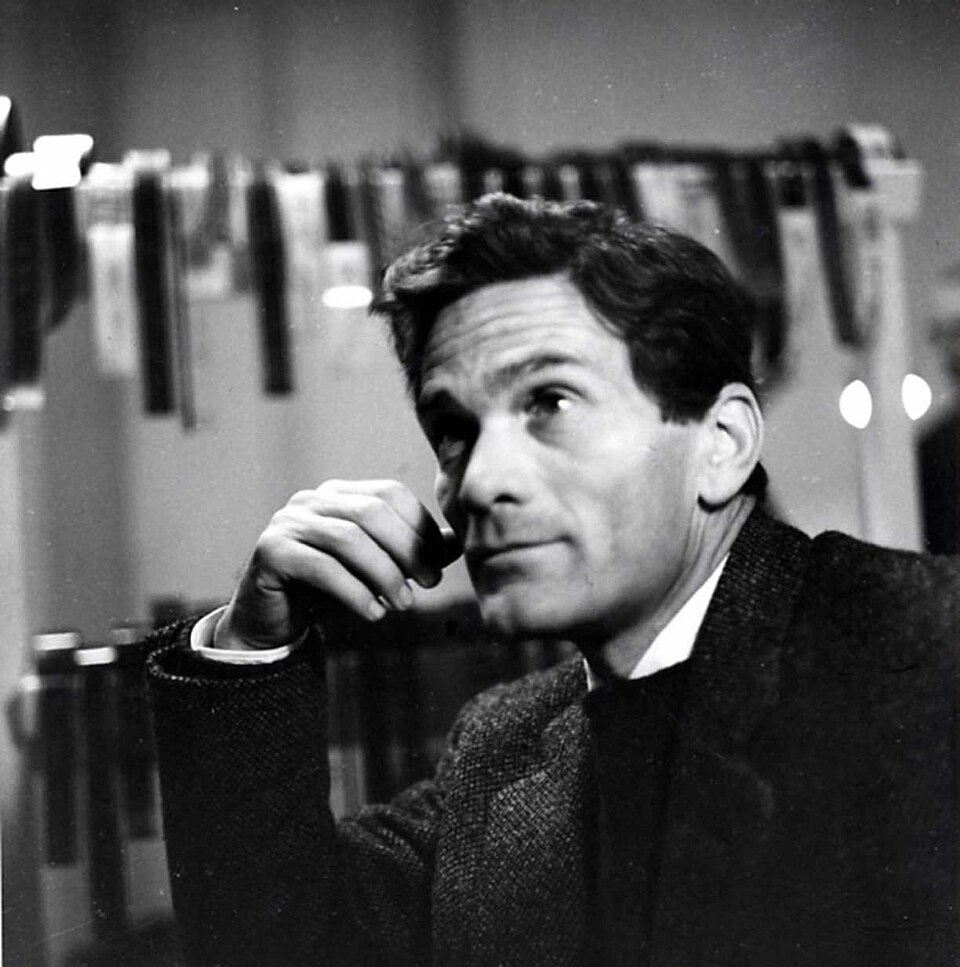
Poet, novelist, filmmaker, and polemicist, he made the sacred and the obscene argue with each other across a body of work that Italian culture could not absorb and could not ignore.
Pier Paolo Pasolini was the most contested public intellectual in postwar Italy — a communist who was expelled from the Communist Party, a Catholic who filmed the Gospel as though it were documentary newsreel, a defender of the poor who denounced the consumer society that was lifting them from poverty. His films and writing coexisted without resolution, sustained by a furious refusal to accept that any of his positions were contradictory.
Bologna and the margins
Born in Bologna in 1922, Pasolini moved with his family through several Italian cities before settling in Rome in 1950 after his expulsion from the Friulian branch of the Communist Party — the charge was a moral scandal the Party did not wish to tolerate. In Rome he lived in the suburban borgate, the working-class periphery, and began publishing novels in Romanesco dialect — Ragazzi di vita (1955) and Una vita violenta (1959) — that brought the Roman underclass into literary Italian with a precision that scandalized the establishment and won him a permanent audience.
Cinema: the sacred and the profane
His first films as director — Accattone (1961) and Mamma Roma (1962) — placed his literary subject matter, the borgate, on screen with a visual severity drawn from early Renaissance painting: frontal compositions, flat light, the faces of non-professional actors. The effect was archaic and immediate simultaneously.
The Gospel According to St. Matthew (1964), dedicated to Pope John XXIII, filmed the life of Christ in the landscape of southern Italy using local faces and a soundtrack that moved from Bach to Odetta to Congolese music. It remains one of the most unusual and affecting religious films ever made — sincere where it might have been ironic, simple where it might have been complex.
The Trilogy of Life — The Decameron (1971), The Canterbury Tales (1972), Arabian Nights (1974) — celebrated the pre-bourgeois body and sensuality in explicit terms that produced legal cases across Europe. Pasolini later repudiated the trilogy, arguing that the consumer culture he had meant to attack had absorbed the films' transgression and neutralised it.
Salò and the final silence
Salò, or the 120 Days of Sodom (1975), released after his death, transposed de Sade to the last days of the Italian Republic of Salò and produced a film of sustained, systematic horror that Pasolini described as an allegory of power. It remains one of the most difficult films in the archive — banned, confiscated, and debated ever since.
He was murdered on the outskirts of Rome on the night of 1–2 November 1975. The circumstances of his death have been contested for decades; no entirely satisfactory account has been established.
The essays and the writing
Alongside the films, Pasolini produced poetry, novels, journalism, theatre, and a vast body of cultural criticism. His newspaper columns, collected in Lutheran Letters and Corsair Writings, delivered savage analyses of Italian television, consumerism, and the homogenisation of Italian culture and speech. He saw the postwar economic miracle as a cultural catastrophe more thorough than Fascism.
The cultural genocide being committed by consumer society against the Italian people is more violent and more complete than anything Mussolini managed.