Rabindranath Tagore
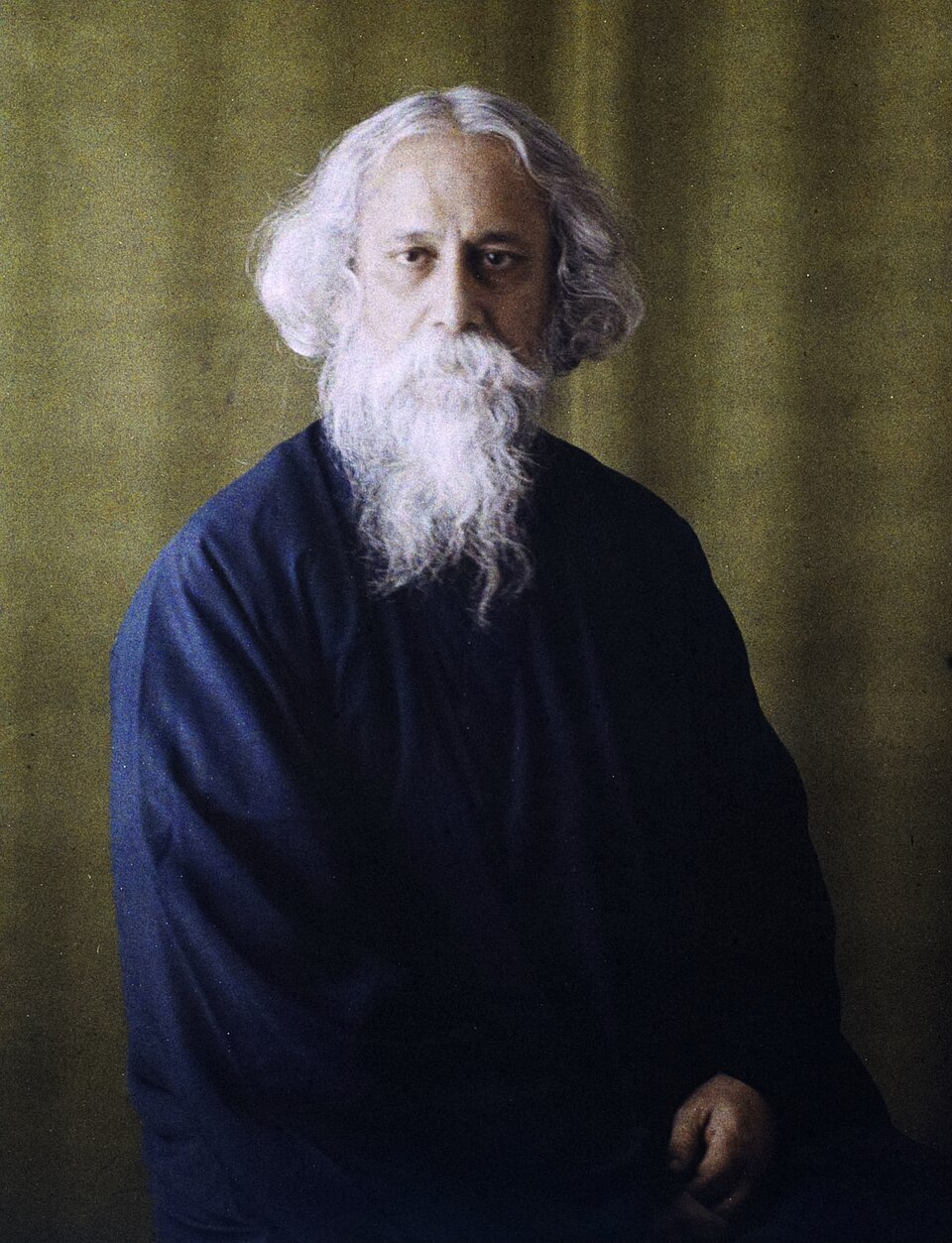
A Bengali poet who reshaped his language, founded a university, wrote two nations' anthems, and then returned his knighthood to a empire that had massacred its own subjects — all before painting.
Rabindranath Tagore was born into a family that had already shaped Bengali intellectual life, and he spent eight decades expanding what that life could hold — poetry, prose, drama, music, philosophy, education, painting, and political dissent. When the Swedish Academy awarded him the Nobel Prize in Literature in 1913, he became the first Asian laureate and the first lyricist ever to receive it. He had composed the national anthems of two countries that did not yet exist, and he would live long enough to return his British knighthood, found a university, travel four continents, and take up painting at seventy.
Origins and formation
Tagore was born on 7 May 1861 in the Jorasanko district of Calcutta (now Kolkata), into the Thakur family — anglicised as Tagore — one of the most prominent households of the Bengal Renaissance. His father Debendranath was a religious reformer; the extended family included musicians, painters, and writers. Tagore began composing verse as a child and published his first collection under a pseudonym at sixteen. He was briefly sent to England to study law in 1878, returned without a degree, and instead committed fully to literature. By his mid-twenties he had produced a body of Bengali poetry, song, and fiction that was already transforming the language.
Gitanjali and the Nobel Prize
The decisive work was Gitanjali (Song Offerings), a collection of devotional poems first published in Bengali in 1910. Tagore himself translated a selection into English prose-verse, and the English Gitanjali appeared in 1912 with an introduction by W. B. Yeats, who had heard Tagore read the translations aloud and declared himself moved beyond expectation. The Nobel Committee awarded Tagore the Prize in Literature in 1913, citing "his profoundly sensitive, fresh, and beautiful verse, by which, with consummate skill, he has made his poetic thought, expressed in his own English words, a part of the literature of the West." He was the first non-European, the first Asian, and the first lyricist to win in any category. The prize transformed his international standing overnight; he spent much of the following decade travelling — Europe, North America, Southeast Asia, Latin America — lecturing on culture, nationalism, and human unity.
Dissent and institution-building
In 1915 the British Crown knighted Tagore. In April 1919, British and Gurkha troops under Brigadier General Reginald Dyer opened fire on an unarmed gathering at Jallianwala Bagh in Amritsar, killing several hundred people. Tagore wrote to the Viceroy renouncing his knighthood, stating that the titles of honour make our shame glaring in the incongruous context of humiliation. The letter remains one of the most cited acts of public resignation in South Asian history. Two years later, in 1921, he formally established Visva-Bharati University at Shantiniketan, the rural retreat near Bolpur that his father had acquired decades earlier. The institution was built on his conviction that education should be outdoor, inter-cultural, and rooted in living tradition rather than colonial bureaucracy; it remains a central university of India.
Range and late work
Tagore's output defies easy cataloguing. He wrote more than a thousand poems, some two dozen plays including Rakta Karabi (Red Oleanders, 1924) and the allegorical Dak Ghar (The Post Office, 1912), eight novels, numerous collections of short stories, and a vast body of essays on politics, education, and aesthetics. He composed approximately 2,200 songs — the genre now known as Rabindra Sangeet — which remain a living part of Bengali musical culture. He composed Jana Gana Mana, adopted as India's national anthem, and Amar Sonar Bangla, adopted as Bangladesh's national anthem in 1971. In his late sixties he began drawing and painting, producing works that critics have since situated within the tradition of modernist primitivism. He died on 7 August 1941 in Kolkata, aged eighty.
"The time has come when badges of honour make our shame glaring in the incongruous context of humiliation."