Rainer Maria Rilke
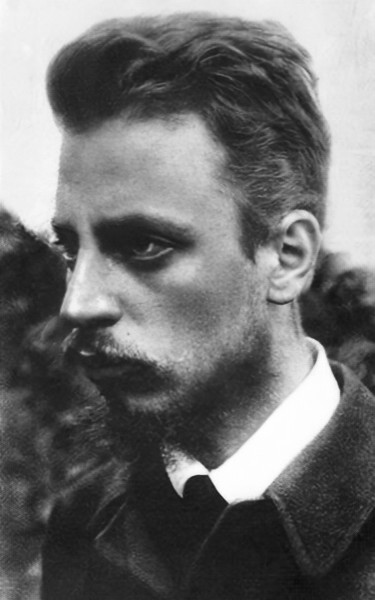
A poet who turned solitude and spiritual yearning into some of the most concentrated lyric verse in the German language.
Rainer Maria Rilke spent his life moving between borrowed rooms and borrowed certainties, turning displacement into the condition of his art. His late cycles — the Duino Elegies and the Sonnets to Orpheus, both completed in a burst of work in 1922 — are among the most demanding and most beautiful poems written in any language in the twentieth century.
Beginnings in Prague and early wandering
Rilke was born in Prague on 4 December 1875, then part of the Austro-Hungarian Empire. His parents' marriage was unhappy and short-lived; his mother dressed him as a girl during his early childhood, a fact biographers have often linked to his later preoccupation with identity and transformation. He was sent to military academies, which he found oppressive, before eventually studying art history briefly in Prague and Munich. His early published verse was romantic and derivative. The shift came when he met Lou Andreas-Salomé in 1897. She became a decisive influence — intellectually, emotionally, and personally — and her criticism pushed him toward a harder, more exact poetry.
Two trips to Russia with Salomé in 1899 and 1900 exposed him to Tolstoyan spirituality and peasant life, material he absorbed into the three books of Das Stunden-Buch (The Book of Hours). A period in the artists' colony at Worpswede introduced him to sculptor Clara Westhoff, whom he married in 1901; the marriage was quickly suspended as both continued their separate careers.
Paris, Rodin, and the Neue Gedichte
In 1902 Rilke moved to Paris to write a monograph on Auguste Rodin. Working in close proximity to the sculptor — eventually serving briefly as his secretary — he absorbed the idea of the Ding (thing): the poem as a finished, self-contained object rather than an expression of feeling. The result was the Neue Gedichte (New Poems, 1907–1908), a collection of object poems — the panther in its cage, an archaic torso of Apollo, a cathedral rose window — in which the lyric voice almost disappears behind the precision of observation.
Works of art are of an infinite loneliness and with nothing to be so little reached as with criticism.
The Elegies and the Sonnets
In January 1912, staying at the castle of Duino on the Adriatic at the invitation of Princess Marie von Thurn und Taxis, Rilke heard — or imagined he heard — a voice calling to him in the wind, and began the Duino Elegies. The first two elegies came quickly; the rest arrived only a decade later, in a ten-day burst of composition at the Château de Muzot in Switzerland in February 1922. In the same weeks he completed the fifty-five Sonnets to Orpheus, poems to music, transformation, and loss. The two cycles together constitute the central achievement of his late work.
Legacy
Rilke's influence on twentieth-century poetry in German is without parallel. He made the lyric bear philosophical weight — questions of angels, death, praise, and transformation — without resorting to abstraction. In translation he has remained central to the reading life of poets in English, Spanish, and beyond; the Letters to a Young Poet (1929), published posthumously, became one of the most widely read texts on the vocation of writing.