Rainer Werner Fassbinder
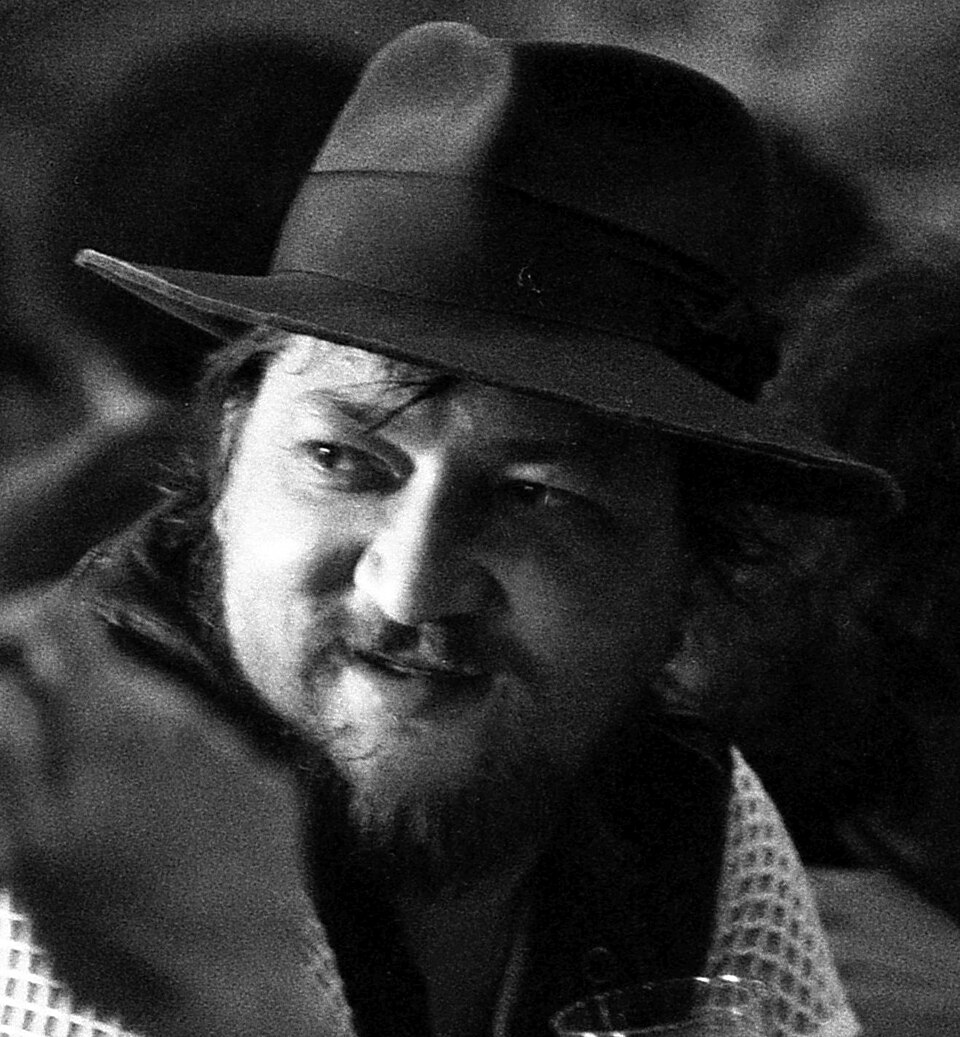
In fifteen years he made over forty films about power, exploitation, and love — all of them the same film, and all of them different.
Rainer Werner Fassbinder worked at a speed that would be impossible to sustain — and did not sustain it, dying at thirty-seven — producing more than forty films that used the genre machinery of Hollywood melodrama to dissect postwar German society's emotional economy: who exploits whom, who accepts exploitation as love, and how institutions teach both.
Bavaria and the anti-theatre
Born in Bad Wörishofen in Bavaria in 1945, Fassbinder grew up in postwar Munich, shuttled between parents who were separating, much of his childhood spent in cinemas. He taught himself film by watching; American genre films — particularly Douglas Sirk's Universal melodramas — provided the formal vocabulary he would spend his career transforming.
He began in theatre, founding the anti-teater in Munich in 1967, a company that worked fast, collectively, and on minimal budgets. The theatre became his laboratory: most of his early film collaborators came from this group, and the speed — rehearsals simultaneous with script development, production measured in weeks — became habitual.
His first feature, Love Is Colder Than Death (1969), announced his method: genre borrowed and alienated, characters who speak in flat emotional registers, camera placement that emphasises the architecture of power within a scene.
The social machine
Fassbinder's central subject was exploitation — the ways in which people use each other's need for affection to exercise control, and the ways in which this dynamic is structured by class, race, sexuality, and gender. The films return obsessively to relationships in which one character dominates and the other accepts domination, often without fully understanding it.
The Merchant of Four Seasons (1971) and Ali: Fear Eats the Soul (1974) — the latter a direct response to Sirk's All That Heaven Allows, placing a German widow and a Moroccan immigrant in a relationship destroyed by every surrounding institution — are the fullest early statements. Fear Eats the Soul was shot in fifteen days.
The BRD Trilogy — The Marriage of Maria Braun (1979), Lola (1981), Veronika Voss (1982) — surveyed the Federal Republic through three female protagonists whose personal history is inseparable from West German economic and political recovery. The films use the woman's story to read the nation.
Scale and ambition
Berlin Alexanderplatz (1980), his adaptation of Alfred Döblin's novel made for German television, ran nearly fifteen hours across fourteen episodes and an epilogue. It is one of the most ambitious literary adaptations in cinema history and the work in which Fassbinder's personal mythology — his identification with the novel's protagonist Franz Biberkopf — is most openly present.
Legacy
Fassbinder's death from a drug overdose in 1982 ended a body of work that had no precedent in volume, range, or intensity. His influence on subsequent filmmakers — Pedro Almodóvar in Spain, Todd Haynes in the United States, and many others — operated through the demonstration that melodrama was not a debased genre but a precise instrument for analysing social life.
My films are about the exploitability of feelings. Love is the best, most efficient, and most economical means of subjugation.