Ralph Waldo Emerson
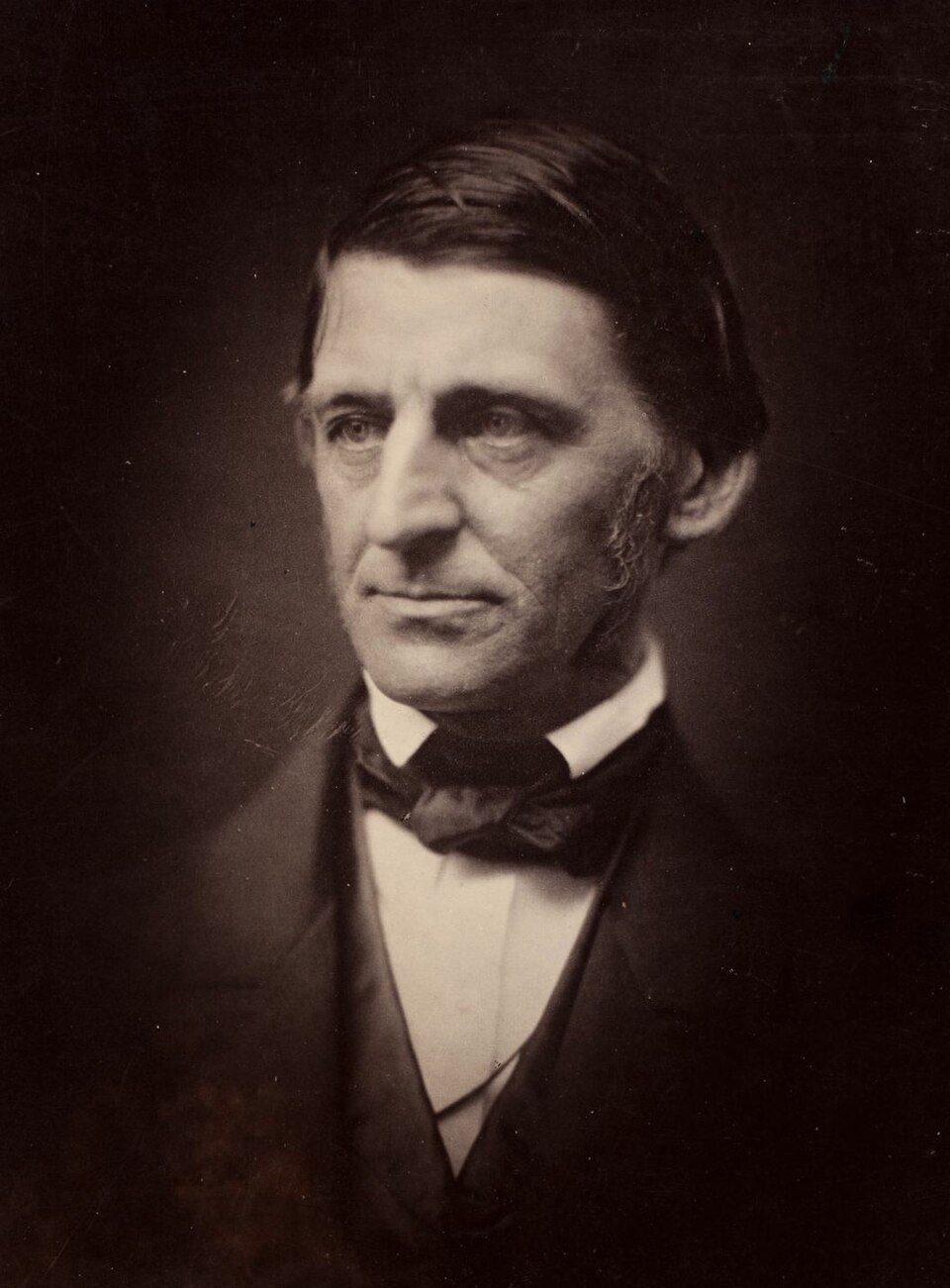
The minister-turned-philosopher who made self-reliance the cornerstone of American thought and launched a literary generation.
Ralph Waldo Emerson was an American essayist, lecturer, philosopher, and poet who led the Transcendentalist movement of the mid-nineteenth century and became the most influential American intellectual of his generation. His central arguments — that individuals should trust their own perception and conscience, that nature is a moral and spiritual teacher, that conformity deadens the soul — gave American culture a philosophical vocabulary it has never fully abandoned.
Formation and the break with orthodoxy
Emerson was born in Boston on 25 May 1803, the son of a Unitarian minister who died when Ralph was eight. He attended Harvard, graduated in 1821, and was ordained a Unitarian minister. In 1832 he resigned his ministry after refusing to administer communion — a gesture that reflected his growing conviction that institutional religion obscured rather than revealed the divine. He sailed for Europe, met Wordsworth, Coleridge, and Carlyle, and returned with the materials of a new intellectual programme.
He settled in Concord, Massachusetts, which became the centre of the Transcendentalist circle. He delivered lectures, wrote for The Dial (the movement's journal), and began producing the essays that made his reputation.
Transcendentalism and the essays
Emerson's first book, Nature (1836), set out the Transcendentalist position: nature is not merely material but symbolic, a language through which the divine speaks to the individual who is attentive enough to read it. The individual, rightly developed, can perceive truth directly without the mediation of tradition, institution, or authority.
"Self-Reliance" (1841), the most famous of his essays, argues this point with maximum force: trust your own judgment; imitation is suicide; consistency is the hobgoblin of little minds. The essay was immediately influential and has remained so — it is the philosophical charter of American individualism, for better and worse.
"The American Scholar" (1837), delivered as an address to the Phi Beta Kappa Society at Harvard, argued that American intellectual life needed to free itself from European models and trust its own experience. Oliver Wendell Holmes Sr. called it "our intellectual Declaration of Independence."
Other major essays include "The Over-Soul" (1841), "Experience" (1844), and "Fate" (1860), which trace a philosophical arc from idealism through a harder-won acknowledgment of contingency and limitation.
The lectures and the Concord circle
Emerson's primary medium was the lyceum lecture — he delivered hundreds of lectures across the United States, reaching audiences from New England to the Midwest. Walt Whitman, who attended his lectures, wrote that Emerson was his "master" and that the address "The American Scholar" set him on fire. Henry David Thoreau became his protégé and close friend, for a time living in Emerson's household. The Concord circle also included Bronson Alcott, Margaret Fuller, and Nathaniel Hawthorne.
He was a committed abolitionist and delivered lectures against slavery, though he was also associated with a strain of thought that prized exceptional individuals in ways that could be read as elitist. Friedrich Nietzsche read him with admiration, calling him "the most gifted of the Americans."
To be yourself in a world that is constantly trying to make you something else is the greatest accomplishment.
Legacy
Emerson died in Concord on 27 April 1882. His influence on American literature, philosophy, and culture is immeasurable — not because he founded a school that persists in academic form, but because his core ideas — self-reliance, the primacy of experience, the suspicion of received authority — became the default intellectual atmosphere of American life, absorbed so thoroughly that they no longer seem to require attribution.