Richard Feynman
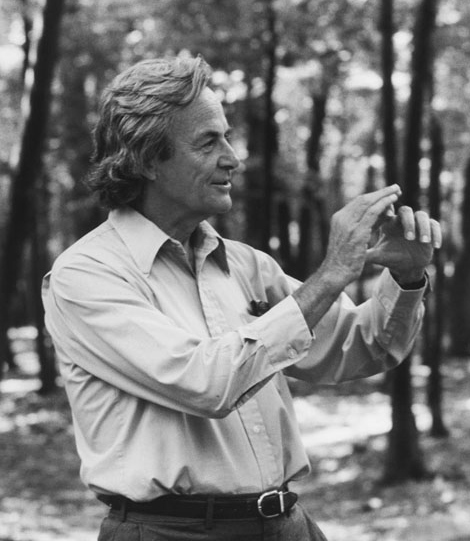
The physicist who made quantum mechanics visible — and who brought the same restless curiosity to safe-cracking, bongo drums, and the Challenger investigation.
Richard Feynman stands among the handful of physicists who did not merely advance their field but changed what physics looks like — literally, by inventing the diagrams that now fill every textbook on particle interactions. His 1965 Nobel Prize in Physics recognised work in quantum electrodynamics that remains the most precisely verified theory in all of science. Outside the laboratory he became the most recognisable scientist of his generation: a storyteller, a showman, and a relentless enemy of fuzzy thinking.
Origins and early formation
Feynman grew up in Far Rockaway, Queens, the son of a uniform salesman who taught him, he later said, to see the world in patterns rather than names. He enrolled at MIT and completed his doctorate at Princeton under John Archibald Wheeler in 1942. His thesis introduced the path integral formulation of quantum mechanics — a way of computing the probability of a particle's behaviour by summing contributions from every conceivable path it might take, not just the classical one. The idea was unorthodox and took years to become standard, but it eventually reshaped theoretical physics and found applications far beyond particle physics, from statistical mechanics to financial modelling.
During the war he joined the Manhattan Project at Los Alamos, where he became as notorious for picking locks on classified filing cabinets as for his physics. After the war he held a position at Cornell before moving to Caltech in 1950, where he remained for the rest of his life.
Quantum electrodynamics and the diagrams
The central achievement recognised by the Nobel committee was Feynman's contribution to quantum electrodynamics (QED) — the relativistic quantum theory of the electromagnetic force. Working independently from Julian Schwinger and Shin'ichirō Tomonaga, who approached the same problems through dense operator algebra, Feynman developed a complementary and more intuitive framework. He introduced a set of pictorial representations — lines for particles, wavy lines for photons, vertices for interactions — that encoded the underlying mathematics in a form that physicists could reason about directly.
Feynman diagrams are not mere illustrations; they are calculational tools, each diagram corresponding to a term in a perturbation expansion. They became universal, translating across quantum field theories and making complex calculations tractable where they had previously been prohibitive.
| Contribution | Status |
|---|---|
| Path integral formulation | Standard tool across multiple fields |
| Feynman diagrams | Universal in particle and condensed-matter physics |
| Parton model | Underpinned quark structure of the proton |
| Theory of superfluidity | Explained quantum behaviour of liquid helium |
Teaching and communication
Feynman's lectures at Caltech — later published as The Feynman Lectures on Physics (1964) — remain in active use. His stated goal was to find the simplest, most honest account of a phenomenon rather than the most technically elaborate one. This commitment produced not only pedagogy but a diagnostic tool: if you cannot explain something simply, he argued, you do not yet understand it.1
His popular books, including Surely You're Joking, Mr. Feynman! (1985) and What Do You Care What Other People Think? (1988), brought his voice to a general audience and made him a cultural figure.
Legacy
Feynman's final public act was his work on the Rogers Commission investigating the 1986 Space Shuttle Challenger disaster. His demonstration — dropping a rubber O-ring into ice water and showing it lost resilience at low temperatures — was a lesson in clear thinking as much as materials science. He insisted on appending his own dissenting statement to the final report.
I would rather have questions that can't be answered than answers that can't be questioned.
Footnotes
- Feynman articulated versions of this principle in lectures and interviews throughout his career; the exact formulation varies across accounts. ↩