Robert Doisneau
The photographer who made the streets of Paris look like a stage set for tenderness — and spent sixty years filling it with ordinary life.
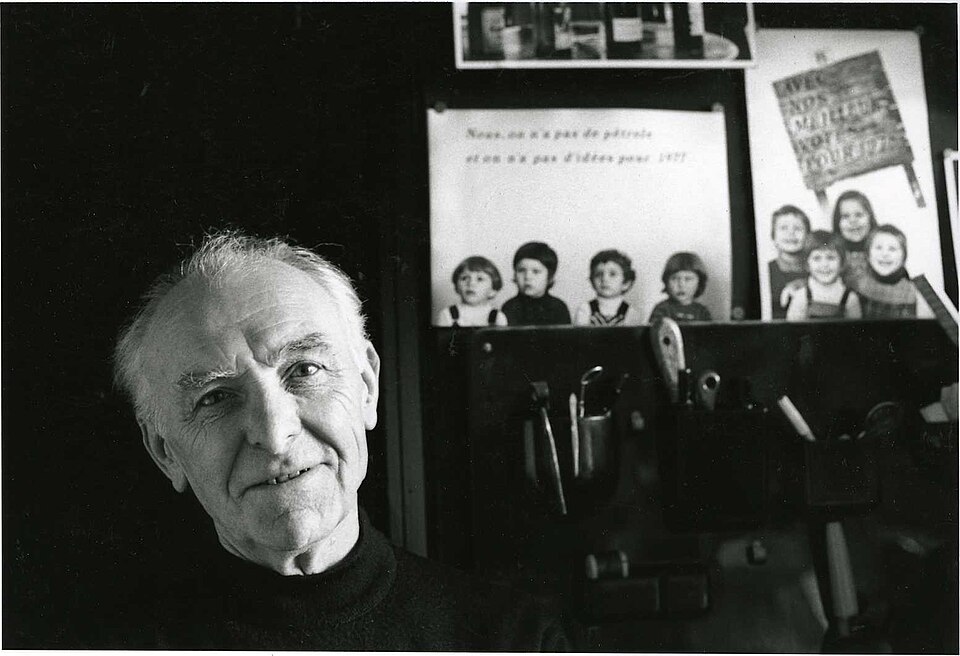
Robert Doisneau photographed Paris for sixty years with the patience and affection of a native who found his own city inexhaustibly strange and beautiful. His images of working-class neighbourhoods, schoolchildren, musicians, and street lovers defined what the world came to imagine when it imagined Paris.
Formation
Doisneau was born in 1912 in Gentilly, a suburb south of Paris, and grew up in the city's working-class periphery. He trained as a lithographer and engraver, developing the practical relationship with reproduction processes that would make him a natural commercial photographer. In 1934 he took a position as an industrial photographer with the Renault car factory at Boulogne-Billancourt, documenting production lines and products. He was dismissed in 1939, reportedly for persistent lateness.
By then he had already begun street photography, working with the Rapho agency and finding his subjects in the neighbourhoods of Montrouge, Montparnasse, and the suburbs he had grown up in. His approach was close to Henri Cartier-Bresson's humanism but more intimate in scale: where Cartier-Bresson organised the whole frame geometrically, Doisneau was drawn to expressions and encounters, to the small emotional event inside the larger scene.
The Kiss and humanist photography
In 1950, Life magazine commissioned Doisneau to produce a series of photographs on Paris lovers. Among the images he submitted was Le Baiser de l'Hôtel de Ville — a couple kissing in the middle of a busy Paris street, figures of apparent spontaneity and joy. It became the most widely reproduced photograph in the history of French photography, appearing on posters, postcards, and calendars for decades.
The image was staged: the couple, Françoise and Jacques Carteaud, were acting students Doisneau had recruited as models. This was disclosed during lawsuits in 1993, when two couples claimed to be the subjects. The staged nature of the photograph — long accepted practice for editorial work — reduced its mythological standing without diminishing its power as an image.
I don't photograph life as it is, but as I would like it to be.
A life on the street
Beyond Le Baiser, Doisneau produced an enormous archive of French life: children playing in schoolyards, street musicians, market traders, suburban families, and the inhabitants of the Parisian banlieue he had always claimed as his natural territory. He worked for fashion magazines — Vogue, Elle — and for major advertising clients without abandoning the street work that drove him.
He was awarded the Grand Prix National de la Photographie in 1983. A close friend of the poet and screenwriter Jacques Prévert, he shared Prévert's feeling for the comic and the poignant in everyday life. He continued working until his death in Paris in April 1994.