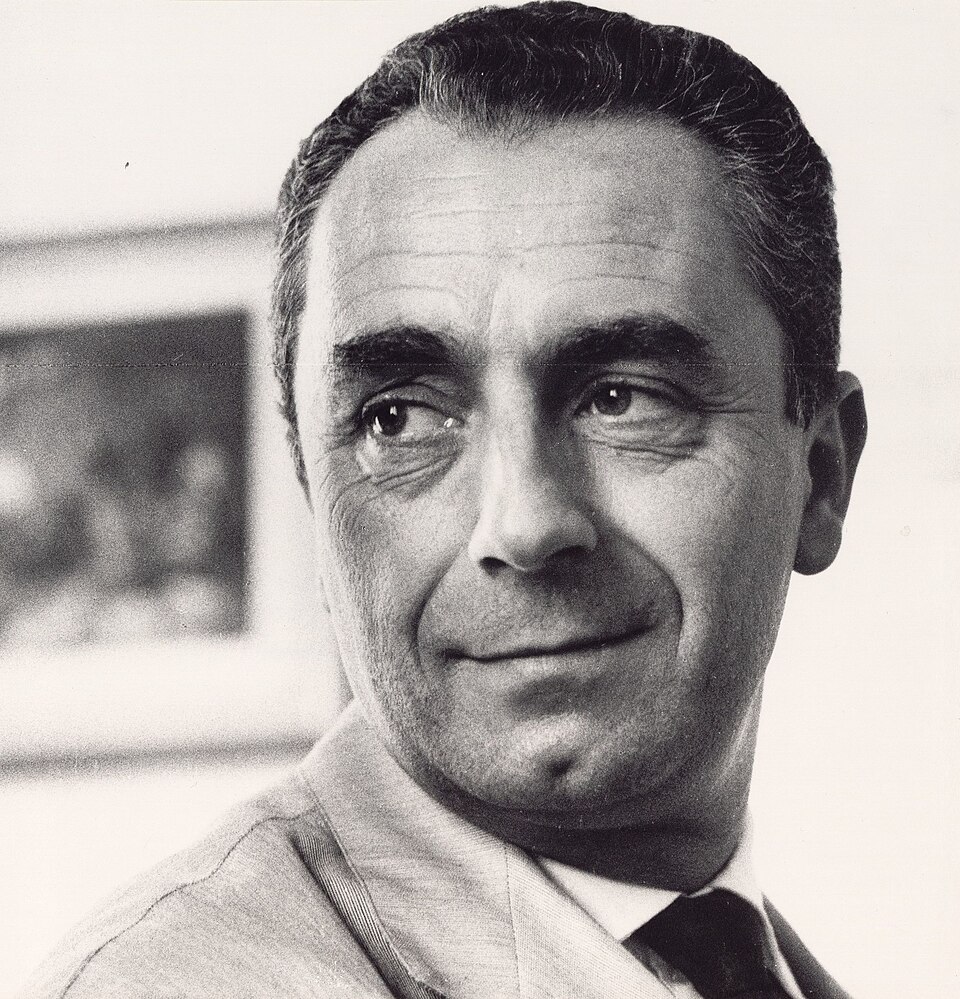
Roberto Rossellini
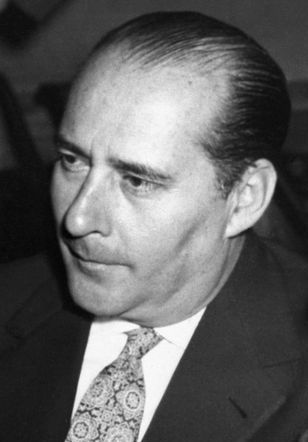
The filmmaker who pointed a camera at the ruins of wartime Rome and invented a new language for what cinema could witness.
Roberto Rossellini made his three great neorealist films — Rome, Open City, Paisan, and Germany, Year Zero — in the immediate aftermath of the Second World War, using non-professional actors, natural light, and actual ruined buildings to produce a documentary truthfulness that transformed what the fiction film was capable of. The camera, placed among actual devastation, became an ethical instrument.
Rome and the war years
Born in Rome in 1906 into a middle-class family whose father built one of the city's first cinemas, Rossellini entered the industry in the 1930s, making short films and working on commercial productions under the Fascist system. The experience left no obvious mark on his method; what shaped him was the fall of Mussolini's regime and the German occupation of Rome.
Rome, Open City (Roma città aperta, 1945) was shot during and immediately after the Liberation, partly on the streets where the events it depicted had taken place, with film stock scrounged from multiple sources and a cast mixing professional actors with local non-professionals. The result looked unlike anything else in Italian or European cinema: raw, uneven, emotionally direct, indifferent to studio finish. It was a scandal and a revelation.
The War Trilogy
Paisan (1946) extended the method across six episodes covering the Allied advance through Italy from Sicily to the Po Valley, each with different casts of Americans and Italians encountering each other across incomprehension and circumstance. Germany, Year Zero (1948) moved to the rubble of Berlin, following a twelve-year-old boy through a city that had nothing left to offer him.
Together the three films constitute the founding documents of Italian neorealism and one of the most significant bodies of work to emerge directly from the experience of the war.
The Bergman period
In 1949, Ingrid Bergman, then the biggest female star in Hollywood, wrote to Rossellini after seeing Open City and offered to work with him. Their subsequent collaboration — personal as well as professional, scandalous by the standards of the time — produced Stromboli (1950), Europe '51 (1952), Journey to Italy (1954), and Fear (1954). The films were largely dismissed on release; the Bergman cycle has since been reappraised as a body of work in which the star's interiority becomes the film's subject, anticipating the European art cinema of the 1960s.
Later work and television
From the 1960s onward Rossellini turned to television, making long educational films about historical figures — Socrates, Pascal, Descartes, Louis XIV — that aimed to make the methods of thought of great thinkers visible. The Taking of Power by Louis XIV (1966) is the most celebrated: a scrupulous reconstruction, shot flat and direct, with no concessions to dramatic convention.
Things are there. Why manipulate them?