Rosalind Franklin
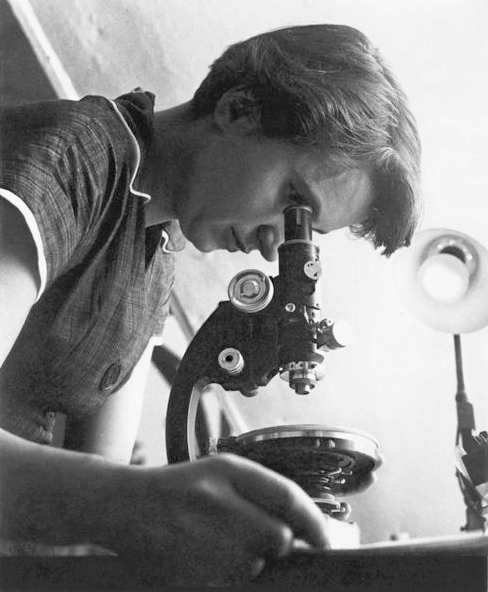
The crystallographer whose X-ray images of DNA proved decisive — and whose contribution was sidelined during her lifetime, only to be reassessed as foundational decades after her death.
Rosalind Franklin produced some of the sharpest X-ray diffraction images of DNA ever made — images that were central to determining the double helix structure announced by Watson and Crick in 1953. That her work was shown to those scientists without her knowledge, and that she received no share of the 1962 Nobel Prize awarded for the discovery, has made her story one of the most discussed cases of overlooked scientific contribution in the twentieth century. Her research on viruses, completed before her death at 37, was equally distinguished.
Education and early career
Franklin was born into a prominent Anglo-Jewish family in London and showed exceptional ability in science from an early age. She read Natural Sciences at Newnham College, Cambridge, graduating in 1941. After wartime work on coal microstructure for the British Coal Utilisation Research Association, she moved to Paris in 1947 to work at the Laboratoire Central des Services Chimiques de l'État under Jacques Mering, where she developed deep expertise in X-ray crystallography applied to disordered materials.
Her Paris years produced important research on the microstructure of graphitising and non-graphitising carbons — work that contributed to the understanding of carbon and coal chemistry and that was recognised by colleagues in both Britain and France. She returned to England in 1951 to take up a post at King's College London, where she was assigned to work on biological fibres, including DNA.
Photo 51 and the DNA structure
At King's, Franklin and her graduate student Raymond Gosling produced a series of X-ray diffraction photographs of DNA fibres. One image taken in May 1952, later designated Photo 51, showed the B-form of DNA with exceptional clarity. The photograph's cross-shaped diffraction pattern was direct evidence of a helical structure; the precise measurements Franklin recorded gave quantitative constraints on the dimensions of any proposed model.
Franklin's data — including Photo 51 and unpublished measurements in an MRC report — were shown to James Watson by her King's colleague Maurice Wilkins without Franklin's knowledge or consent. Watson and Francis Crick used these data in building their model of the double helix, published in Nature in April 1953. Franklin's own papers appeared in the same issue, providing independent experimental confirmation. The degree to which her unpublished data was critical to the Watson–Crick model has been subject to scholarly analysis ever since.1
Viruses and the Birkbeck years
In 1953 Franklin moved to Birkbeck College, where she worked under J.D. Bernal. She built a productive group studying the structure of plant viruses using X-ray crystallography. Her research on the tobacco mosaic virus (TMV) established that its RNA is embedded within the protein coat — a significant structural finding. She extended this work to other viruses, including turnip yellow mosaic virus, and was preparing further publications when she was diagnosed with ovarian cancer in 1956. She continued working almost until her death in April 1958, aged 37.
Legacy and reassessment
Watson, Crick, and Wilkins shared the Nobel Prize in Physiology or Medicine in 1962 — four years after Franklin's death, making her ineligible under Nobel rules. Watson's account of the discovery in The Double Helix (1968) depicted Franklin in terms widely criticised as dismissive. Subsequent historical scholarship, drawing on Franklin's notebooks, letters, and colleagues' accounts, has substantially revised the picture, placing her as an independent scientist of the first order whose contributions to the DNA story were more central than early accounts acknowledged.
Science and everyday life cannot and should not be separated.
Footnotes
- Detailed examination of laboratory notebooks and correspondence has been carried out by historians including Brenda Maddox and Matthew Cobb, who document how Franklin's measurements constrained the Watson–Crick model. ↩