Samuel Beckett
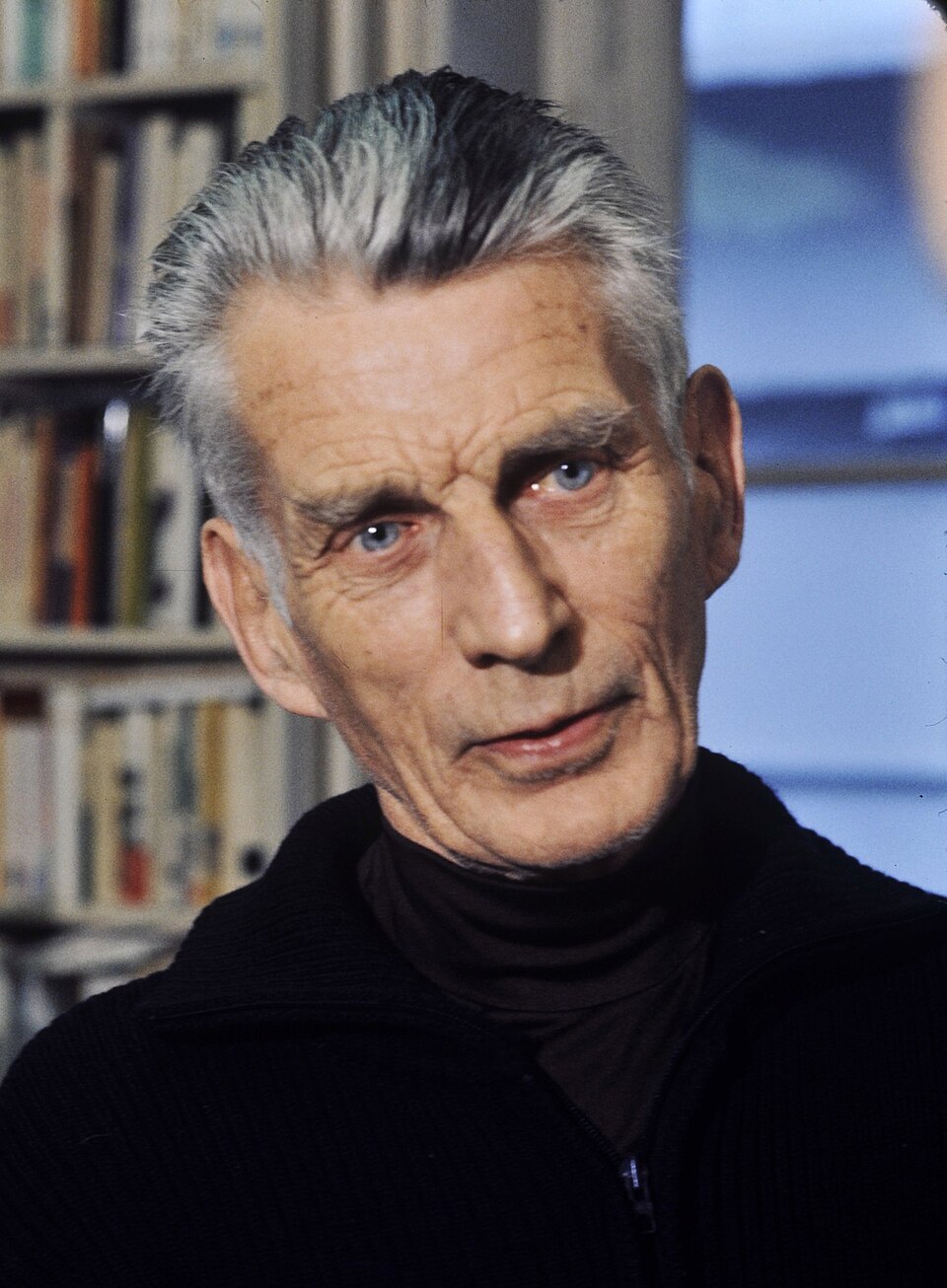
The Irish writer who stripped drama and fiction down to their minimum and found that the minimum was enough — and that it said everything.
Samuel Beckett wrote in two languages, neither of them his own by birth — English, which was, and French, which he adopted deliberately to achieve a prose stripped of the rhetorical comforts of his mother tongue. The result was a body of work — plays, novels, short prose — that dismantled the conventions of narrative and theatre more radically than almost any other writer of the century, and did so from a position of desolate comedy rather than avant-garde theory.
Formation
Beckett was born on Good Friday, 13 April 1906, in Foxrock, a southern suburb of Dublin, into a prosperous Protestant family. He studied French and Italian at Trinity College Dublin, graduating with a first-class degree in 1927, and spent two years in Paris as an English lecturer at the École Normale Supérieure, where he met James Joyce, with whom he maintained a close personal and literary relationship.
Joyce's influence — the extreme pressure on language, the concern with consciousness and time — is present in Beckett's early work but is methodically refused in the mature writing. Where Joyce accumulated, Beckett subtracted.
He returned to Dublin and then to London before settling permanently in Paris in 1937. He remained there during the German Occupation, joining the French Resistance; he was forced to flee to unoccupied France in 1942 after his cell was betrayed, and spent the war years in hiding in the Vaucluse.
The postwar work
After the Liberation, Beckett entered what he later called his "siege in the room": a period of extreme creative concentration in which he wrote the works that define his reputation. Molloy, Malone Dies, and The Unnamable — the "Trilogy" — were written in French between 1947 and 1950. They follow a series of increasingly disintegrated narrators who attempt and fail to tell coherent stories about themselves; the prose becomes progressively more stripped and contradictory.
En attendant Godot (Waiting for Godot), written in French in 1948–49, was staged in Paris in 1953. Two men wait for someone named Godot who does not come. They talk, argue, perform comic routines, sleep, and wait again. The play's subject — the experience of waiting itself, as a condition of existence rather than a narrative situation — had no precedent in Western theatre and changed what the stage was capable of saying.
Method
Beckett's approach was subtractive: later works are shorter and more denuded than earlier ones. Endgame (1957) reduces its setting to a room and its cast to four characters in terminal stasis. Krapp's Last Tape (1958) is a single actor listening to recordings of his younger self. Not I (1972) is eight minutes of a disembodied mouth speaking in the dark.
The Nobel Committee's citation acknowledged his work as writing which "in new forms for the novel and drama — in the destitution of modern man acquires its elevation." The destitution and the elevation are inseparable.
Ever tried. Ever failed. No matter. Try again. Fail again. Fail better.
Nobel Prize and legacy
Beckett received the Nobel Prize in Literature in 1969. He did not attend the ceremony; the award was accepted on his behalf. He continued to write, producing increasingly short and compressed work until the end of his life.
His influence on theatre has been structural: every playwright who works with minimal setting, with silence as a dramatic element, with the refusal of resolution, works in the space Beckett opened. Harold Pinter, Tom Stoppard, and Edward Albee all acknowledged the debt directly.