Sappho
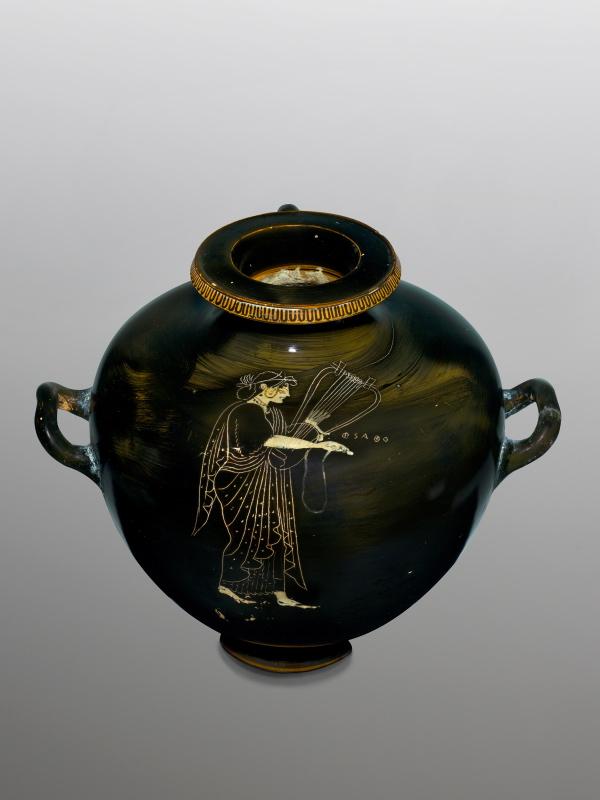
The lyric poet of Lesbos who wrote about desire, longing, and beauty with an intimacy that time has mostly destroyed — yet what survives is enough to secure her reputation as one of antiquity's greatest voices.
Sappho of Lesbos was the most celebrated lyric poet of antiquity — called "the Tenth Muse" by Plato and "The Poetess" by ancient critics who needed no further identification. She wrote in a first-person voice of startling directness about desire, longing, and the beauty of young women. Most of her work is lost; the fragments that survive are among the most affecting poems in any language.
Life and context
Almost nothing about Sappho's biography is verifiable. Ancient sources place her birth on the island of Lesbos — either at Eresos or Mytilene — sometime around 630 BC, with death estimated around 570 BC. She was apparently associated with a circle of young women to whom she wrote many of her poems, and ancient commentators understood these poems as expressions of erotic and emotional attachment. She was exiled to Sicily at some point, possibly for political reasons; she may have had a daughter named Kleis; she had brothers. These details come from ancient notices of varying reliability.
Ancient critics ranked her without hesitation among the greatest poets. Horace, Catullus, and other Latin poets studied and adapted her metres. The stanza form she used — four lines with a specific metrical pattern — bears her name: the Sapphic stanza.
The fragments
Of the approximately nine books of poetry attributed to Sappho by Alexandrian scholars, only fragments survive, preserved in quotations by later writers who cited her to illustrate metrical or grammatical points, and in damaged papyrus finds. The Ode to Aphrodite is generally regarded as the only complete poem; it is a prayer to Aphrodite asking for help in love, ending with the goddess's promise to assist.
Other substantial fragments include a meditation on old age and the beauty that memory preserves, and a poem describing the physical symptoms of passionate desire — racing heart, burning skin, the failure of voice — that remains one of the most precise accounts of erotic experience in literature.
My tongue breaks and fire races under my skin, my eyes can see nothing, my ears are full of humming, sweat pours down me, I tremble all over.
Note: Fragment 31 is authentic; translations vary widely. The above follows the general sense of multiple scholarly translations rather than a specific one.
Reception and reconstruction
The history of Sappho's reception is also a history of destruction and recovery. The Church destroyed much ancient literature; what remains of Sappho comes largely from ancient quotations preserved in texts about metre, rhetoric, and criticism. New papyrus finds in the 20th and 21st centuries have added fragments — the Tithonus poem was substantially recovered in 2004 from a Cologne papyrus.
Her name and island gave English the word "Sapphic" and became culturally loaded in ways that have sometimes distorted discussion of her work. Modern classical scholarship tends to read the poems as grounded in the social practices of archaic Greek lyric — performed at specific occasions, within specific institutions — rather than projecting modern categories onto them.
Legacy
Sappho's influence on lyric poetry — on Catullus, Horace, and through them on the entire European tradition of love poetry — is pervasive and structural. The directness of her first-person voice, the precision of her emotional observation, and the Sapphic stanza form she developed have been absorbed into the tradition so thoroughly that they feel natural rather than inherited. She is a starting point for lyric as a mode.