Satyajit Ray
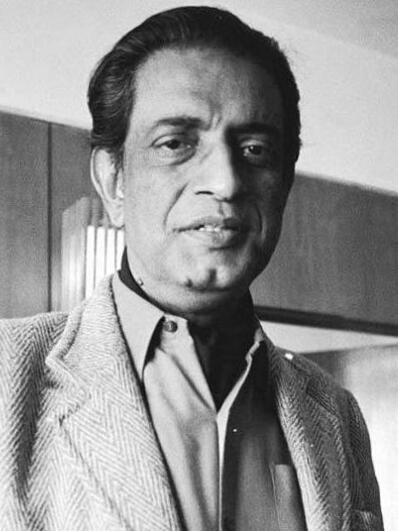
An Indian filmmaker who brought the textures of Bengali life to a world audience, working equally as director, writer, composer, and designer of his own singular cinema.
Satyajit Ray was a filmmaker who worked as though the whole apparatus of cinema were a single instrument in his hands. Across a career that began with Pather Panchali in 1955, he directed, wrote, and — from the 1960s — composed the scores for his films, while also designing their titles and publicity. Born into a distinguished Bengali family of writers and artists, he became the figure through whom much of the world first encountered Indian cinema.
A Bengali inheritance
Ray was born in Calcutta into a family already central to Bengali culture. His grandfather, Upendrakishore Ray Chowdhury, was a writer, illustrator, and printing pioneer; his father, Sukumar Ray, was celebrated for his nonsense verse and children's literature. That inheritance shaped Ray's lifelong movement between word and image. He studied at Presidency College in Calcutta before moving to Visva-Bharati University at Santiniketan, the institution founded by Rabindranath Tagore, where he was exposed to the arts in a setting deliberately removed from the commercial mainstream.
Leaving Santiniketan, Ray worked as a commercial and graphic artist and as a book illustrator, a trade that trained the strong compositional sense visible throughout his films. Two encounters proved decisive. When the director Jean Renoir came to Calcutta to shoot The River, Ray sought him out and discussed his ambitions; and on a stay in London he saw Vittorio De Sica's Bicycle Thieves, whose neorealist economy convinced him that a film of everyday Bengali life could be made without studios or stars.
The Apu Trilogy and international recognition
Ray's debut, Pather Panchali (1955), was the first film of what became the Apu Trilogy, following a boy named Apu from rural childhood into adulthood. Made under difficult conditions with a largely inexperienced crew, it won a prize at Cannes and announced a major new voice. He completed the trilogy with Aparajito (1956), which won the Golden Lion at Venice, and Apur Sansar (1959).
The films that followed confirmed his range. Jalsaghar (The Music Room, 1958) traced the decline of a feudal aristocrat through his obsession with musical soirées; Charulata (1964), adapted from Tagore, is often cited as his most refined study of an inner life. In 1977 he made Shatranj Ke Khilari (The Chess Players), his Hindi-language feature. From the early 1960s onward he composed his own film scores, drawing on both Indian classical music and Western forms.
Writer, editor, and the wider work
Ray's authorship extended well beyond the screen. He created two enduring series of fiction: the Feluda detective stories and the Professor Shonku science-fiction tales, both written for a broad readership and rooted in Bengali settings. He also edited Sandesh, the children's magazine his grandfather had founded, sustaining a family tradition of writing and illustration for young readers. These pursuits were not incidental to his cinema but part of the same integrated practice, in which drawing, storytelling, and music continually informed one another.
Late honours
Recognition accumulated across four decades of work. In 1992, shortly before his death, Ray received an Honorary Academy Award for his contribution to cinema. The same year he was awarded the Bharat Ratna, India's highest civilian honour. He died on 23 April 1992, having built a body of work that remains a reference point for the argument that a national cinema can be at once wholly local and fully universal.
He made films the way a novelist writes — controlling every register at once, so that a single frame could carry the weight of a whole world.