Saul Leiter
The painter-photographer who made colour an instrument of atmosphere rather than information, and spent decades perfecting an art the world took time to find.
Saul Leiter photographed New York in colour when colour photography was considered commercial and photography itself was considered minor. He kept working quietly for decades, accepted obscurity without complaint, and was rediscovered in his eighties as one of the founding figures of the colour photograph as an art form.
Pittsburgh and New York
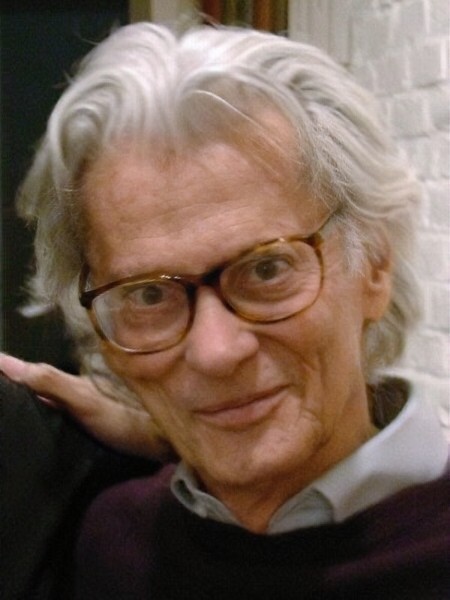
Leiter was born in Pittsburgh in 1923, the son of a Talmudic scholar who expected him to pursue rabbinic studies. In 1946, at twenty-three, he left Pittsburgh for New York — a decisive break with both the religious path and the city of his origins. He had begun painting and found himself drawn to the painters he encountered in New York; a friendship with Richard Pousette-Dart deepened his engagement with abstract expressionism and with the idea that a painted surface could hold ambiguity rather than resolve it.
He began photographing, first in black and white and then, remarkably early, in colour — acquiring colour transparency film in the late 1940s when most photographers considered it too unpredictable for serious work. His early colour photographs of East Village streets, rain-blurred windows, and figures seen through glass and neon are among the earliest examples of colour used as a painterly instrument in street photography.
The New York school and fashion work
Leiter's circle in the early 1950s included Richard Avedon, Robert Frank, and others who would define American photography's postwar character, though Leiter's own work was quieter and less celebrated. He photographed without a programme — the city simply provided an endless supply of surfaces: wet pavement, steamed windows, umbrellas, signs seen through fog — and he organised these surfaces into images of unusual tonal complexity.
To support his photography and painting he worked as a commercial fashion photographer, shooting for Harper's Bazaar and Esquire from the 1950s onward. The fashion work was widely admired but kept him in a professional category that obscured his photographic art.
I have a great weakness for the beauty of the world. Perhaps that comes through in my pictures.
Rediscovery and late recognition
By the 1990s Leiter had largely withdrawn from professional life and was living with his archive of thousands of colour transparencies and black-and-white negatives in his East Village apartment. A 2006 retrospective in Hamburg, organised by Steidl, brought his early colour work to wide attention for the first time. The accompanying book Early Color — published by Steidl — revealed fifty years of photographs that had never been properly seen.
He was the subject of a documentary film, In No Great Hurry: 13 Lessons in Life with Saul Leiter (2012), filmed shortly before his death. He died in New York in November 2013, aged eighty-nine.