Sergei Eisenstein
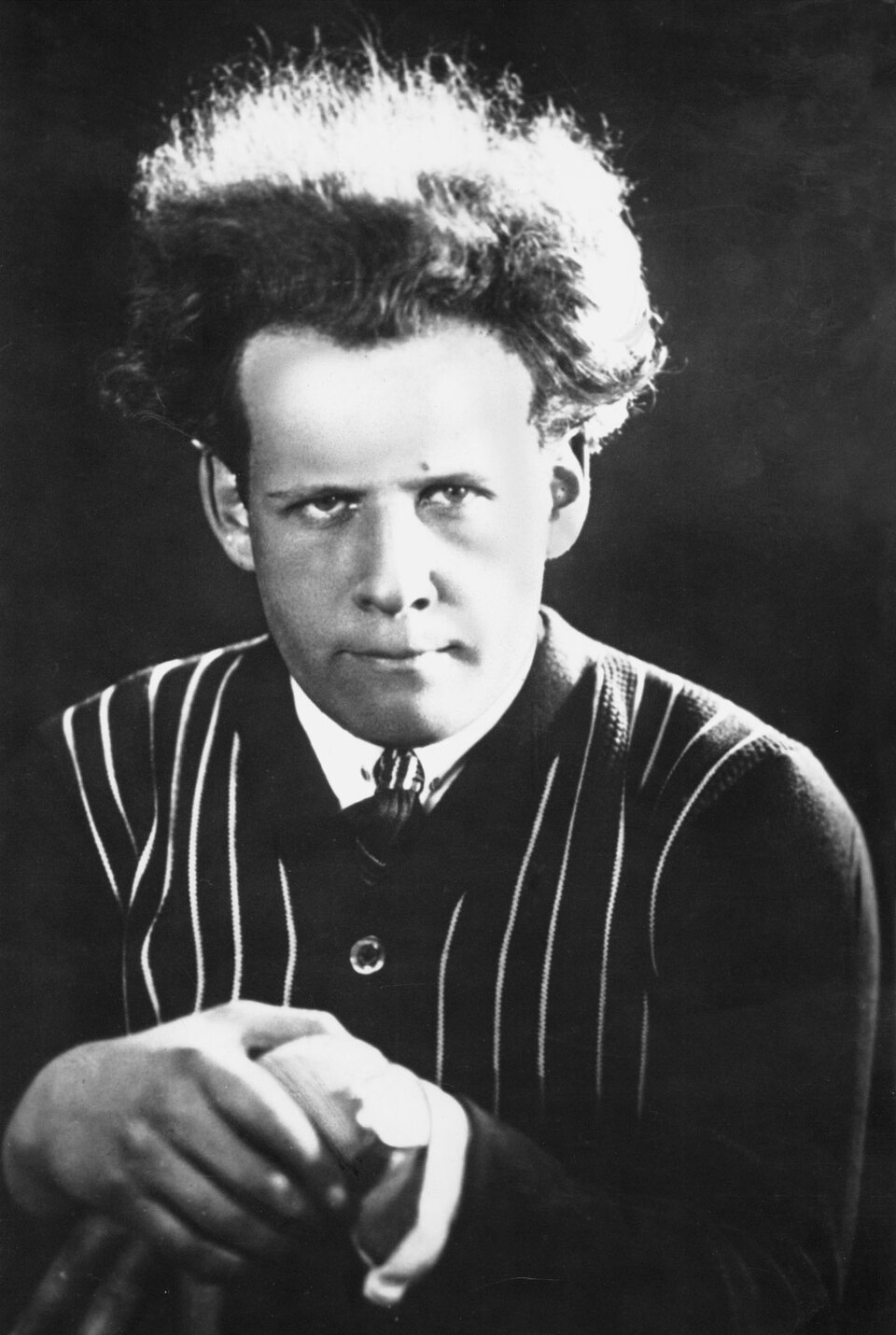
A Soviet director and theorist who argued that cinema's meaning arises not from the shot but from the collision between shots — and built the grammar of montage that the century's filmmakers would inherit.
Sergei Eisenstein made only a handful of finished films, but each one reorganised how the medium was understood. He treated editing not as a way of joining scenes but as the essential engine of cinematic thought, and paired that practice with a body of theory dense enough to be taught for generations after his death. His career traced the full arc of early Soviet cinema — from revolutionary experiment to state-mandated historical epic — and the pressures of that arc are legible in nearly everything he made.
From engineering to montage
Eisenstein was born in Riga, then part of the Russian Empire, in 1898. He trained first as an engineer and architect, a background that shaped his lifelong appetite for structure, system, and diagram before he turned to the theatre and then to film. Out of that theatrical and constructivist milieu came his central idea: montage, the theory that the meaning of a film is produced by the collision of shots rather than their smooth succession. Where others cut to preserve continuity, Eisenstein cut to generate conflict — juxtaposing images so that a third meaning, present in neither shot alone, emerged in the viewer's mind. He gave this method several names over his career, most influentially dialectical or intellectual montage, framing it as a cinematic analogue to dialectical reasoning.
Potemkin and the revolutionary films
His first feature, Strike (1925), applied these principles to a story of industrial labour and its violent suppression. The same year brought Battleship Potemkin (1925), a dramatisation of the 1905 naval mutiny that remains among the most studied films ever made. Its Odessa Steps sequence — in which soldiers advance on fleeing civilians in a relentless downward march — became the most cited demonstration of montage in the history of cinema, its rhythmic, fragmented cutting endlessly imitated and referenced. Three years later came October: Ten Days That Shook the World (1928), commissioned to mark the tenth anniversary of the Bolshevik revolution and pushing his intellectual montage toward its most experimental extreme.
Hollywood, Mexico, and the return
At the end of the decade Eisenstein travelled west. He reached Hollywood in 1930, but the projects he developed there collapsed without a film being made. He then began an ambitious independent work in Mexico, ¡Que viva México!, which was left unfinished when funding and support fell away; the footage would be assembled by others long after. He returned to the Soviet Union, where the cultural climate had hardened around the doctrine of socialist realism and the demands of Stalin's state.
Historical epics and the final reckoning
Eisenstein's later films turned to grand historical subjects. Alexander Nevsky (1938) reimagined a medieval Russian victory over invading knights, its famous battle scenes scored by Sergei Prokofiev in one of cinema's landmark collaborations between director and composer. He then embarked on Ivan the Terrible, conceived as a multi-part epic. Part I (1944) earned him the Stalin Prize; Part II, completed in 1946, was banned by Stalin — who read its portrait of a tyrant too clearly — and not released until 1958, a decade after the director's death. Alongside the films, Eisenstein produced influential theoretical writings, later collected in English as Film Form and The Film Sense, which secured his standing as much as a thinker of cinema as a maker of it. He died of a heart attack in Moscow in 1948, aged 50.
Two film pieces of any kind, placed together, inevitably combine into a new concept, a new quality, arising out of that juxtaposition.