Simone de Beauvoir
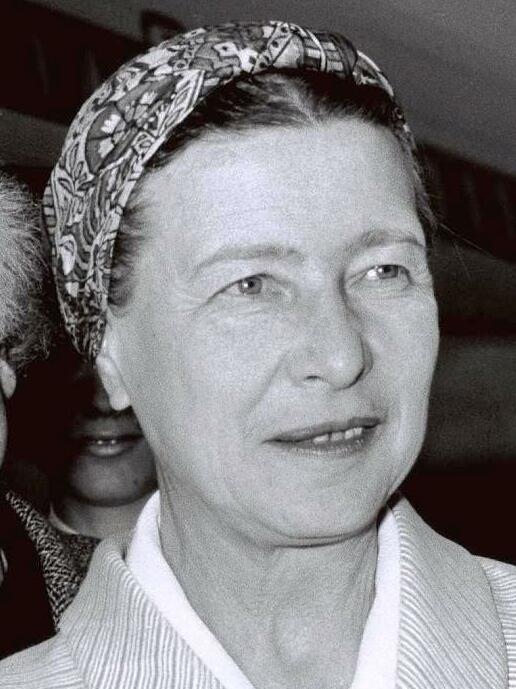
The philosopher who grounded feminism in existentialist thought and established that womanhood is a condition imposed by history, not a fact of nature.
Simone de Beauvoir stands as the founding theorist of second-wave feminism and one of the defining voices of twentieth-century existentialist philosophy. Her 1949 work The Second Sex — a systematic investigation of how women are constructed as "the Other" by culture, history, and language — remains the most widely read and debated work in feminist philosophy. She was simultaneously a major novelist, memoirist, and public intellectual.
Formation in the Grandes Écoles
Born in Paris to a bourgeois Catholic family, de Beauvoir was educated at the Cours Désir and later at the Institut Catholique and the Institut Sainte-Marie. She read mathematics and literature before turning to philosophy at the Sorbonne, where she studied alongside Maurice Merleau-Ponty, Claude Lévi-Strauss, and Jean-Paul Sartre. In 1929 she passed the agrégation in philosophy — the demanding state examination — ranking second in France; Sartre ranked first. She was, at twenty-one, the youngest person to pass the exam.
Her relationship with Sartre, which began in the same year, became one of the most discussed intellectual partnerships of the century. They rejected conventional marriage while maintaining a lifelong philosophical and personal bond, each pursuing other relationships alongside their own.
The Second Sex and the Argument That Changed Everything
Published in 1949, Le Deuxième Sexe opens with one of philosophy's most quoted formulations: that "one is not born, but rather becomes, a woman." The line encapsulates de Beauvoir's central claim — that femininity is not a biological destiny but a social and historical construction, imposed on women through myth, law, labour, and language.1
The work spans anthropology, psychoanalysis, Marxism, and existentialism, examining how women have been systematically defined in relation to men — as the Other to man's Subject. The analysis moved across history, biology, lived experience, and literary representation. Translated into English by H.M. Parshley in 1953, it became the theoretical backbone of feminist movements in the 1960s and 1970s, though subsequent scholars noted that the translation shortened and occasionally distorted her arguments.
Novelist and Memoirist
De Beauvoir was also a major literary figure. Her novel The Mandarins (1954), which fictionalised the postwar Parisian intellectual milieu, won the Prix Goncourt. Her four-volume autobiography — beginning with Memoirs of a Dutiful Daughter (1958) and ending with All Said and Done (1972) — is a sustained record of intellectual self-formation and one of the great memoirs in the French tradition.
| Work | Type | Year |
|---|---|---|
| She Came to Stay | Novel | 1943 |
| The Second Sex | Philosophy | 1949 |
| The Mandarins | Novel | 1954 |
| Memoirs of a Dutiful Daughter | Memoir | 1958 |
| A Very Easy Death | Memoir | 1964 |
Legacy
De Beauvoir lived long enough to see the feminist movements she had helped theorise take institutional form. She signed the "Manifesto of the 343" in 1971, publicly declaring she had had an abortion — an act of deliberate political exposure in France where abortion remained illegal. She participated in the founding of the journal Questions féministes in 1977.
Her insistence that liberation is never a private achievement but always entails changing the structural conditions under which others live remains a touchstone for feminist philosophy, queer theory, and existentialist ethics alike.
One is not born, but rather becomes, a woman.
Footnotes
- The original French reads: "On ne naît pas femme, on le devient." The Parshley translation, long the standard English edition, was substantially revised by Constance Borde and Sheila Malovany-Chevallier in 2010. ↩