Socrates
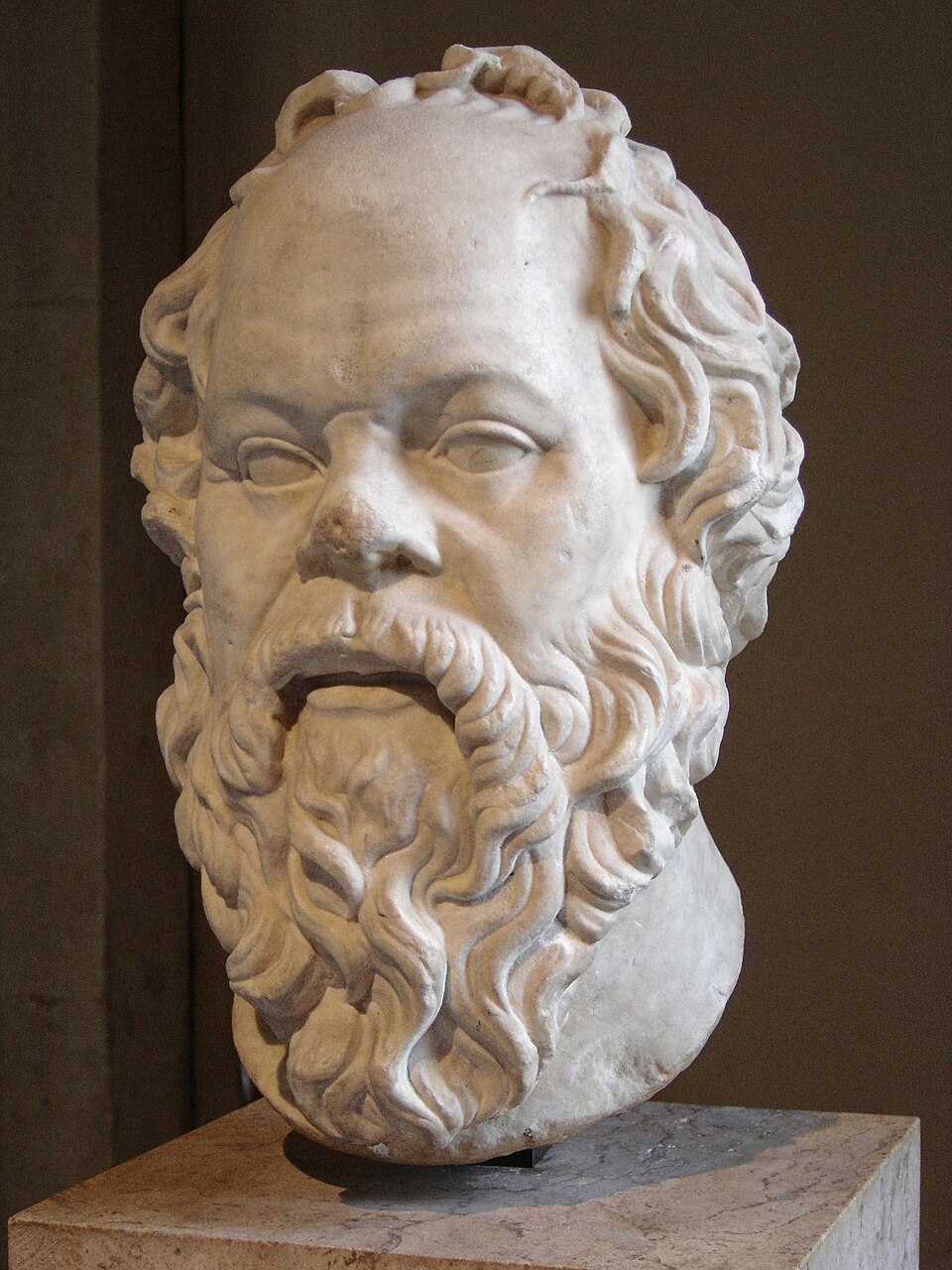
The philosopher who wrote nothing, questioned everything, and died for it — leaving only the words his students put in his mouth.
Socrates left no writings. Everything known about him comes from the accounts of others — above all his student Plato, whose dialogues cast Socrates as the central interlocutor, and Xenophon, whose more prosaic memoirs offer a different figure. The gap between these accounts, and the impossibility of reaching the historical Socrates through them, is known as the Socratic problem. What is certain is that he was tried by an Athenian jury in 399 BC on charges of impiety and corrupting the youth, found guilty, and put to death by hemlock. The Western philosophical tradition largely begins with the question of what he was actually teaching.
Life in Athens
Socrates was born around 470 BC in Alopeke, a deme of Athens, to a stonemason named Sophroniscus and a midwife named Phaenarete. He served as a hoplite in the Athenian army during the Peloponnesian War — he fought at Potidaea, Delium, and Amphipolis, reportedly with conspicuous courage and endurance. He was married to Xanthippe, with whom he had three children.
He spent his adult life in the public spaces of Athens — the agora, the gymnasia, the workshops — engaging citizens, politicians, craftsmen, and sophists in conversation. He took no fee for these discussions and claimed to have no knowledge of his own, only the capacity to expose the ignorance concealed within others' claims to knowledge. He was in his mid-sixties at the time of his trial.
The method
Socratic inquiry — as represented in Plato's early dialogues — follows a consistent pattern: Socrates encounters someone who claims expertise in some virtue (courage, piety, justice), invites a definition, and then through questioning shows that the definition is inadequate or internally contradictory. The outcome is typically aporia — a state of productive confusion, in which the interlocutor recognises that they do not know what they thought they knew.
This method — elenchus — has been called the first systematic use of dialectic in Western thought. It assumes that knowledge cannot be transmitted directly but must be elicited from within. Socrates compared himself to his mother the midwife: he delivered ideas already present in the minds of his interlocutors rather than inserting his own.
The trial and death
In 399 BC, Socrates was indicted by Meletus, Anytus, and Lycon on charges of failing to acknowledge the gods the city acknowledged and of corrupting the youth. The trial is described in Plato's Apology. Socrates declined to mount a conventional defence, arguing instead that his philosophical activity was a service to Athens mandated by the oracle at Delphi, and refusing to propose exile as an alternative penalty. He was sentenced to death by a jury of five hundred men.
In Plato's Phaedo, Socrates' final hours are spent in philosophical discussion about the immortality of the soul. He drinks the hemlock willingly, in composure. The scene has been one of the most frequently represented events in Western cultural history.
The unexamined life is not worth living.
Legacy
Plato built his entire philosophical system on the dialogue form that featured Socrates, though in the later dialogues Socrates increasingly becomes a mouthpiece for positions that are probably Plato's own rather than his teacher's. The Socratic dialogue became a distinct literary and philosophical genre. His commitment to following an argument wherever it led, regardless of social consequences, established a model of intellectual integrity that philosophers have returned to for two and a half millennia. The Stoics, the Cynics, the Sceptics, and many others all claimed descent from his example.