Srinivasa Ramanujan
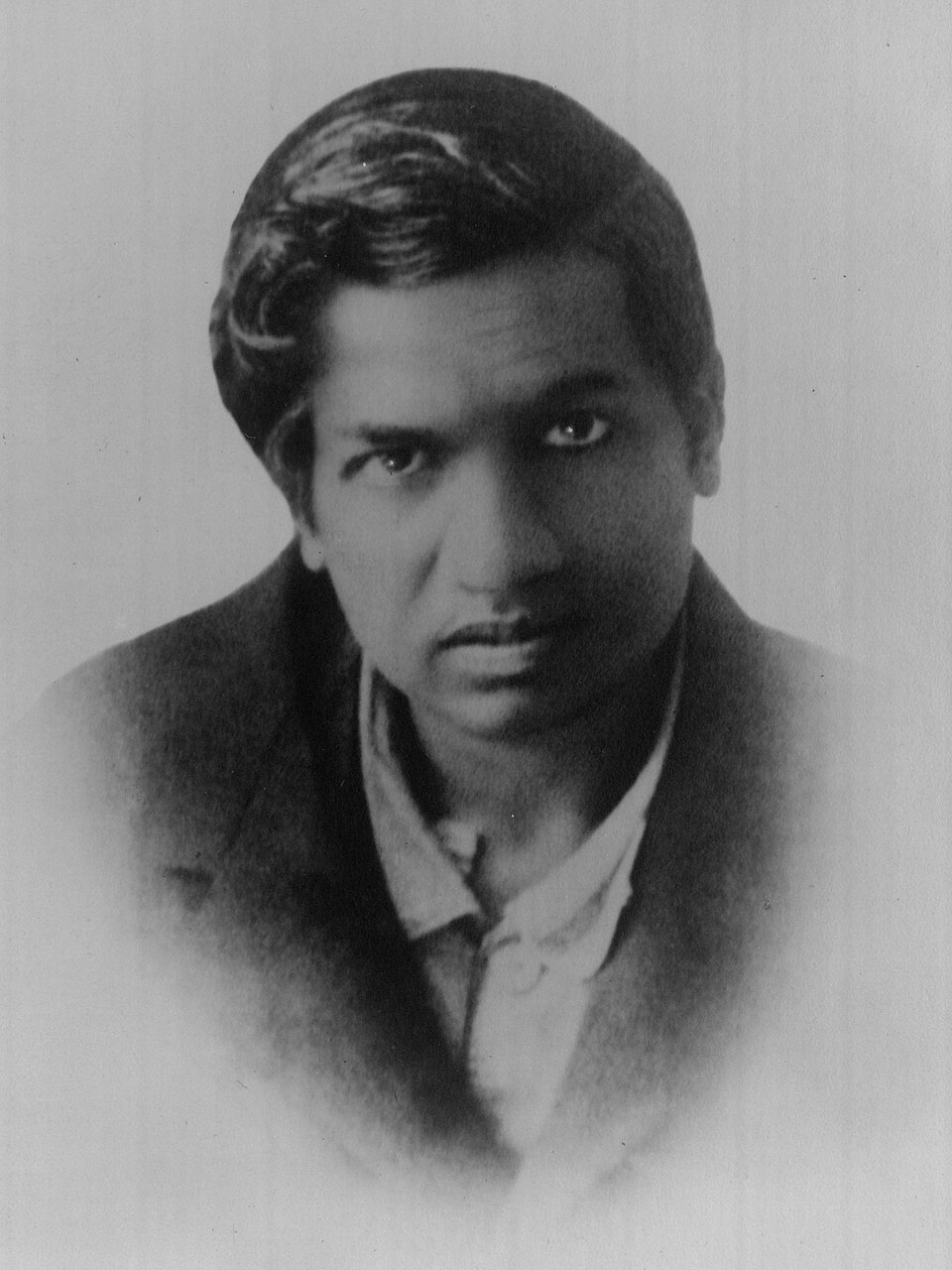
The self-taught clerk from Tamil Nadu who, with almost no formal training, produced results in number theory and infinite series that left the most rigorous Cambridge mathematicians struggling to keep up.
Srinivasa Ramanujan arrived at Cambridge in 1914 with two notebooks full of theorems — most unproved, some incorrect, and many of a depth that professional mathematicians had not imagined possible from someone working in near isolation at a colonial port authority. By the time he died at thirty-two, he had reshaped the landscape of analytic number theory and left behind a third notebook of results whose implications are still being worked out a century later.
Erode and Madras
Ramanujan was born on 22 December 1887 in Erode, in the Madras Presidency, and grew up in Kumbakonam. His mathematical gift was evident early: he mastered available textbooks by his early teens and began filling notebooks with original results. He twice failed his Fine Arts examination at Government College, Kumbakonam — he neglected every subject but mathematics — and for a period had no academic affiliation at all. Working as a clerk at the Madras Port Trust from 1912, he continued his private investigations and began writing to British mathematicians, largely without response. The letter he sent to G. H. Hardy at Trinity College, Cambridge, in January 1913, enclosed around 120 theorems. Hardy, examining the results with J. E. Littlewood, concluded that they could only have come from a mathematician of the first rank.
Cambridge and the Hardy Collaboration
Hardy arranged a scholarship and passage; Ramanujan reached Cambridge in April 1914. The collaboration with Hardy was one of the most productive partnerships in mathematical history. Together they developed the Hardy–Ramanujan asymptotic formula for the number of partitions of an integer — a result of extraordinary precision that introduced the circle method, a technique that became a cornerstone of analytic number theory. Their 1918 paper "Asymptotic formulae in combinatory analysis" remains a landmark of the field. Ramanujan was elected Fellow of the Royal Society and Fellow of Trinity College in 1918, the first Indian to hold either distinction.
Method and Intuition
Ramanujan worked in a manner that confounded his contemporaries. He produced results with minimal formal proof, guided by an intuition for the deep structure of numbers that Hardy described as unparalleled in his experience. His identities involving infinite series, continued fractions, and hypergeometric functions often could not be verified for years after he stated them. His three notebooks — the first compiled before he left India, the third discovered posthumously in the Wren Library in 1976 — continue to generate research. The so-called mock theta functions he introduced in a letter to Hardy months before his death were not properly understood until Sander Zwegers provided a theoretical framework in 2002.
The Hardy–Ramanujan number, 1729, entered mathematical legend when Hardy arrived at a nursing home in a taxi bearing that number and Ramanujan immediately noted it as the smallest integer expressible as the sum of two cubes in two distinct ways — a remark Hardy later described as typifying Ramanujan's instinctive familiarity with numbers.
Legacy
Ramanujan returned to India in 1919, his health broken by tuberculosis, and died at Kumbakonam on 26 April 1920. He was thirty-two. The work he left behind has been productive far beyond what its volume suggests: his notebooks have generated hundreds of research papers, and his ideas connect to areas — modular forms, string theory, black hole physics — that lay entirely outside his horizon. The annual Ramanujan Prize is awarded by the International Centre for Theoretical Sciences; 22 December is observed as National Mathematics Day in India.
I have never met his equal, and can compare him only with Euler or Jacobi.