Stanley Kubrick
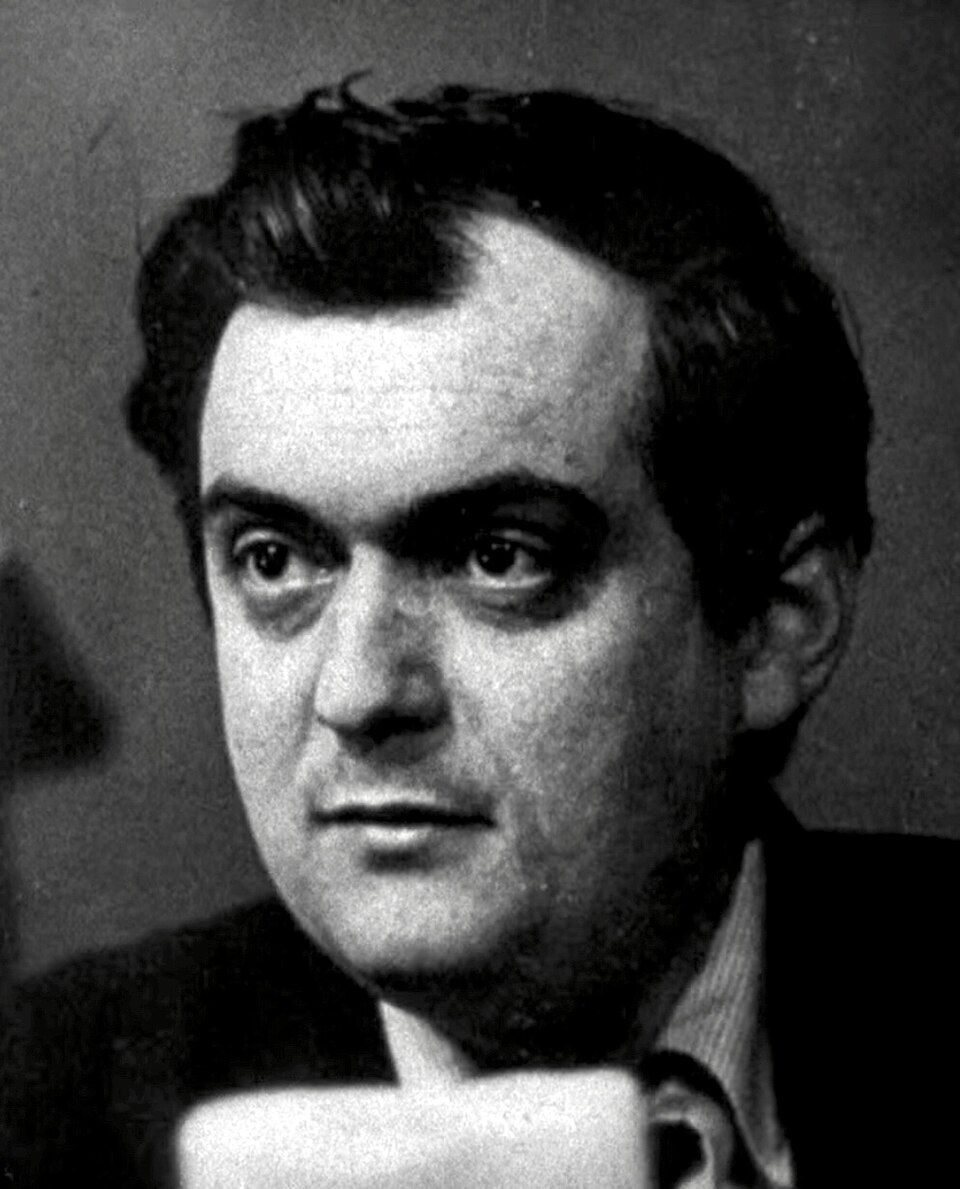
A self-taught perfectionist who remade cinema's grammar one obsessive frame at a time, leaving behind a body of work that no single genre can contain.
Stanley Kubrick began his career as a photojournalist for Look magazine before turning to film, bringing a documentarian's precision and a visual artist's eye to Hollywood narrative. Over four decades he directed thirteen feature films — none of them alike in genre, all of them unmistakable in authorial voice.
From the Bronx to the cutting room
Kubrick showed little academic interest at DeWitt Clinton High School but was a prodigious chess player and self-taught photographer. By seventeen he was selling photographs to Look. The discipline of composition absorbed in those early years never left him: every frame of his films reads as a considered still image. He made his first two low-budget features, Fear and Desire (1953) and Killer's Kiss (1955), independently, financing them through chess winnings and small loans. The Killing (1956) brought him studio attention, and Paths of Glory (1957), a devastating anti-war film starring Kirk Douglas, established his reputation internationally.
The defining work
The run of films Kubrick produced between 1960 and 1999 spans a breadth unusual even among major directors. Spartacus (1960) was the one film on which he was a hired hand; every subsequent project was initiated and controlled by Kubrick himself. Dr. Strangelove or: How I Learned to Stop Worrying and Love the Bomb (1964) turned nuclear annihilation into savage farce. 2001: A Space Odyssey (1968) rewrote what science-fiction cinema could aspire to, dispensing with conventional dialogue for long passages and ending in a sequence that defeated summary. A Clockwork Orange (1971), The Shining (1980), and Full Metal Jacket (1987) cemented a reputation for films that disturb as much as they impress.
| Film | Year | Genre |
|---|---|---|
| Dr. Strangelove | 1964 | Satire |
| 2001: A Space Odyssey | 1968 | Science fiction |
| Barry Lyndon | 1975 | Historical drama |
| The Shining | 1980 | Horror |
| Full Metal Jacket | 1987 | War |
Method and obsession
Kubrick relocated to England in 1968 and rarely left thereafter, recreating Vietnam jungles in Hertfordshire and eighteenth-century Ireland on the Curragh. He was notorious for demanding dozens — sometimes hundreds — of takes per shot, a working method that exhausted actors and crew but produced performances of unusual precision.1 He frequently used a wide-angle lens and the Steadicam, then new technology, for fluid tracking shots that have since become ubiquitous. His use of pre-existing music rather than original scores — Also sprach Zarathustra, Bartók string quartets, the Shining's Wendy Carlos synthesiser work — was consistently inventive.
Legacy
Kubrick died of a heart attack six days after delivering the final cut of Eyes Wide Shut (1999) to Warner Bros. His influence on subsequent directors is pervasive — evident in Paul Thomas Anderson's long takes, the visual ambition of Alfonso Cuarón, the genre-crossing of Christopher Nolan, and the controlled darkness of David Fincher. Film schools still analyse the one-point-perspective corridor shots in The Shining and the match-cut from bone to spacecraft in 2001 as canonical examples of cinematic language at its most economical.
I never learned anything from a movie that made a profit.
Footnotes
- The record is contested; Shelley Duvall reportedly completed over 100 takes of certain scenes during The Shining. ↩