Thomas Hardy
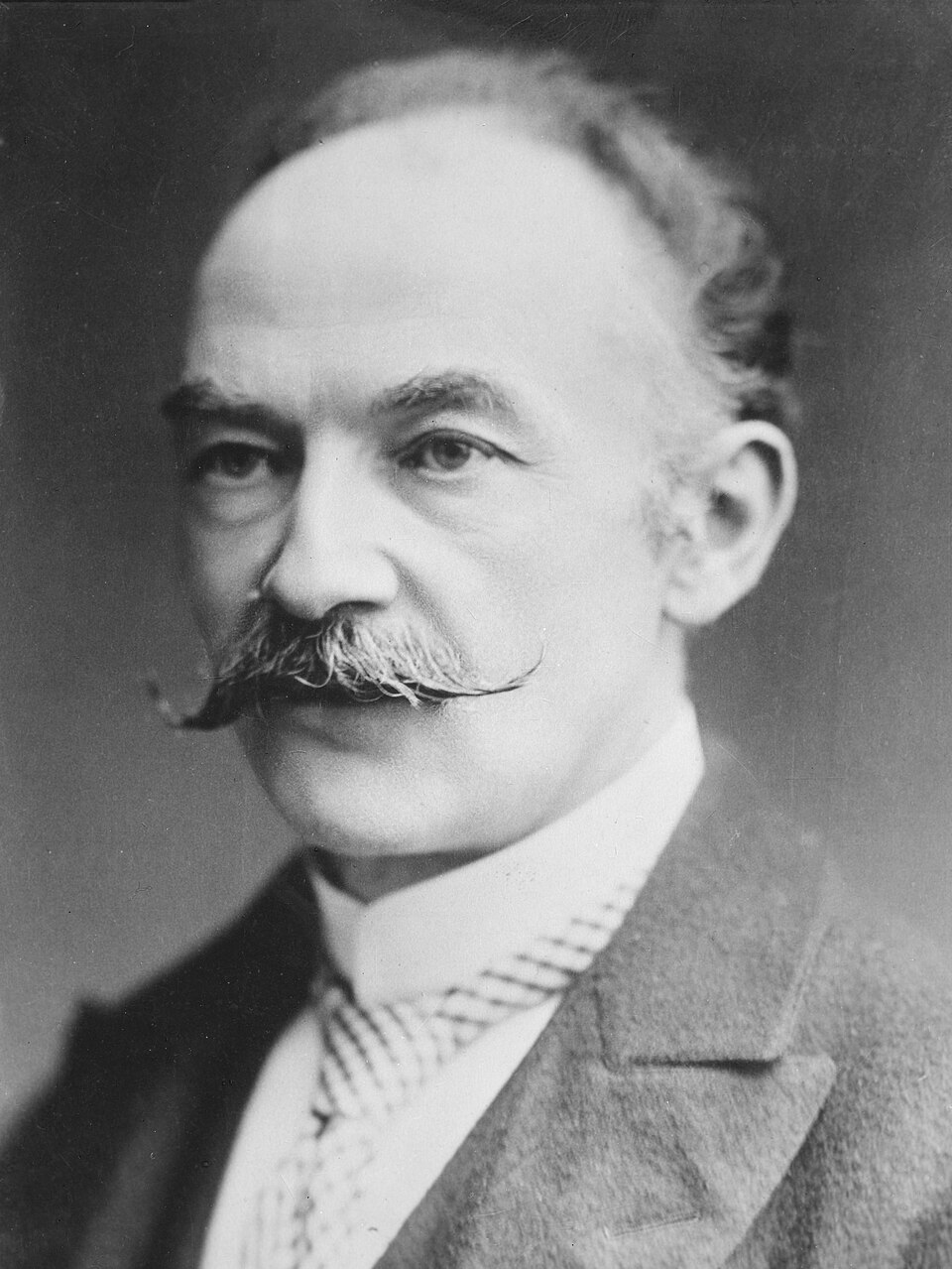
The Dorset novelist and poet who mapped a vanishing rural England with the precision of an architect and the grief of an elegist.
Thomas Hardy trained as an architect, drew plans for church restorations, and then wrote fifteen novels over twenty-five years before the public's reaction to Jude the Obscure persuaded him to stop. He spent the last thirty years of his life writing poetry. Both halves of the career are canonical.
The architect and the novel
Hardy grew up in Higher Bockhampton, a hamlet outside Dorchester, the son of a master mason. He was apprenticed to a local architect at sixteen and worked in London for Arthur Blomfield in the 1860s, measuring and restoring medieval churches. He submitted poems to magazines and was rejected; he turned to fiction as a more viable form and never entirely forgave it.
The Dorset landscape — the heath, the chalk downlands, the decaying agricultural villages losing population to the cities — became Wessex, a fictional county that used real place names and real geography. Hardy mapped it with the exactness of a surveyor and the fatalism of someone who had watched a way of life end within a single generation.1
Far from the Madding Crowd to Tess
Far from the Madding Crowd (1874), serialised in the Cornhill Magazine, made his reputation. It was followed by a sequence of novels that examined the same region's social fabric under increasing pressure: The Return of the Native (1878), The Mayor of Casterbridge (1886), and Tess of the d'Urbervilles (1891), in which a woman's moral worth is asserted against the society that destroys her, with a directness that made comfortable readers uncomfortable.
The President of the Immortals, in Aeschylean phrase, had ended his sport with Tess.
Jude and the turn to poetry
Jude the Obscure (1895) was denounced from the pulpit, burned by at least one bishop, and received with sufficient hostility that Hardy described the experience as nearly killing his interest in novel-writing. The attacks were on its treatment of marriage, religion, and class. He published no more novels.
Wessex Poems appeared in 1898 — Hardy was fifty-eight, regarded as primarily a novelist, releasing poetry that had been accumulating for decades. The Dynasts (1904–1908), a vast verse drama about the Napoleonic Wars in three parts and nineteen acts, followed. The lyric poetry that came after his first wife Emma's death in 1912 — collected in Poems of 1912–13 — is now considered among the finest English elegiac verse.
Late life and burial
Hardy was awarded the Order of Merit in 1910, received honorary degrees from Oxford and Cambridge, and was visited at Max Gate, his Dorchester house, by writers including Siegfried Sassoon and T. E. Lawrence. He died in January 1928. His heart was removed and buried at Stinsford church, next to Emma; his ashes went to Westminster Abbey's Poets' Corner.
Footnotes
- Hardy's Wessex maps directly to the historic Kingdom of Wessex. He attached a map to later editions of his novels; readers could, and did, use it as a guide to the actual Dorset landscape. ↩