Thomas Mann
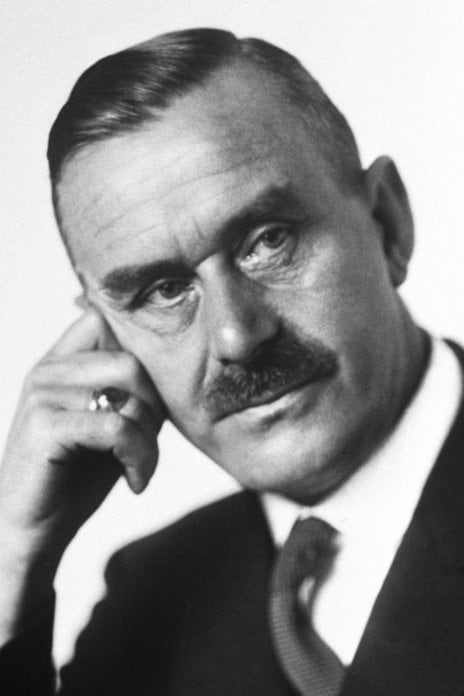
Mann turned the German bourgeois novel into an instrument of moral and psychological precision, chronicling the decay of dynasties and the temptations of the artist with an irony so controlled it reads, even now, like the steadiest voice in a room losing its mind.
Thomas Mann was a German novelist and essayist whose career stretched from the Wilhelmine empire through two world wars and into the Cold War years he spent in American exile. His fiction — dense, ironic, and deeply literary — explored the entanglement of art, disease, and decline in the European bourgeoisie, earning him the Nobel Prize in Literature in 1929 and a permanent place in the canon of world prose.
Lübeck and the formation of a sensibility
Paul Thomas Mann was born in Lübeck on 6 June 1875, the second son of a prosperous grain merchant and senator. The family embodied the Hanseatic merchant class — civic, Protestant, commercially serious — that Mann would spend much of his life examining. His father died in 1891; the family firm was wound down and his mother moved to Munich, where Thomas and his elder brother Heinrich — later himself a major novelist — followed.
Mann briefly worked for an insurance company and attended lectures at the Munich Polytechnic before devoting himself entirely to writing. He spent time in Rome with Heinrich, and it was there that he began the novel that would make his name.
Buddenbrooks and early recognition
Buddenbrooks: Verfall einer Familie (Buddenbrooks: The Decline of a Family) was published in 1901, when Mann was twenty-six. The novel traces four generations of a Lübeck merchant dynasty from commercial confidence to artistic incapacity and extinction — a Schopenhauerian parable dressed as social realism. It was long, exact, and immediately successful; within a decade it had sold hundreds of thousands of copies. When the Nobel Committee awarded Mann the 1929 prize, they cited Buddenbrooks specifically, by then already a classic.
The decade following Buddenbrooks produced the novella Tonio Kröger (1903), a crystalline study of the artist caught between bourgeois belonging and aesthetic isolation, and Königliche Hoheit (Royal Highness, 1909). Then, in 1912, came Der Tod in Venedig (Death in Venice), the novella in which an ageing writer pursues an unobtainable ideal of beauty through a cholera-stricken city until it destroys him. It is among the most formally perfect things Mann ever wrote.
The Magic Mountain and the inter-war years
Mann spent much of the 1910s writing Betrachtungen eines Unpolitischen (Reflections of a Nonpolitical Man, 1918), a lengthy defence of German cultural conservatism against his brother Heinrich's liberal Francophilia. The book embarrassed him later; he repudiated its politics as Weimar democracy took hold.
Der Zauberberg (The Magic Mountain), published in 1924, became the defining German novel of its era. Set in a tuberculosis sanatorium in the Swiss Alps before and during the First World War, it trapped a young Hamburg engineer among representatives of every European ideological tendency — positivist rationalism, Jesuit reaction, romantic nihilism — and let them argue themselves toward catastrophe. The seven-year writing project, interrupted by the war, resulted in a book of roughly a thousand pages that rewrote the possibilities of the European realist novel.
Exile and the American years
Hitler's accession to power in January 1933 caught Mann abroad on a lecture tour. Warned not to return, he settled first in Switzerland, then in France, then in the United States, where he arrived in 1938. He became an American citizen in 1944. He settled in Pacific Palisades, California, where the émigré community included Bertolt Brecht, Lion Feuchtwanger, and Arnold Schoenberg.
In American exile Mann completed the four-volume Joseph und seine Brüder (Joseph and His Brothers, 1933–1943), a retelling of the biblical Joseph story as a myth of civilization and human self-consciousness. He also delivered regular anti-Nazi radio broadcasts to Germany via the BBC. In 1947 he published Doktor Faustus, his most ambitious late work: a fictional biography of a composer who makes a pact with the devil, read widely as an allegory for Germany's capitulation to National Socialism.
Final years and legacy
Mann returned to Europe in 1952, settling in Kilchberg near Zurich. He died there on 12 August 1955, of arteriosclerosis, at the age of eighty. His diaries, unpublished in his lifetime, were released after the deaths of their named executors and revealed, among other things, a lifelong tension around same-sex desire that had been sublimated throughout his fiction — most obviously in Death in Venice and The Magic Mountain.
His influence on the twentieth-century novel is substantial: Günter Grass, John Irving, and Salman Rushdie have all cited him; his essays on Nietzsche, Freud, and Goethe remain important critical documents.
A writer is someone for whom writing is more difficult than it is for other people.