T. S. Eliot
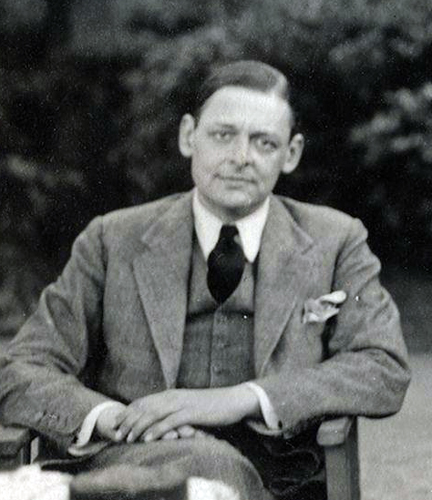
The poet who made disorder the subject and structure of verse, and in doing so gave modernism its most durable — and most demanding — literary monument.
T. S. Eliot arrived in London from St. Louis as a philosophy student and remade the English-language poem from its foundations — replacing Victorian sentiment with fragmentary citation, juxtaposition, and the weight of a civilisation he believed was failing. His 1922 poem The Waste Land is the most discussed single text in twentieth-century literature, a fact that has both confirmed his importance and obscured how strange the poem still is.
Formation across two worlds
Thomas Stearns Eliot was born in St. Louis, Missouri in 1888 into a New England family with deep roots in Unitarian Boston. He studied at Harvard, the Sorbonne, and Merton College, Oxford, absorbing Sanskrit, German idealism, French Symbolism, and the lectures of Irving Babbitt. The cross-Atlantic formation was decisive: he arrived in England in 1914 intending to complete a Harvard doctorate on F. H. Bradley, but the war and a rapidly developing literary life kept him. He settled permanently, married Vivienne Haigh-Wood in 1915, and joined the cultural circle that included Ezra Pound — who became the most important editorial influence on his work.
His early poems, collected in Prufrock and Other Observations (1917), demonstrated a technique already fully formed: dramatic monologue pushed into uncertainty, the speaker's voice undercut by irony, the diction mixing high and low register without apology. "The Love Song of J. Alfred Prufrock" placed an anxious, self-aware narrator in a poem that refused to resolve his anxiety into meaning.
The Waste Land
Published in 1922 — the same year as Joyce's Ulysses — The Waste Land assembled quotations, voices, and languages into a 434-line poem that depicted postwar European civilisation as a scene of spiritual exhaustion and fragmentation. The poem draws on Dante, the Fisher King legend, Sanskrit texts, Elizabethan drama, and street speech, often within a single page. Pound's editing cut approximately half the original draft, sharpening the juxtapositions. The poem's famous epigraph — from Petronius — announces themes of death-in-life before the first line.
April is the cruellest month, breeding / Lilacs out of the dead land.
Critical authority and later work
Alongside poetry, Eliot built a second career as a literary critic. His essays introduced the concept of the objective correlative — the idea that a poem's emotion must be produced by a specific set of objects, situations, or events rather than stated directly — and rehabilitated the Metaphysical Poets, who had been largely dismissed since the eighteenth century. The influence on subsequent criticism and pedagogy was enormous.
His later poetry moved toward religious resolution. After his conversion to Anglo-Catholicism and British naturalisation in 1927, the register of his verse changed. Ash Wednesday (1930) and the Four Quartets (1943) are quieter and more devotional, meditating on time, redemption, and the limits of language. Four Quartets is widely considered his most sustained achievement. He also wrote plays — Murder in the Cathedral (1935) and The Cocktail Party (1950) — and received the Nobel Prize in Literature in 1948.