Ursula K. Le Guin
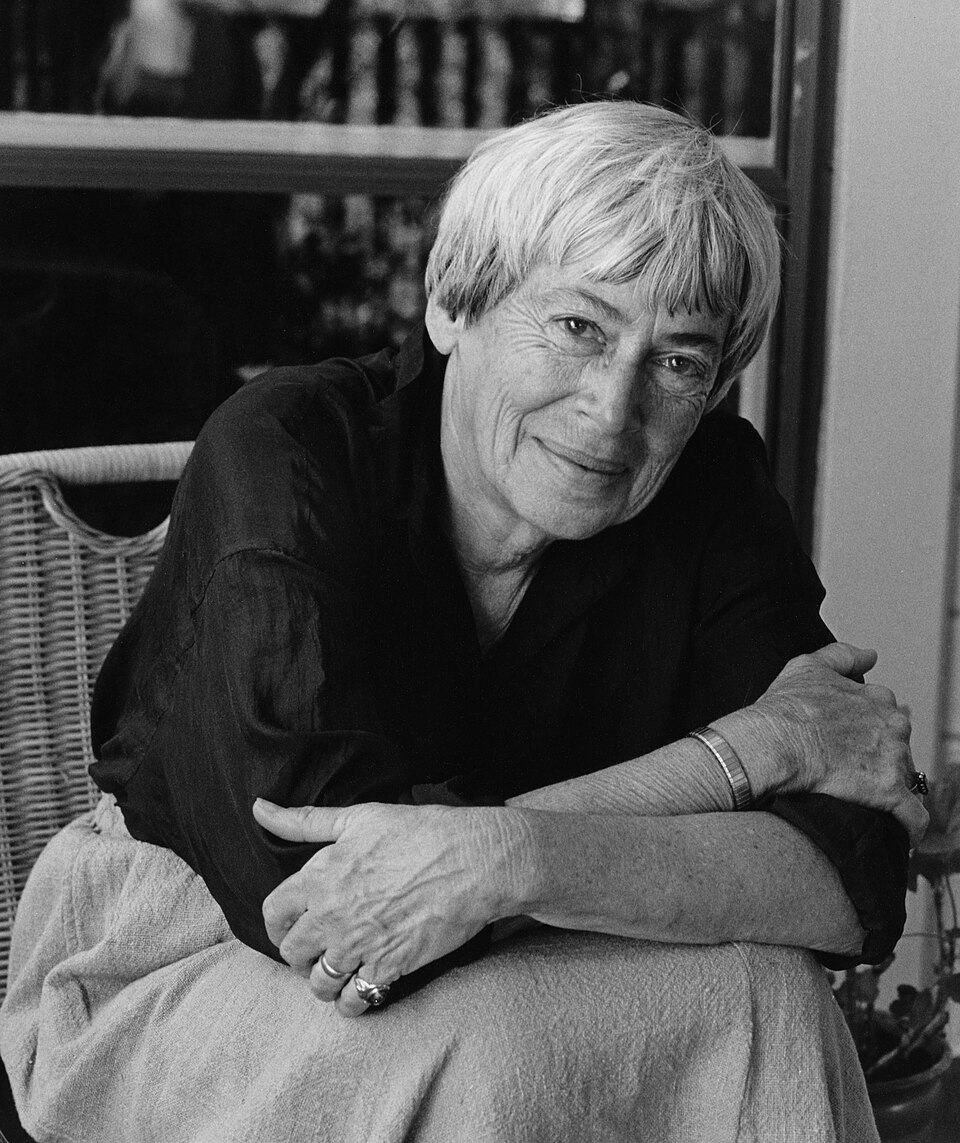
The novelist who took science fiction seriously as a tool for thinking about society, gender, and power — and in doing so enlarged what the form could hold.
Ursula K. Le Guin wrote science fiction and fantasy for nearly sixty years without ever accepting the genre's conventional limits. Her novels explored anarchism, gender, ecology, and anthropology through worlds that were fully imagined rather than merely scenic — and she made the case, in prose of exceptional clarity, that speculative fiction is one of the oldest and most serious forms of human thought.
Background and formation
Ursula Kroeber was born in Berkeley, California in 1929, the daughter of the anthropologist Alfred Kroeber and the writer Theodora Kroeber. The anthropological household shaped her fundamentally: she grew up attending to the structures of unfamiliar cultures, to the way societies organise meaning, kinship, and power. She studied at Radcliffe College and Columbia University, where she met Charles Le Guin, a historian she married in 1953. Her first published stories appeared in 1959; her early novels were rejected by mainstream publishers before finding homes in science fiction imprints.
The Hainish Cycle and landmark novels
Her major work is set within the Hainish Cycle — a loose future history in which many of Earth's humanoid peoples are descendants of ancient settlers from the planet Hain. The novels are not sequential; they share a universe and recurring institutions (notably the ansible, an instantaneous communicator) but can be read independently.
The Left Hand of Darkness (1969) is set on the planet Gethen, whose inhabitants are ambisexual, entering brief fertile periods without fixed gender. The novel follows a human envoy attempting to negotiate Gethen's entry into an interplanetary league. It uses the gender experiment not as spectacle but as a device for examining how much of what seems universal — about politics, loyalty, and trust — is in fact gendered assumption. It won both the Hugo and Nebula Awards.
The Dispossessed (1974) follows a physicist from an anarchist moon visiting the capitalist planet it orbits. The novel alternates between both worlds and refuses the easy resolution of political allegory: neither society is adequate; both contain their own repressions. It won the Hugo, Nebula, and Locus Awards.
The only thing that makes life possible is permanent, intolerable uncertainty: not knowing what comes next.
Earthsea and later work
The Earthsea series, beginning with A Wizard of Earthsea (1968), was conceived as a fantasy sequence for younger readers but developed into a sustained meditation on mortality, language, and the limits of power. Le Guin returned to the world repeatedly over four decades, each return deepening rather than simply extending the original.
Her literary career also included short stories, poetry, essays, criticism, and translations. Her essay collection The Language of the Night (1979) and the later The Wave in the Mind remain important statements of her aesthetics. She was a consistent and specific critic of the science fiction field's tendency to treat genre as a reason to avoid demanding prose.