Vera Rubin
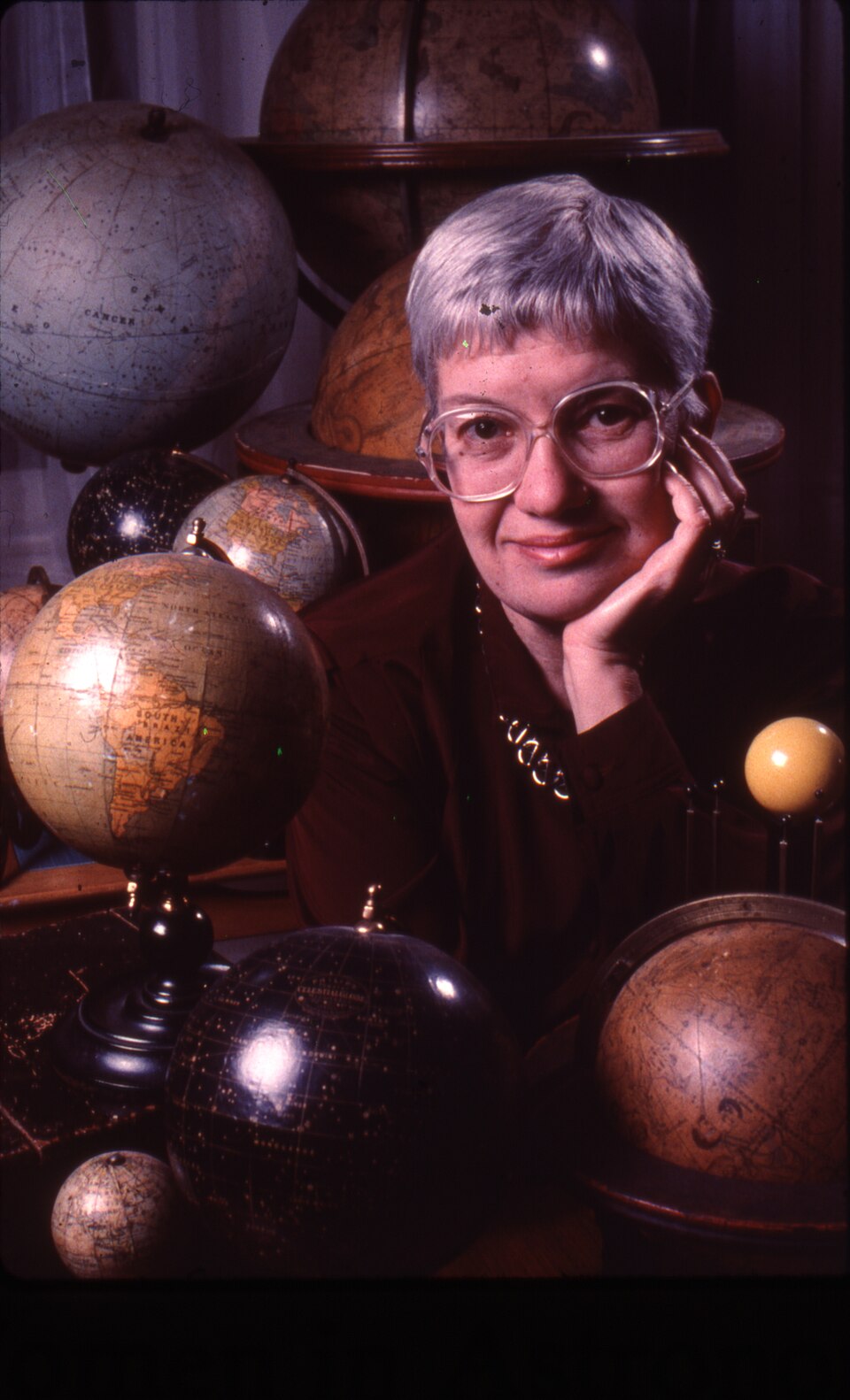
The astronomer whose meticulous measurements of galaxy rotation curves produced the first compelling observational evidence for dark matter — and rewrote the mass budget of the universe.
Vera Rubin spent decades measuring how fast stars move around the centres of their galaxies — and found that they move far too fast. The stars at the outer edges of galaxies orbit just as quickly as those near the core, when Newtonian mechanics predicted they should slow down dramatically. The only explanation that held was the existence of an enormous invisible mass: dark matter. Rubin's observational work turned a theoretical proposal into an empirical fact that cosmology could not ignore.
Early life and education
Vera Florence Cooper was born in Philadelphia in 1928 and grew up in Washington, D.C., where she built a backyard telescope as a teenager and spent nights tracking meteor paths. She was the only astronomy major in her class at Vassar College, graduating in 1948. Cornell admitted her to a graduate programme but she instead attended Georgetown University, where she completed a master's degree in 1951 — her thesis proposed that galaxies might have a large-scale rotational motion around some point beyond our own galaxy, a claim then considered controversial. She completed her PhD at Georgetown in 1954, her dissertation examining galaxy clustering. Both pieces of work anticipated questions that would take decades to resolve.
The rotation curve measurements
In the 1960s Rubin began working at the Carnegie Institution of Washington, a collaboration that continued for the rest of her career. With astronomer Kent Ford, who had built a highly sensitive spectrograph, she began systematic observations of galactic rotation curves — measurements of how quickly different parts of a galaxy orbit its centre, derived from Doppler shifts in spectral lines.
The prediction from Newtonian mechanics and visible mass was a drop-off: stars at the periphery of a galaxy, far from the concentrated mass of the nucleus, should orbit slowly, just as the outer planets orbit the sun more slowly than the inner ones. Rubin and Ford found the opposite. The rotation curves were flat: stars at the edges of spiral galaxies orbited at the same velocity as stars near the centre. The discrepancy was consistent across galaxy after galaxy. The mass required to produce this motion vastly exceeded the visible matter.
We have peered into a new world and have seen that it is more mysterious and more complex than we had imagined.
The case for dark matter
The flat rotation curve was not new in theoretical discussion — Fritz Zwicky had proposed the need for unseen mass from cluster dynamics in the 1930s — but Rubin and Ford's data, accumulated across dozens of galaxies, converted speculation into a systematic observational programme. Subsequent confirmation by other astronomers using 21-centimetre hydrogen line radio telescopes made the case overwhelming. Dark matter, whatever its physical nature, accounts for roughly five times as much mass as all visible matter in the universe.
Rubin received the National Medal of Science in 1993. She was widely considered for the Nobel Prize in Physics, which she did not receive before her death in 2016. The next generation of astronomers, and the facilities built to study dark matter's effects on cosmological structure, carry her work forward.