Victor Hugo
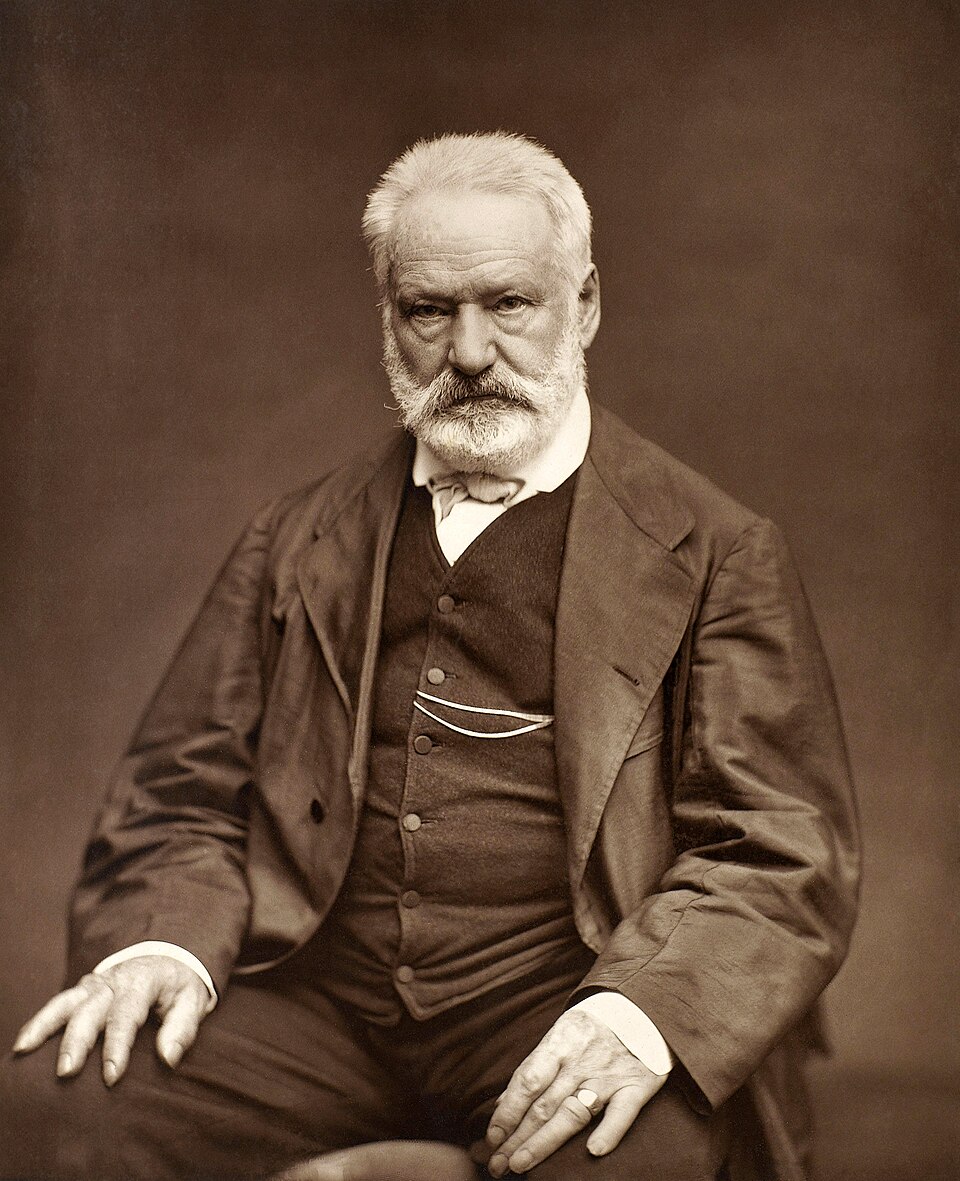
The giant of French Romanticism whose novels gave the dispossessed their most enduring voices and whose political exile became a form of moral witness.
Victor Hugo was the dominant literary figure in France for much of the nineteenth century — poet, playwright, novelist, polemicist, and politician. His two great novels, Notre-Dame de Paris (1831) and Les Misérables (1862), gave the poor and outcast of historical and contemporary France a narrative scale commensurate with their suffering. He spent nineteen years in exile rather than accept the coup of Napoleon III, and when he returned in 1870, a crowd of hundreds of thousands received him in Paris.
Origins and early career
Hugo was born on 26 February 1802 in Besançon to a general in Napoleon's army and a Royalist mother — a domestic tension that informed his political formation. He grew up between Paris and his father's postings in Italy and Spain. A precocious writer, he published his first collection of poetry at eighteen and received a royal pension from Louis XVIII at twenty.
His early plays and poetry established him as a leader of the Romantic movement in France. The preface to his play Cromwell (1827) became a manifesto for French Romanticism, demanding the mixture of the sublime and the grotesque, the rejection of classical unities, and the embrace of history as dramatic material. Hernani (1830), his theatrical breakthrough, caused a famous public scandal between Romantics and classicists on its opening night.
The great novels
Notre-Dame de Paris (1831) — known in English as The Hunchback of Notre-Dame — is set in medieval Paris and centres on the archdeacon Frollo's obsession with the dancer Esmeralda, and the hunchback bellringer Quasimodo's love for her. Hugo used the novel partly to argue for the preservation of Gothic architecture, then being neglected or demolished; the book is credited with stimulating the restoration of Notre-Dame cathedral itself.
Les Misérables (1862) is his supreme achievement. The novel follows Jean Valjean — a man imprisoned for stealing bread — through the social machinery of post-Napoleonic France. The inspector Javert, who pursues him for decades, embodies law without mercy. The novel encompasses the June Rebellion of 1832, the Paris sewers, the Parisian underworld, and an argument about the relationship between crime, poverty, and social organisation.
Exile and politics
After Napoleon III's coup d'état in December 1851, Hugo refused to live under what he called a crime against the republic and went into exile — first to Brussels, then to Jersey, then to Guernsey, where he lived for fifteen years on the island of Sark in a house overlooking the sea. He continued to write there: Les Misérables was largely composed in exile. He refused offers of amnesty.
He returned to Paris on the day after Napoleon III's fall in September 1870. He was elected to the National Assembly, opposed the terms of the peace with Prussia, and later served as a senator of the Third Republic. His political life was as substantial as his literary one.
There is one spectacle grander than the sea, that is the sky; there is one spectacle grander than the sky, that is the interior of the soul.
Legacy
Hugo died on 22 May 1885. France observed a national period of mourning. More than two million people followed his funeral cortège from the Arc de Triomphe to the Panthéon, where he was interred. Les Misérables has never been out of print and has been adapted for film, stage musical, and opera more times than can easily be counted. His image appears on French cultural institutions; several streets, squares, and a metro station in Paris bear his name.