Vladimir Nabokov
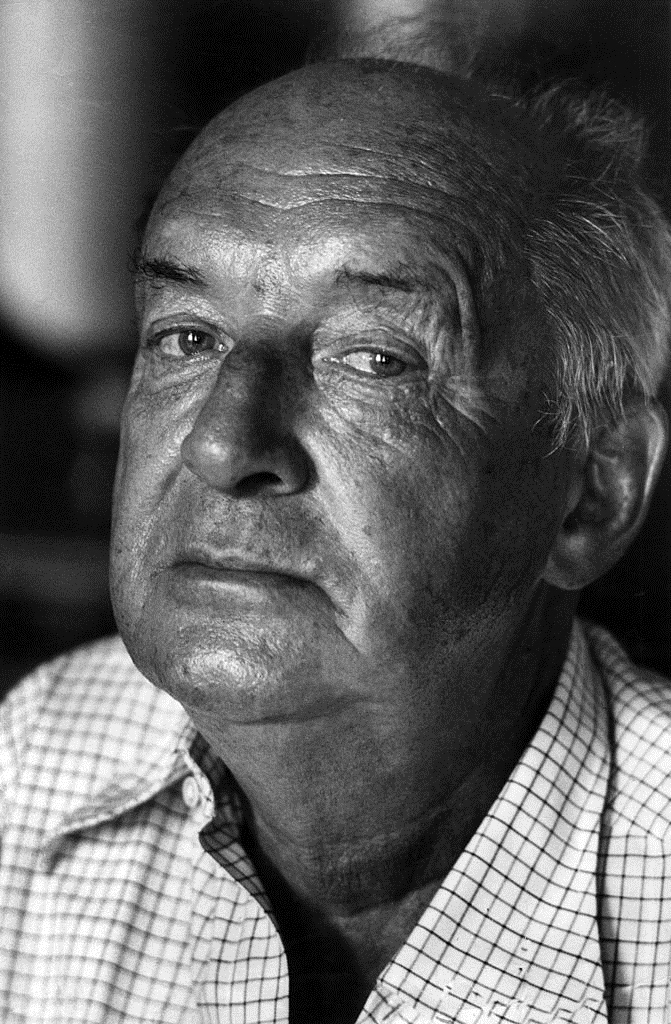
The Russian-American novelist who wrote with equal mastery in two languages and made the pleasures of precise prose — its tricks, its traps, its displays of attention — a moral as well as an aesthetic standard.
Vladimir Nabokov fled Russia, then Germany, then France, eventually settling in the United States, where he produced — in his third language — the novel that made him famous and the critical and teaching work that made him influential: a body of writing in which playfulness and precision are not opposites but the same impulse operating at different scales.
Origins and exile
Nabokov was born in Saint Petersburg in 1899 into a wealthy and liberal-minded aristocratic family. He was trilingual from childhood — Russian, English, French — and educated partly by English governesses. In 1919, following the Bolshevik Revolution, the family fled Russia; Nabokov went to Cambridge, where he read French and Russian literature at Trinity College, graduating in 1922.
He moved to Berlin, where the Russian émigré community provided an audience for his early fiction in Russian, published under the pen name Vladimir Sirin. He wrote nine novels in Russian before the Second World War displaced him again: to France in 1937, and to the United States in 1940.
The American period
Arriving in America with little money and no English-language reputation, Nabokov taught Russian literature and creative writing at Wellesley College and Cornell University while writing his first English novels. His teaching notes on Russian and European fiction — published posthumously as Lectures on Literature (1980) — demonstrate a pedagogy based on close reading of textual surfaces: the exact colour of a detail in Tolstoy, the precise timing of a sentence in Kafka.
Lolita, written in English, was completed in 1953. It was rejected by American publishers; Nabokov published it with Olympia Press in Paris in 1955. Graham Greene's praise in a year-end survey provoked a pamphlet war in the British press; the novel was imported, banned, and ultimately published in the United States by Putnam in 1958, where it became a bestseller.
Lolita and its reception
The novel — narrated by Humbert Humbert, a European academic who becomes obsessed with and abuses a twelve-year-old American girl — presents its subject through a prose of extreme beauty and verbal ingenuity, requiring the reader to disentangle the narrator's self-justification from the violence it describes. The complexity of this demand has made the novel a persistent test case in discussions of literary ethics, unreliable narration, and what prose style can and cannot conceal.
Nabokov moved to Montreux, Switzerland, in 1961 with the proceeds, living in the Palace Hotel until his death in 1977.
Later work
Pale Fire (1962), a novel in the form of a scholarly edition of a 999-line poem, is considered by many critics as formally as adventurous as Lolita. Ada or Ardor: A Family Chronicle (1969) was his most ambitious late novel; his final book, The Original of Laura, was left unfinished and published posthumously in 2009.
He was also a serious lepidopterist and worked as a research fellow at Harvard's Museum of Comparative Zoology, describing several new species and subspecies of butterflies.
Life is a great surprise. I do not see why death should not be an even greater one.
Legacy
Nabokov's influence on American and international prose fiction has been extensive: his combination of verbal play, unreliable narration, and metatextual awareness fed into the postmodern fiction of John Barth and Thomas Pynchon, and his insistence on precise observation — the particular against the general — runs through contemporary literary fiction.