Voltaire
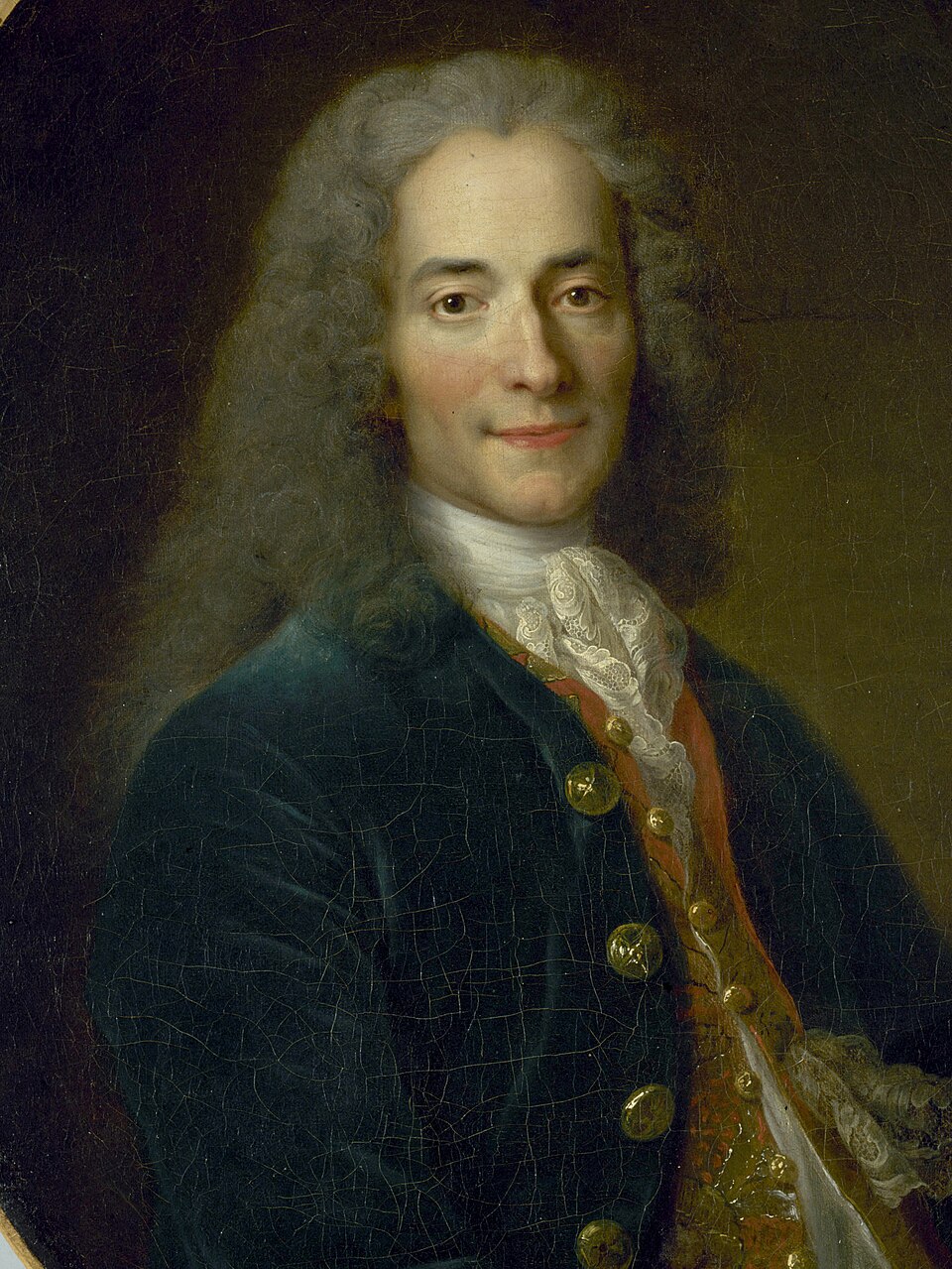
France's sharpest wit and most dangerous pen: a philosopher, satirist, and tireless agitator who made the mockery of superstition, intolerance, and arbitrary power the most influential literary act of the Enlightenment.
Voltaire spent his life in productive collision with authority — imprisoned in the Bastille, exiled to England, banished from Paris — and turned each displacement into material. His output was vast, his targets were powerful, and his instrument was a wit precise enough to puncture theological certainty and political complacency in the same sentence.
The making of a philosophe
François-Marie Arouet was born in Paris on 21 November 1694, the son of a notary. He was educated by the Jesuits at the Collège Louis-le-Grand, acquiring the classical fluency that would underpin a lifetime of provocative verse and prose. The pen name Voltaire — an anagram of a Latinised form of his surname — first appeared around 1718, coinciding with the success of his play Œdipe and the beginning of the reputation he would spend sixty years extending and defending.
His early career was punctuated by confinement. He was imprisoned in the Bastille twice: first in 1717 for verses mocking the Regent, and again in 1726 following a quarrel with the Chevalier de Rohan, whose lackeys had him beaten. Rather than face a second imprisonment, he accepted exile.
England and its consequences
The three years Voltaire spent in England between 1726 and 1729 were among the most formative of his intellectual life. He encountered Locke's empiricism and Newton's natural philosophy, attended Quaker meetings, visited the Royal Society, and observed a country where religious dissent was tolerated and criticism of government was published rather than punished. The result was his Lettres philosophiques (1734), which held England up as an implicit rebuke to French religious and political life. The book was condemned and burned in France; the scandal made Voltaire famous across Europe.
Candide and the war on optimism
By the late 1750s, Voltaire had refined his satirical method to its sharpest point. Candide, ou l'Optimisme (1759) is a novella that follows its naive hero through a catalogue of disasters — natural, military, theological, and personal — designed to demolish the Leibnizian argument that we live in the best of all possible worlds. The Lisbon earthquake of 1755 and the Seven Years' War had made philosophical optimism seem obscene; Voltaire made it seem ridiculous. Candide circulated in defiance of official condemnation and has never since gone out of print.
Campaigns for justice and freedom of thought
In his later years, living at his estate at Ferney near the Swiss border, Voltaire waged sustained campaigns for specific victims of religious intolerance. The Calas affair (1762–1765) — in which a Protestant merchant was wrongly broken on the wheel for allegedly murdering his son to prevent his conversion to Catholicism — became an international cause through Voltaire's intervention. He secured a posthumous rehabilitation of Calas in 1765, one of the earliest successful campaigns for what we would now call human rights.
His Dictionnaire philosophique (1764) pursued the same targets in encyclopaedic form: superstition, fanaticism, persecution, and the political abuse of religion, article by article, with a mordancy that ensured its repeated condemnation and equally repeated reprinting.
If God did not exist, it would be necessary to invent him.