Walt Whitman
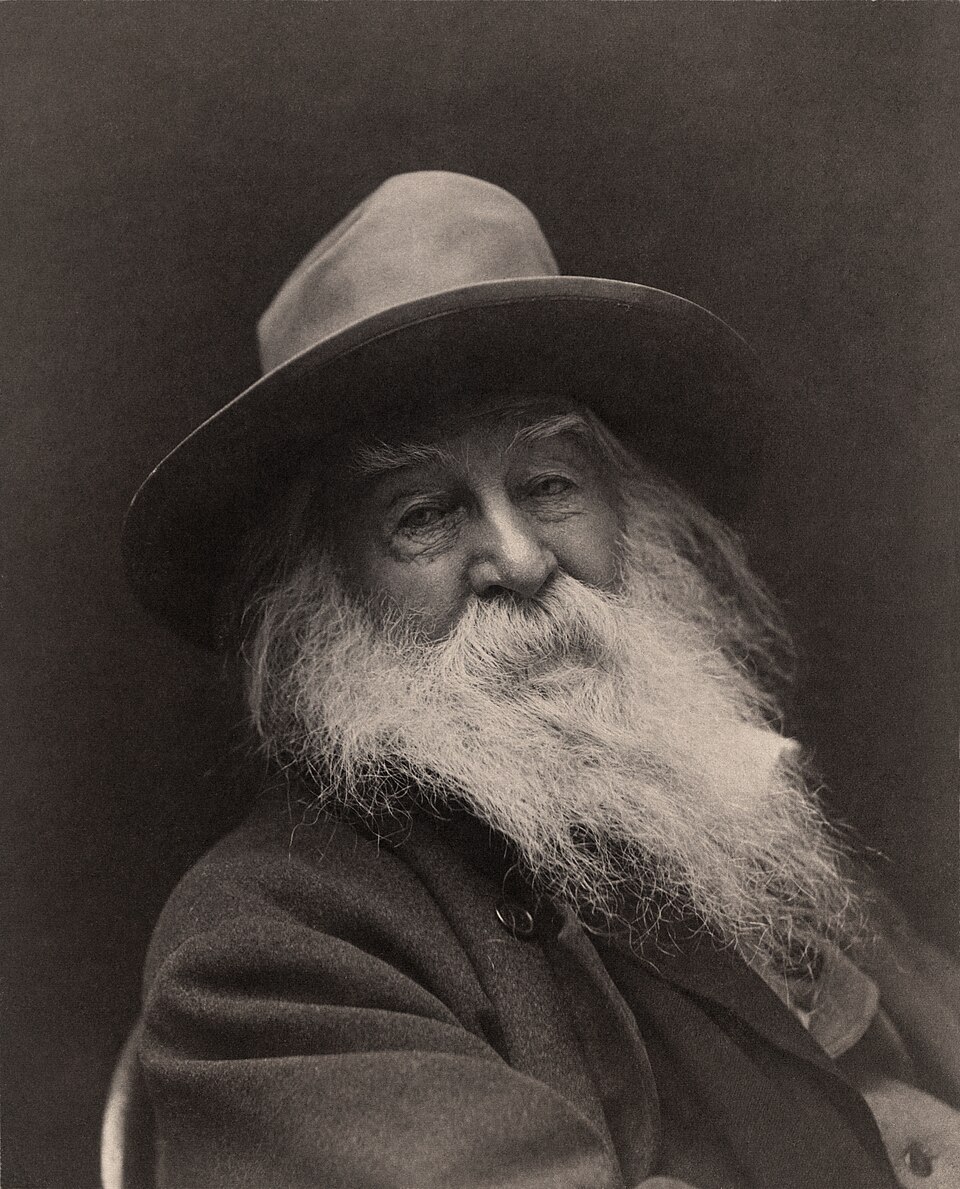
The journalist who remade American poetry in his own image — sprawling, democratic, carnal, and ecstatic.
Walt Whitman published the first edition of Leaves of Grass in 1855 and spent the rest of his life expanding it — the book grew from twelve poems to nearly four hundred, revised and reordered across nine editions. It is one of the most sustained single literary projects in American culture: a democratic catalogue of a continent, a celebration of the body alongside the soul, and a claim that free verse — long, breathing, biblical in rhythm — was the appropriate form for a republic that had broken from inherited European structures.
Origins
Walter Whitman Jr. was born on 31 May 1819 in West Hills, Long Island, the second of nine children of Walter Whitman Sr. and Louisa Van Velsor. The family moved to Brooklyn when he was four. He had little formal schooling beyond the age of eleven, working as an office boy, then as a printer's apprentice, then as a journalist and editor for various New York newspapers throughout the 1830s and 1840s. He read voraciously, particularly the Bible, Homer, Shakespeare, and Dante, and he attended the opera.
He worked as a schoolteacher on Long Island for several years and edited the Brooklyn Daily Eagle from 1846 to 1848. A trip to New Orleans in 1848 — his first extended journey away from New York — exposed him to a wider American geography and society, including the slave markets of the South, that marked his writing.
Leaves of Grass
The first edition of Leaves of Grass, published at Whitman's own expense in July 1855, contained twelve untitled poems. The centrepiece — later titled "Song of Myself" — runs to fifty-two sections and begins with a claim of self that is simultaneously a claim on behalf of all humanity: "I celebrate myself, and sing myself, / And what I assume you shall assume."
Ralph Waldo Emerson wrote to Whitman to call it "the most extraordinary piece of wit and wisdom that America has yet contributed." The book was condemned by others as indecent for its frank treatment of the body and sexuality.
Whitman worked as a volunteer nurse in military hospitals in Washington DC during the Civil War, experiences recorded in Drum-Taps (1865) and the prose memoir Specimen Days (1882). The death of Abraham Lincoln prompted the elegy "When Lilacs Last in the Dooryard Bloom'd" (1865).
Form and influence
Whitman's verse has no regular metre and no rhyme scheme. Its unit is the long line, shaped by breath and grammatical parallelism — a structure derived partly from biblical cadence, partly from the cadence of catalogues and inventories. He lists: occupations, landscapes, body parts, nationalities, animals, tools. The lists are inclusive by design: the poem's "I" contains multitudes and refuses to exclude.
His incorporation of transcendentalism — the belief in the divinity immanent in nature and in the individual soul — aligns him with Emerson and Thoreau, though Whitman is more physical and more explicitly political than either.
Do I contradict myself? / Very well then I contradict myself, / (I am large, I contain multitudes.)
Legacy
Whitman's influence on American poetry is incalculable. Allen Ginsberg's "Howl" (1956) is a direct descendant, in form and ambition. Pablo Neruda, García Lorca, and D. H. Lawrence all acknowledged him. He is consistently described as the father of free verse in English, though he might have preferred to be called its liberator.