W. E. B. Du Bois
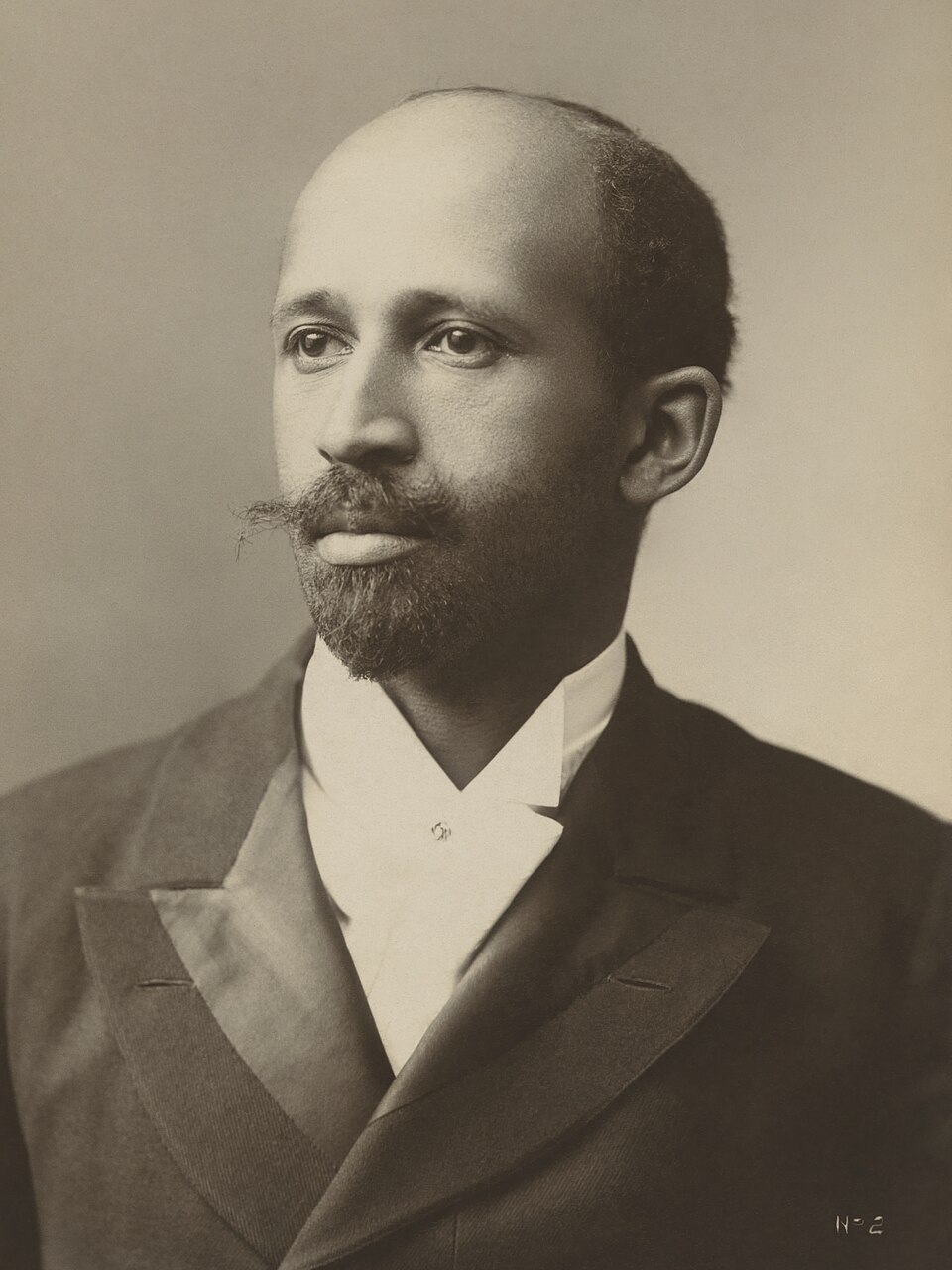
Sociologist, editor, and organiser across nine decades, Du Bois diagnosed the structural conditions of Black American life with a rigour that American institutions were not yet built to accommodate.
W. E. B. Du Bois was twenty-seven years old when he became the first African American to earn a doctorate from Harvard, and he spent the next seven decades doing the empirical, theoretical, and organisational work that would make the equality that doctorate implied a political reality rather than a credentialed exception. He lived to ninety-five and died in Ghana, a citizen of that country, one day before the March on Washington.
Origins and education
William Edward Burghardt Du Bois was born on 23 February 1868 in Great Barrington, Massachusetts, into a small, relatively integrated New England community. He graduated from Fisk University in Nashville in 1888, an encounter with the Deep South that fundamentally altered his understanding of American racial life. He then attended Harvard, where he earned a bachelor's degree in 1890 and a master's degree in 1891. He studied at the University of Berlin from 1892 to 1894, engaging directly with the methods of historical and social science as practised by figures including Gustav von Schmoller and Adolf Wagner. Returning to Harvard, he completed his doctorate in 1895 — the first African American to do so. His dissertation, The Suppression of the African Slave-Trade to the United States of America, was published in 1896 as the first volume of the Harvard Historical Studies series.
The Philadelphia Negro and empirical sociology
In 1896, Du Bois was commissioned to conduct a sociological study of the Black community in Philadelphia's Seventh Ward. The result, The Philadelphia Negro (1899), was one of the first works of systematic empirical sociology produced in the United States. Du Bois conducted surveys, interviews, and statistical analyses of 9,000 residents, producing detailed maps of household structure, employment, education, and social organisation. The work challenged prevailing assumptions that poverty in Black communities was the result of innate deficiency, documenting instead the structural effects of discrimination. It established Du Bois as a sociologist of the first rank and anticipated methods that would later be associated with the Chicago School.
The Souls of Black Folk
The Souls of Black Folk (1903) is the work for which Du Bois is most widely remembered. Fourteen essays on history, sociology, autobiography, and music introduced the concept of double consciousness — the sense of "always looking at one's self through the eyes of others, of measuring one's soul by the tape of a world that looks on in amused contempt and pity" — as the distinctive psychological condition of African Americans. The book also contained a direct challenge to the accommodationist politics of Booker T. Washington, whose programme of vocational training and political deference Du Bois argued amounted to a surrender of civil and political rights. The polemic set the terms of debate about Black politics for a generation.
The NAACP and The Crisis
In 1909, Du Bois was among the co-founders of the National Association for the Advancement of Colored People (NAACP). From 1910 to 1934, he edited the NAACP's magazine, The Crisis, building it from a small newsletter to a publication with a circulation of more than 100,000. Through The Crisis, Du Bois published journalism, fiction, poetry, and data, making it a central platform for Black intellectual and cultural life during the Harlem Renaissance. He resigned from the editorship in 1934 after a dispute over editorial independence and his advocacy for a degree of voluntary Black economic separatism that conflicted with the organisation's integrationist position.
Later work and Pan-Africanism
Black Reconstruction in America (1935) offered a revisionist account of the post-Civil War period, arguing against the prevailing historiography — dominated at the time by the Dunning School — that Reconstruction had been a corrupt failure, and for an interpretation that centred the agency and legislative achievements of formerly enslaved people. Du Bois organised Pan-African Congresses from 1919 onwards, working to build political solidarity across African and diasporic communities and to link the conditions of Black Americans to the broader structures of European colonialism. In his final years, Du Bois moved toward communism; he joined the Communist Party of the United States in 1961, the same year he accepted Kwame Nkrumah's invitation to settle in Ghana and begin work on an Encyclopaedia Africana. He renounced his United States citizenship before his death. He died in Accra on 27 August 1963, aged ninety-five. The March on Washington took place the following day.
"The problem of the twentieth century is the problem of the color-line."