Werner Herzog
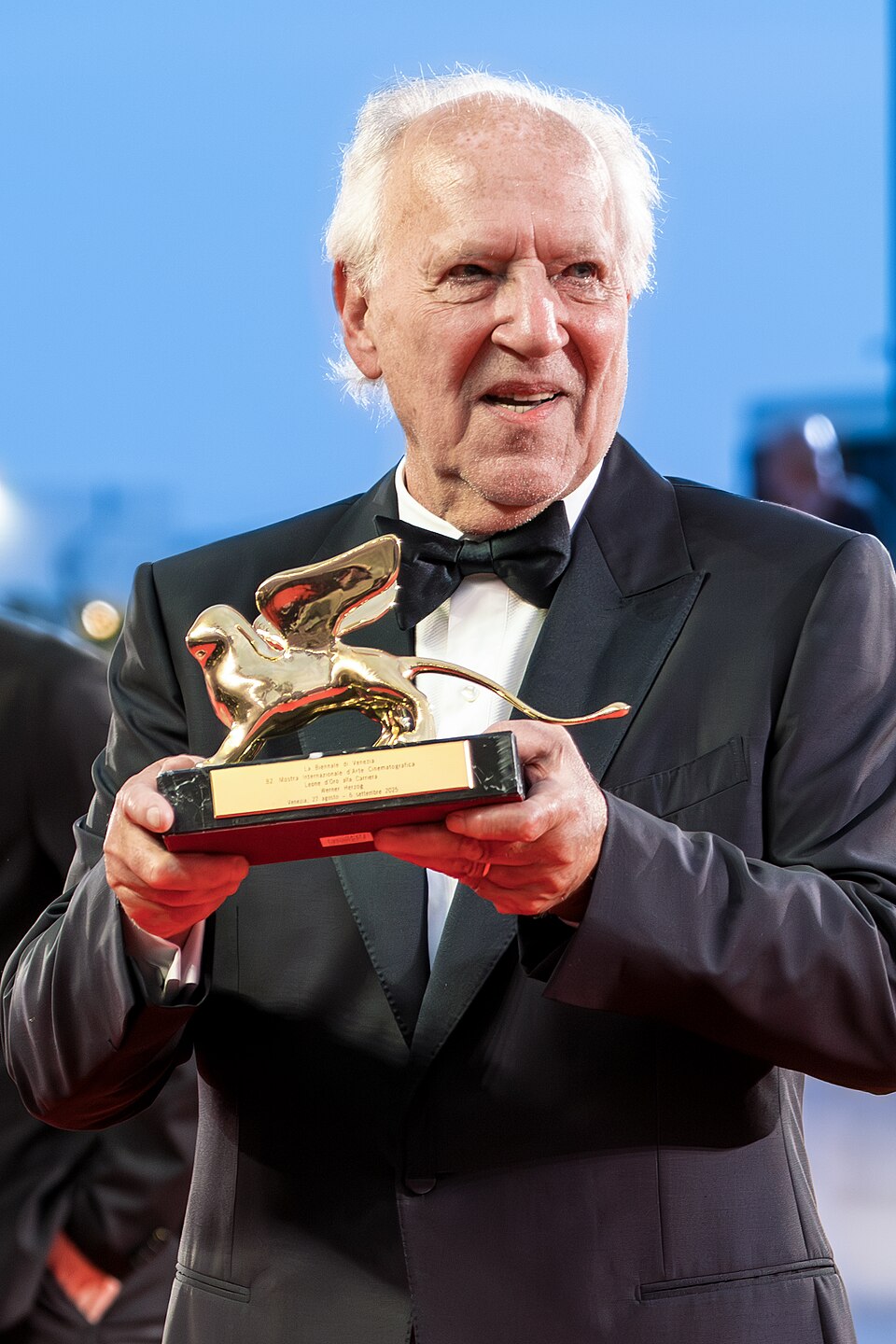
A filmmaker who treats cinema as an act of will — placing cast, crew, and camera into raw, often dangerous situations to capture what he calls the "ecstatic truth."
Werner Herzog has made films on volcanoes, in jungles, on ice floes, and inside the minds of obsessives — and he has done so with a conviction that cinema must risk something real to say something true. Over six decades his work has ranged from fiction to documentary without respecting the boundary between them.
Origins and early conviction
Herzog was born in Munich in 1942 and grew up in a remote Alpine village, returning to the city as a teenager. He taught himself filmmaking by stealing a camera from the Munich Film School — a story he tells without apology, as though it proves a point about initiative. His first feature, Signs of Life (1968), announced a preoccupation that would never leave him: people trapped by circumstance, struggling against a world indifferent to their ambitions.
He became a central figure of the New German Cinema alongside Rainer Werner Fassbinder and Wim Wenders, but his work sat apart from theirs. Where Fassbinder dissected society and Wenders mourned dislocation, Herzog went looking for extremity — geographical, psychological, moral.
The obsessive protagonist
The figure that runs through Herzog's major fiction films is the man of impossible will: Aguirre searching for El Dorado in the Amazon (Aguirre, the Wrath of God, 1972), Fitzcarraldo dragging an opera house into the jungle (Fitzcarraldo, 1982), Nosferatu as the undead embodiment of longing (Nosferatu the Vampyre, 1979). Klaus Kinski, his most famous collaborator, embodied this figure in five films — a collaboration that was volcanic, documented in the retrospective account My Best Fiend (1999).
Herzog did not use storyboards. He improvised; he filmed what appeared. When Fitzcarraldo required a real steamship to be pulled over a real hill, he pulled it. The question of what separates performance from documentary ceased to matter.
What is the use of a film that is merely interesting, if it does not illuminate something deeper?
Documentary as encounter
From the 1970s onward Herzog ran a parallel documentary practice of comparable ambition. Grizzly Man (2005), about Timothy Treadwell's fatal cohabitation with Alaskan bears, became his most widely seen non-fiction film — a meditation on the human need to project meaning onto wild nature. Cave of Forgotten Dreams (2010) took a 3D camera into the Chauvet Cave in France, the oldest known repository of human art. Into the Abyss (2011) examined capital punishment through conversations with a death-row prisoner and the families of victims.
He has received numerous accolades including a Silver Bear Award and four awards at the Cannes Film Festival, as well as a nomination for the Academy Award for Best Documentary Feature.
Legacy
Herzog's influence on documentary filmmaking is difficult to overstate: his willingness to appear in his own films, to interrogate his subjects on camera, to let the filmmaker's presence become part of the material, opened a mode that many subsequent non-fiction filmmakers have adopted. His fiction features remain a touchstone for directors interested in extreme production conditions as an ethical commitment rather than a spectacle.