William Faulkner
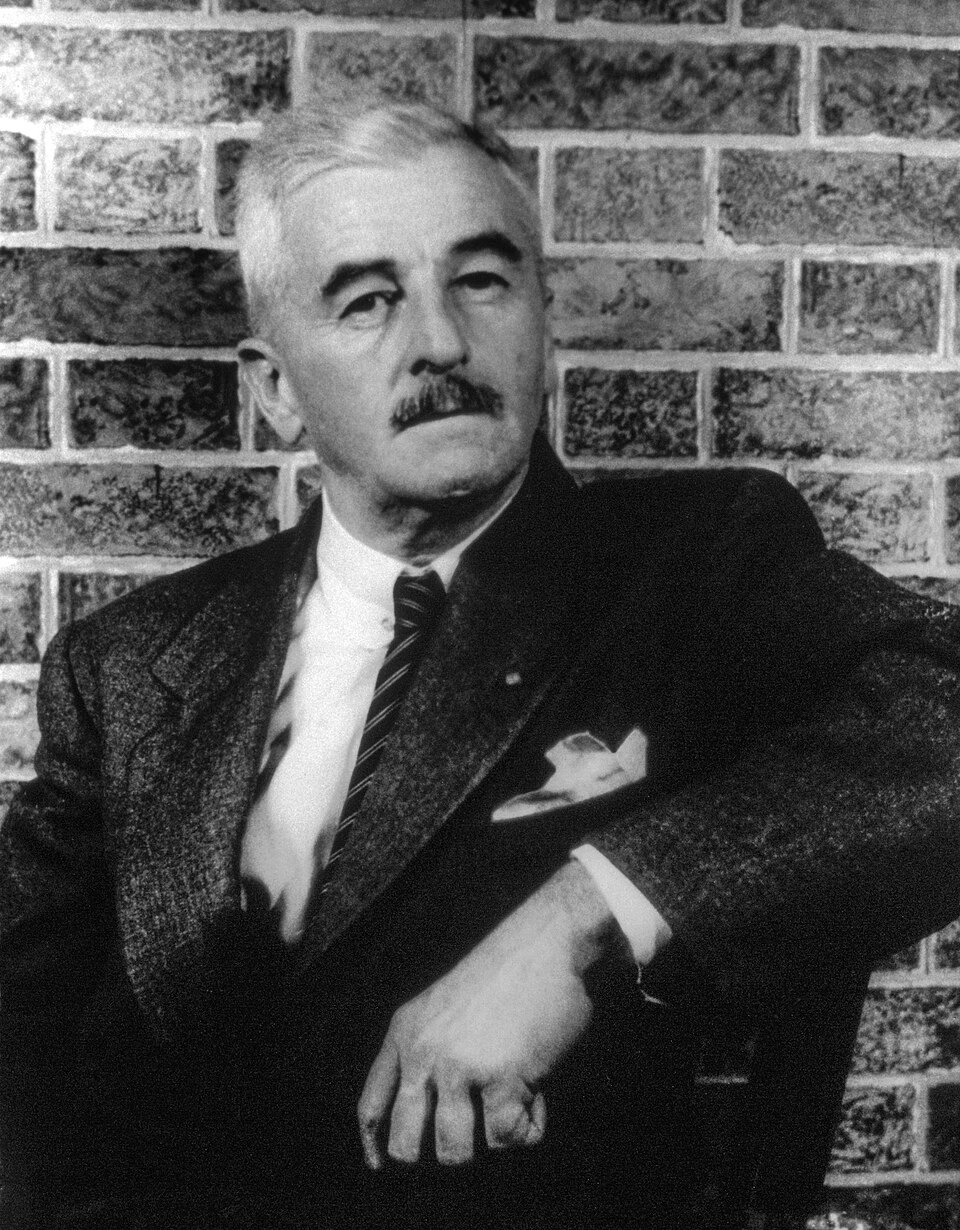
The American novelist who invented a fictional county in Mississippi and used it to map the full weight of Southern history — race, decay, time, and guilt — in prose of concentrated formal daring.
William Faulkner spent most of his life within thirty miles of Oxford, Mississippi, and built from that ground a fictional county — Yoknapatawpha — that contains the full wreckage of Southern American history: the plantation economy, its collapse, the long aftermath of slavery, and the psychological inheritance passed down through families who cannot release the past because the past has not released them.
Formation
Faulkner was born in New Albany, Mississippi, in 1897, and grew up in Oxford, the seat of Lafayette County, which became the model for Jefferson and Yoknapatawpha. His great-grandfather was a colonel in the Confederate army and a published novelist; the family legacy — martial, literary, and shadowed — shaped his imagination. He attended the University of Mississippi intermittently and never graduated.
He worked as postmaster at the University of Mississippi post office, a job he performed inattentively and lost in 1924. His early poetry and fiction attracted little notice. In 1925 he went to New Orleans, where he met Sherwood Anderson, who encouraged him and helped him place his first novel, Soldiers' Pay, in 1926.
The major work
Between 1929 and 1942, Faulkner wrote the novels that constitute his central achievement. The Sound and the Fury (1929) narrates the decline of the Compson family through four different consciousnesses, each with a different relationship to language and time; the first section is told by Benjy, a man with an intellectual disability, and is one of the most technically demanding passages in American fiction.
As I Lay Dying (1930) gives its narrative across fifteen different speakers as the Bundren family carries their matriarch's coffin across Mississippi for burial. Light in August (1932) and Absalom, Absalom! (1936) extend the Yoknapatawpha chronicle, the latter a story of antebellum ambition and its consequences narrated from multiple perspectives across generations with a Gothic intensity that influenced Latin American writers as much as American ones.
Technique
Faulkner's prose is characterised by long, syntactically complex sentences, multiple simultaneous time frames, and an approach to consciousness that renders thought as it occurs rather than as it is subsequently organised. He uses unreliable and multiple narrators not as a trick of voice but as a structural claim: that Southern history is unknowable from any single position, that the past is contested rather than settled, and that what characters believe determines what they can see.
The past is never dead. It's not even past.
Nobel Prize and legacy
Faulkner was awarded the Nobel Prize in Literature in 1949. His acceptance speech, delivered in Stockholm, was an eloquent argument for the role of literature in the face of nuclear anxiety: the writer's subject is the human heart in conflict with itself. The speech is among the most quoted Nobel lectures.
His influence on subsequent fiction is extensive: Gabriel García Márquez cited The Sound and the Fury as among the works that made One Hundred Years of Solitude possible; Toni Morrison's engagement with Southern and African American history is in direct dialogue with his example.