Wim Wenders
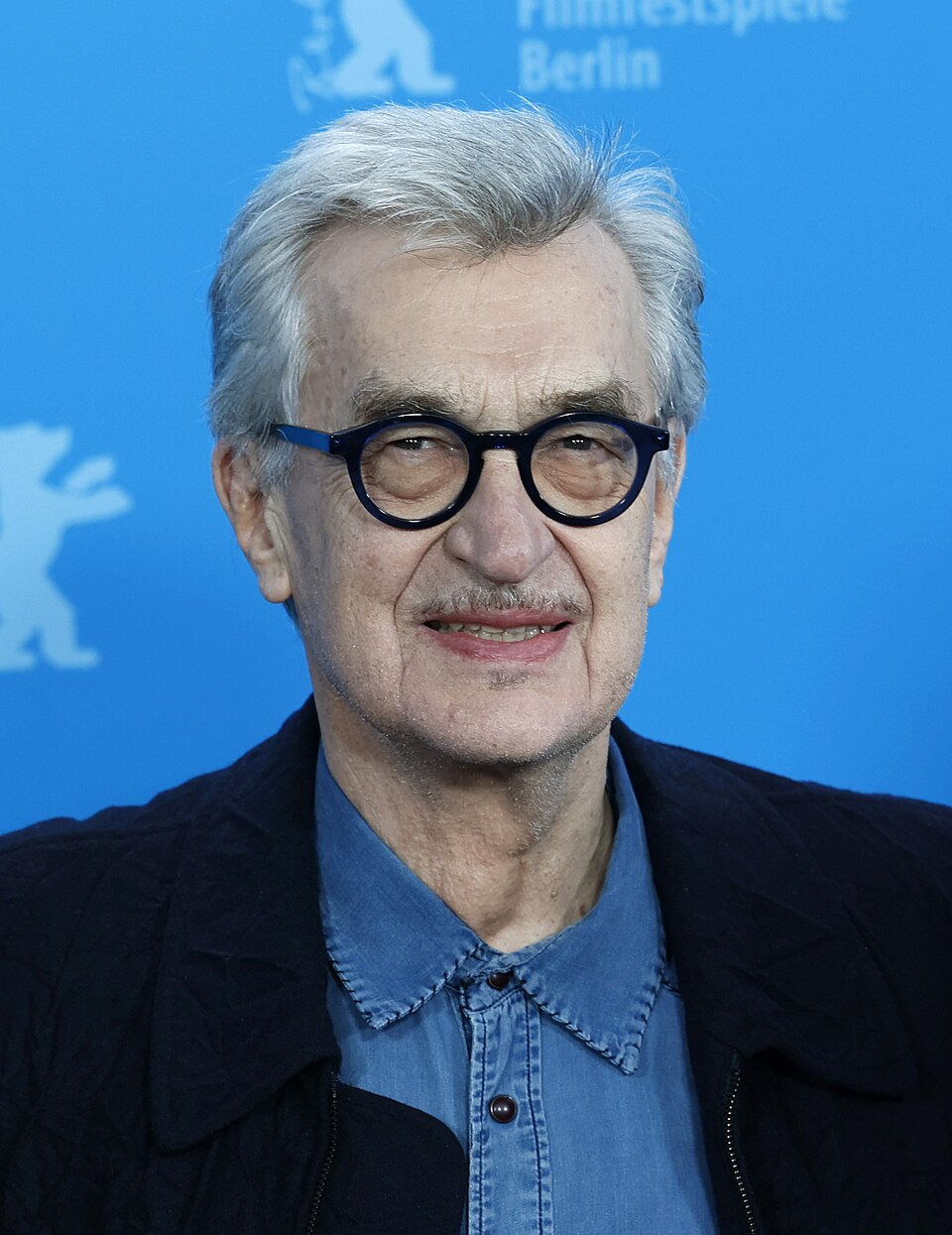
A filmmaker who treats the road, the city, and the act of looking as his true subjects — and who has been asking what images mean since the moment he started making them.
Wim Wenders has spent fifty years investigating what it means to look — at landscapes, at cities, at faces, at the surfaces of American and European culture — and whether the images a camera produces tell the truth about the world or merely its appearance. His films are both the investigation and its record.
Düsseldorf and the image
Born in Düsseldorf in 1945, Wenders studied medicine and philosophy before turning to film. He enrolled at the Hochschule für Fernsehen und Film in Munich — the film school that also produced Werner Herzog and others who would constitute the New German Cinema — and made his first features in the early 1970s.
His early films showed an immediate preoccupation with American popular culture seen from a European distance: rock music, road movies, pinball machines, the grammar of Hollywood genre. These were not celebrations so much as examinations — what does it mean that German consciousness has been colonised by American images? The question runs through his career.
The Road Trilogy
Alice in the Cities (1974), Wrong Move (1975), and Kings of the Road (1976) constitute the loose road trilogy that established his reputation. Shot in black and white, with spare dialogue and long passages of landscape and movement, they were meditations on identity, displacement, and the unreliability of destination. Kings of the Road, at nearly three hours, follows two men driving along the inner-German border — a journey that becomes a study in German male silence.
Paris, Texas and Wings of Desire
Paris, Texas (1984), written by Sam Shepard and shot by Robby Müller in the American Southwest and Houston, won the Palme d'Or at Cannes and brought Wenders his widest international audience. A man emerges from the desert with no memory; the film follows his attempt to reconstruct his past and his relationship with a son he has not seen. The film's use of American landscape and Harry Dean Stanton's interior performance were exact realisations of the Wenders method.
Wings of Desire (Der Himmel über Berlin, 1987) placed invisible angels in contemporary Berlin — a divided city in which the weight of history pressed visibly on every street — and asked what it would mean to choose mortality. Bruno Ganz and Otto Sander as the angels, and Henri Alekan's black-and-white cinematography alternating with colour, produced a film of rare contemplative beauty.
Photography and late work
Alongside his film career, Wenders has pursued photography as a distinct and complementary practice, publishing extensively and exhibiting internationally. His late films — including Buena Vista Social Club (1999), Pina (2011), and Perfect Days (2023) — have ranged widely in subject while maintaining the central preoccupation: attention as an ethical act.
Perfect Days (2023), about a Tokyo toilet cleaner played by Koji Yakusho, won Yakusho the Best Actor prize at Cannes and introduced Wenders to a new generation of audiences, demonstrating a late simplicity that felt like a distillation of everything he had always meant.
Every image is an act of faith in the visible world. If you stop believing in it, you stop seeing.