Yasunari Kawabata
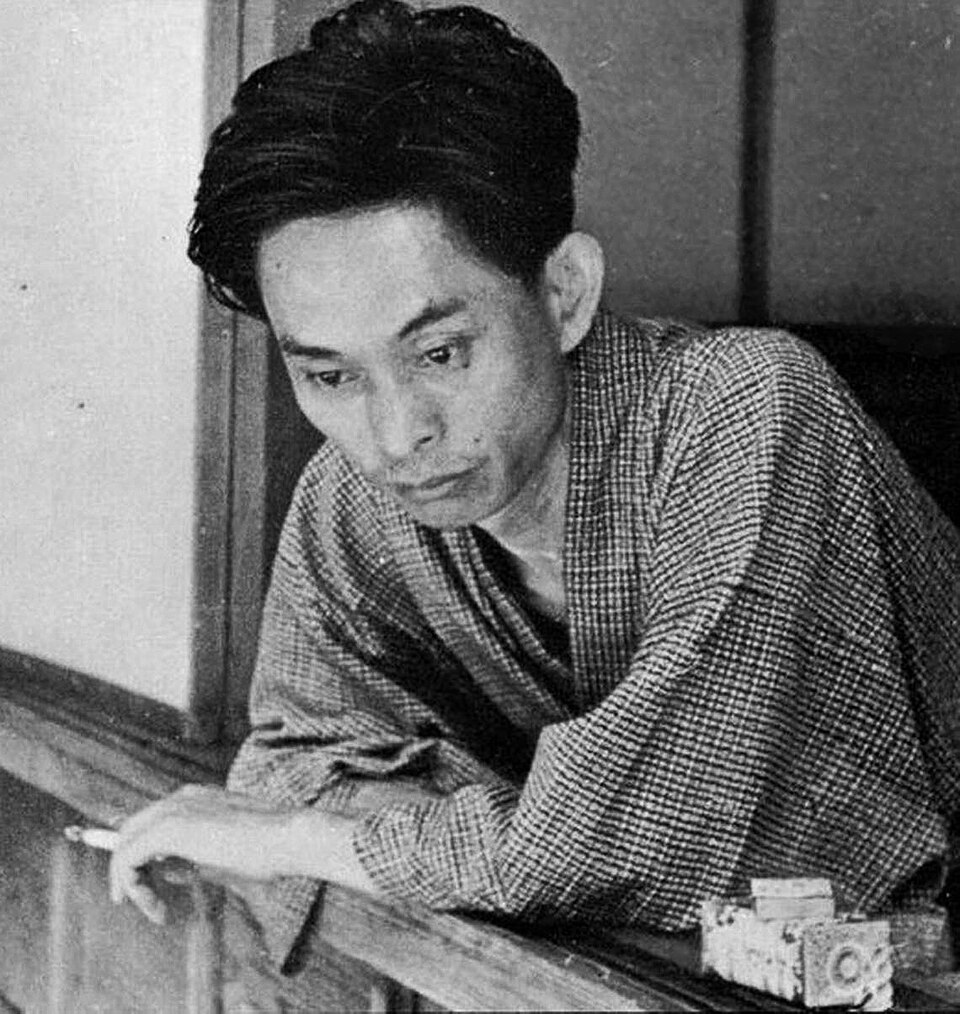
An author forged by early and relentless loss, Kawabata turned grief into a prose of extreme delicacy — melancholy made beautiful, transience made permanent on the page.
Yasunari Kawabata was the first Japanese author to receive the Nobel Prize in Literature, awarded in 1968 for a body of work that brought the spare, elliptical aesthetics of classical Japanese literature into the modern novel. His prose — attentive to season, silence, and the texture of longing — made him an international figure while remaining firmly rooted in a sensibility that the Nobel Committee described as "great narrative mastery, which with great sensibility expresses the essence of the Japanese mind."
Origins
Kawabata was born on 11 June 1899 in Osaka, into what would become a life shaped almost entirely by loss. His father died when he was two, his mother when he was three. He was raised by his grandparents; his grandmother died when he was seven, his sister when he was ten. By the time his grandfather died in 1914 — an event Kawabata recorded in what became known as his "Diary of a Sixteen-Year-Old" — he had outlived every immediate family member. Critics have consistently found in this biography the emotional substrate of his fiction: a recurring preoccupation with solitude, the beauty of impermanence, and attachment formed in the certainty of loss.
He studied Japanese literature at Tokyo Imperial University, graduating in 1924. That same year he co-founded the journal Bungei Jidai (Literary Age), which became the vehicle for the Japanese Neo-Perceptionist movement (Shinkankakuha) — a modernist tendency that sought to revitalise prose through heightened sensory attention and techniques borrowed in part from European avant-garde writing.
Defining work
Kawabata's early story "The Izu Dancer" (1926) established his characteristic register: a young man travelling alone, an encounter with a troupe of itinerant performers, longing handled with extraordinary restraint. Snow Country (Yukiguni), written between 1935 and 1948, extended this method across a longer canvas — a Tokyo dilettante making periodic visits to a geisha in a hot-spring town on the Japan Sea coast, the relationship observed through a prose that is cool, precise, and deeply melancholic. It remains one of the most translated Japanese novels of the twentieth century.
Thousand Cranes (Sembazuru, 1949–1951) returned to the tea ceremony as both setting and structural principle, using ritual objects — a cracked tea bowl, a kerchief with crane patterns — to carry the weight of grief and erotic tension across generations. The Sound of the Mountain (Yama no Oto, 1949–1954) is an older man's account of a Tokyo family coming quietly apart, rendered through images of extraordinary economy. The House of the Sleeping Beauties (Nemureru Bijo, 1961) disturbed many readers while demonstrating Kawabata's willingness to push his central themes — mortality, desire, the beauty of the unconscious — toward their logical extremes.
Method and style
Kawabata worked with the haiku-like unit of perception as a structural principle: the accumulation of intensely observed, emotionally charged moments rather than conventional plot. He drew on the classical Japanese aesthetic concept of mono no aware — the poignant awareness of impermanence — and on the Zen tradition of the sketch (shasei) that captures the object in its particularity. His Nobel lecture, "Japan, the Beautiful, and Myself," traced his own aesthetic lineage through the medieval poet-monks Dōgen and Myōe, situating his work within a tradition of literary Buddhism rather than Western modernism.
He was a close friend and early champion of Yukio Mishima. After Mishima's death by ritual suicide in November 1970, Kawabata wrote a tribute and reportedly told friends that Mishima had "done it for him." He never completed another major work.
Legacy
Kawabata died on 16 April 1972 in Zushi. He was found from gas asphyxiation; no suicide note was left and no formal determination of manner of death was made. He was seventy-two. His work has remained continuously in print internationally and continues to be read as the defining expression of a particular strand of modern Japanese literary sensibility — one in which beauty and grief are not contrasted but understood as inseparable.
"The Japanese have always been sensitive to the beauty of the seasons… and this love of nature, I believe, is closely related to the sense of impermanence."