Yukio Mishima
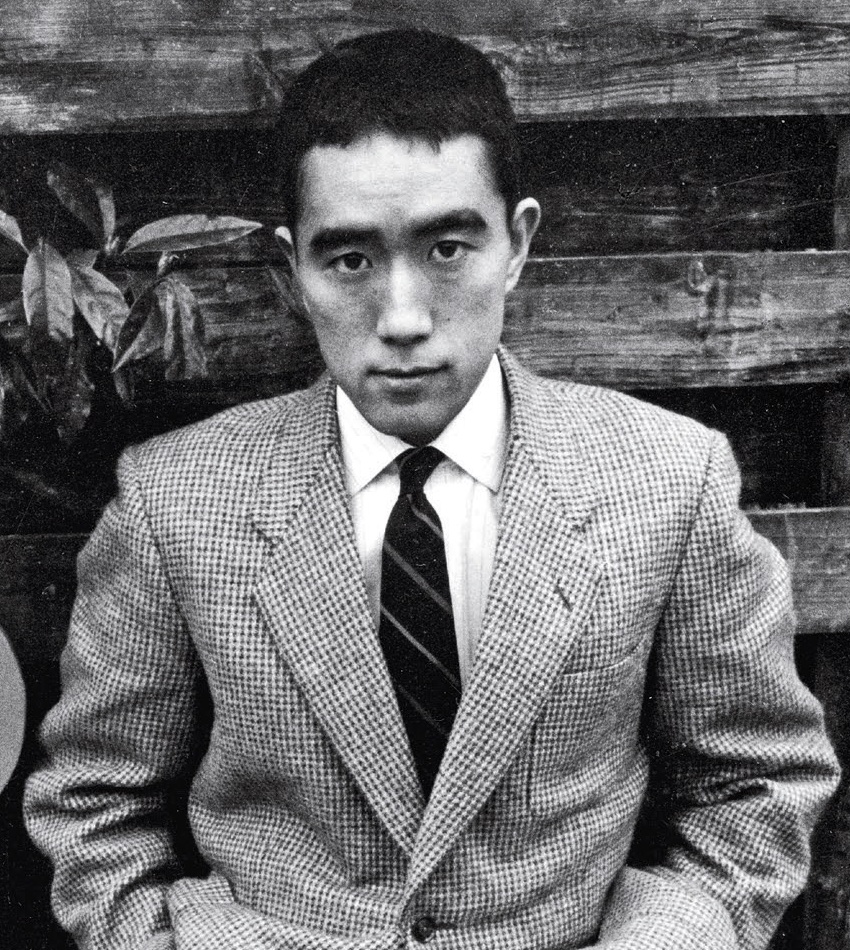
The most stylistically celebrated Japanese writer of the postwar era, Mishima was consumed by an idea of heroic beauty that his life and death were both arranged to perform.
Kimitake Hiraoka, who published under the name Yukio Mishima, wrote some forty novels, eighteen plays, and numerous short stories and essays before his death at forty-five. He is considered one of the most important postwar stylists of the Japanese language. His prose, which drew on classical Japanese aesthetics and European modernism simultaneously, obsessed over beauty, transience, and the tension between the body and the spirit. On 25 November 1970, having occupied a Self-Defense Forces headquarters in Tokyo with four followers and delivered an unsuccessful speech calling for a restoration of imperial rule, he took his own life by seppuku. He was forty-five years old and had delivered the final volume of his tetralogy to his publisher the previous day.
Origins
Kimitake Hiraoka was born on 14 January 1925 in Yotsuya, Tokyo. His father was a government official. From infancy until the age of twelve he was raised largely by his paternal grandmother, Natsu Hiraoka, a woman of aristocratic descent and intense temperament whose attachment to classical literature and the Kabuki theatre shaped his early sensibility. He returned to his immediate family in his adolescence and attended the elite Peers' School (Gakushūin), where he wrote precociously and attracted the notice of senior literary figures. His debut short story collection, Hanazakari no Mori ("The Forest in Full Bloom"), was published while he was still a student. He adopted the pen name Yukio Mishima to conceal his literary activities from his father.
The early novels
Confessions of a Mask (Kamen no Kokuhaku, 1949), his first major novel, established him immediately as a significant voice in postwar Japanese literature. Written in confessional first person, it traces a narrator's awareness of his homosexual desire and his attempts to perform normality through a series of masks. The directness of its psychological investigation was remarkable in the context of postwar Japan. Thirst for Love (Ai no Kawaki, 1950) and Forbidden Colors (Kinjiki, 1951–53) extended his exploration of desire and power. The Sound of Waves (Shiosai, 1954), by contrast, is a pastoral love story set on a remote island — the most accessible and conventionally beautiful of his early works.
The Temple of the Golden Pavilion
The Temple of the Golden Pavilion (Kinkaku-ji, 1956) is widely regarded as his masterpiece. Based on the 1950 arson of the Kinkaku-ji temple in Kyoto by a young Buddhist acolyte, the novel explores the narrator's tortured relationship with beauty — how perfect beauty can become unbearable, and how the desire to possess or destroy it consumes the mind that cannot look away. The prose is dense, formal, and precisely controlled. The novel confirmed Mishima's international reputation and was translated into many languages.
The Sea of Fertility
Between 1965 and 1970 Mishima wrote the four novels of The Sea of Fertility tetralogy: Spring Snow (1969), Runaway Horses (1969), The Temple of Dawn (1970), and The Decay of the Angel (1971, published posthumously). The sequence follows a single character, Honda, across the full arc of the twentieth century, tracing successive incarnations of a soul through radically different social contexts. The tetralogy is considered his most ambitious sustained work, and the final volume, delivered to his publisher on the morning of 25 November 1970, ends with an image of absolute emptiness.
Final years and death
In the mid-1960s Mishima founded the Tatenokai (Shield Society), a small private nationalist militia of university students trained in martial arts and dedicated to the protection of the Emperor and traditional Japanese values. On 25 November 1970 he and four Tatenokai members occupied the office of the commandant at the Ichigaya headquarters of the Japan Ground Self-Defense Force in Tokyo. From the commandant's balcony Mishima delivered a speech to the assembled soldiers calling for a coup to restore imperial power to the Emperor. He was largely met with jeers. He returned inside and died by seppuku. He had been nominated multiple times for the Nobel Prize in Literature; the prize went to his countryman Kawabata Yasunari in 1968.
"I want to make a poem of my life."