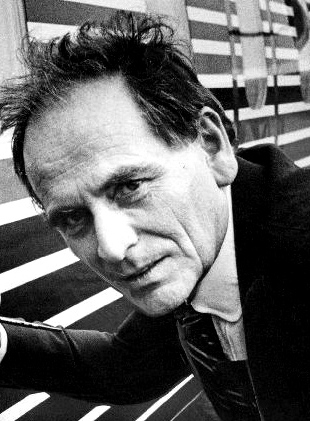
Yves Saint Laurent
The French couturier who democratised the wardrobe by translating haute couture rigour into ready-to-wear, and who made the trouser suit a permanent fixture of women's dress.
Yves Saint Laurent arrived at the House of Dior at nineteen and within two years was directing it. Over the following four decades he systematically widened the vocabulary of women's dress: the trouser suit, the safari jacket, the tuxedo jacket worn as eveningwear — each intervention absorbed so completely into mainstream fashion that it is now impossible to see them as radical.
Origins and early formation
Born in Oran, Algeria in 1936, Saint Laurent showed an obsessive early interest in theatre, sketching elaborate stage designs and costume ideas as a child. He sent drawings to Michel de Brunhoff, editor of French Vogue, who passed them to Christian Dior. Dior hired him in 1955, aged eighteen. When Dior died suddenly in 1957, Saint Laurent was twenty-one and found himself chief designer of the most famous fashion house in Paris. His first solo collection for Dior — the Trapeze line of 1958 — was received as a triumph; he was photographed being carried through the street on the shoulders of admirers.
The Maison YSL and ready-to-wear
Military service in Algeria in 1960 led to a breakdown; Dior replaced him with Marc Bohan. Saint Laurent and his partner Pierre Bergé sued Dior for breach of contract, settled, and used the proceeds to open their own house in 1961. It was immediately successful. The early collections drew on art — Mondrian dresses (1965), a collection referencing Pop Art (1966) — as legitimate sources for fashion, an approach that was new in its directness.
In 1966 Saint Laurent opened Rive Gauche, one of the first ready-to-wear boutiques run by a couture house, placing his design vocabulary within reach of women who could not afford bespoke prices. The move was commercially transformative and critically controversial: couture establishments regarded it as a debasement. Saint Laurent regarded it as the future.
| Year | Key introduction |
|---|---|
| 1962 | Pea coat for women |
| 1965 | Mondrian dress |
| 1966 | Le Smoking tuxedo jacket |
| 1968 | Nude sheer dress; safari jacket |
Le Smoking — the tuxedo jacket cut for women — first appeared in 1966 and returned in almost every collection thereafter. Saint Laurent argued that a woman in a well-cut suit expressed a kind of authority unavailable in a dress. The garment generated outrage initially; by the 1980s it had become a universal wardrobe staple.1
Style and method
Saint Laurent worked with a small number of close collaborators across decades, including pattern-cutter Anne-Marie Muñoz and seamstress Esther Ackermann. His technique was rooted in classic couture construction — impeccable tailoring was never optional — but the surface language ranged widely: Spanish infanta silhouettes, Russian embroidery, North African textiles, African beadwork. These borrowings were undertaken with varying degrees of critical reflection; the cross-cultural reach was both a strength and a recurring point of debate.
He retired from couture in 2002, citing failing health. His final couture show was a retrospective staged at the Centre Pompidou in Paris, attended by clients who had worn his clothes for forty years.
Legacy
The Yves Saint Laurent brand was acquired by the Gucci Group (later Kering) in 1999, and the ready-to-wear label was renamed Saint Laurent under creative director Hedi Slimane in 2012. The couture house retains the Yves Saint Laurent name. Two museums bear his name: the Musée Yves Saint Laurent Paris (opened 2017) and the Musée Yves Saint Laurent Marrakech (opened 2017), the latter in the Majorelle Garden villa he shared with Bergé.
Over the years I have learned that what is important in a dress is the woman who is wearing it.
Footnotes
- Helmut Newton's photographs of Le Smoking in the 1970s — a woman in a tuxedo standing alone at night — are among the most reproduced images in fashion photography. ↩